
Shabbat shalom!
As Israel marked its 77th Independence Day, the skies above Jerusalem were choked not with fireworks, but with smoke. Flames swept through more than 5,000 acres of forest and brush land, forcing the cancellation of dozens of celebrations across the country. But it wasn’t just the fires that darkened the mood — it was the absence of unity. The sense of national solidarity that so often defines Yom Ha’atzmaut felt, to many Israelis, painfully out of reach.
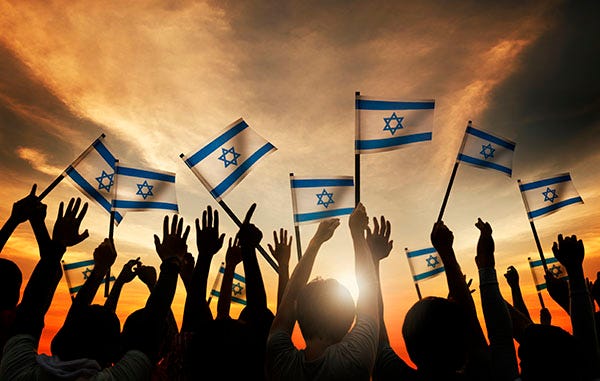
For the families of hostages still held in Gaza, this marked a second Independence Day spent in limbo, yearning for reunion, suspended between fear and hope. And yet — Israelis are nothing if not resilient. The nation presses on.
Today, Israel’s population has surpassed 10 million. Forty-five percent of the world’s Jews now call Israel home. That statistic, more than any flag or speech, is a symbol of perseverance — and of promise.
Yes, there are reasons for concern. But there are also, always, reasons for hope.
When the war in Gaza ends, as all wars eventually must, Israel will face a new and perhaps even more daunting question: What kind of country will they be when the dust settles? Will they return to the bitter divisions of October 6th, when it felt as though the bonds tying Israeli society together had frayed to the breaking point? Or will they find a way to hold on to the sense of unity that emerged on October 8th, when the shock of massacre gave way to a rare and visceral feeling that Israelis are, after all, one people?
Before October 7th, Israel was already fighting a war — not against Hamas or Hezbollah, but against itself. The protest movement against judicial overhaul, the rifts between secular and religious, between left and right, between center and periphery, had reached a fever pitch. For many, it felt as if we were no longer speaking the same language. Yom Kippur prayers in public spaces had turned into battlegrounds. Soldiers were threatening not to report for duty. Trust in institutions — the courts, the Knesset, the IDF — was unraveling.
And then came the blood-soaked dawn of October 7th.
In an instant, everything changed. The country remembered, with painful clarity, that it has enemies who do not distinguish between settlers and activists, between Ashkenazim and Mizrahim, between left and right. For a moment — perhaps only a moment — Israel remembered that what unites the country is far greater than what divides it.
The outpouring of solidarity was immediate. Reservists reported for duty in record numbers. Civil society mobilized with breathtaking speed. People opened their homes, their wallets, and their hearts. The flags returned to the balconies. It was grief that brought Israelis back together, but also something else: recognition. Recognition of a greater national purpose. Recognition that all Israelis belong to each other.
But unity forged in trauma is fragile. Already, the old fault lines are beginning to show. Debates about legal reform, the conduct of the war, about the hostages, about the future of Gaza and of Israeli democracy are reopening wounds that had only just begun to scab over. The sense of national purpose is giving way once more to suspicion and recrimination.
So we return to the question: When the war ends, what kind of country will Israel be?
They cannot afford to go back to October 6th. The stakes are too high. The luxury of division is one that history has shown they cannot afford. If we are to honor the memory of those that were lost — not only on October 7th, but throughout this war — then the people must build a new Israeli covenant.
One that makes room for disagreement, but not delegitimization. One that cherishes dissent, but not disunity. One that remembers that Israel has always been a fractious people, but they are, still, a people.
The enemy from within is cynicism and the mistaken belief that Israelis cannot live together. That their tribes are too different, their wounds too deep. That the Israeli shared project is broken beyond repair.
If October 8th taught us anything, it is that in their darkest moments, Israelis remember who they are. And the healing will come, not led by the current generation of leaders who created the schism, but by the generation that is paying the price for that schism. A generation who have rose to the occasion and sacrificed blood, limbs and treasure to fight Israel’s most thankless war. No previous Israeli war has been more disparaged around the world. In no other war have Israeli soldiers been so cavalierly compared to Nazis. They are fighting with extraordinary heroism under conditions that no other army has ever had to fight. They are fighting in the darkness of torture tunnels, they are fighting door to door in the booby-trapped homes of Gaza.
And yet, they keep showing up.
Will this new generation rise again to the occasion to battle against the enemy from within? Will they recognize that external threats may end at the borders, but the peace will, and must, begin at home?
Let’s end this on a positive note, taken from an interview by Dan Señor with author Yossi Klein Halevi:
“So the extraordinary transition that we made as a society from the lowest point of our schism in Israel’s history, which is the year leading up to October 7th, to literally pivoting overnight from October 6th to October 8th to one of the peak moments of Israeli unity is, I think, the single most impressive expression of Israeli solidarity in our history. And the reason that I say that is because we have had other moments, tremendous moments of national unity, the weeks before and after the Six Day War in 1967, the celebration over the Entebbe rescue in 1976, but never were we coming from such a low point of schism and instantly moving to unity. And so what we proved to ourselves on October 8th was that we haven’t lost the instincts of peoplehood, of national solidarity.”
“And when this war is over, Israeli society is going to be faced with a very stark choice. October 6th or October 8th. Do we go back to the profound schisms of October 6th, where Israelis were beginning to feel that we have nothing in common with each other? Or is our model October 8th?
Every Israeli poll that I see points to the direction that there is a majority, even a strong majority, that wants healing and not schism.”
Let’s hope for healing. And let’s also be careful out there.
Brad out.
 Jew News Review