
Shabbat shalom!
The horror in Gaza continues to rattle my sensibilities. I’m not sure what the F is going on there anymore. Thinking about the current situation there, I am reminded of the TV show “House” where the good, but cynical doctor House would admonish his staff about their patients, that “everyone lies”. That is how I feel about all the actors in this most abysmal Gaza horror show. All the major actors lie: Bibi and his coalition of nut jobs, Hamas, Palestinians, the United Nations, and worst of all, the mainstream media.
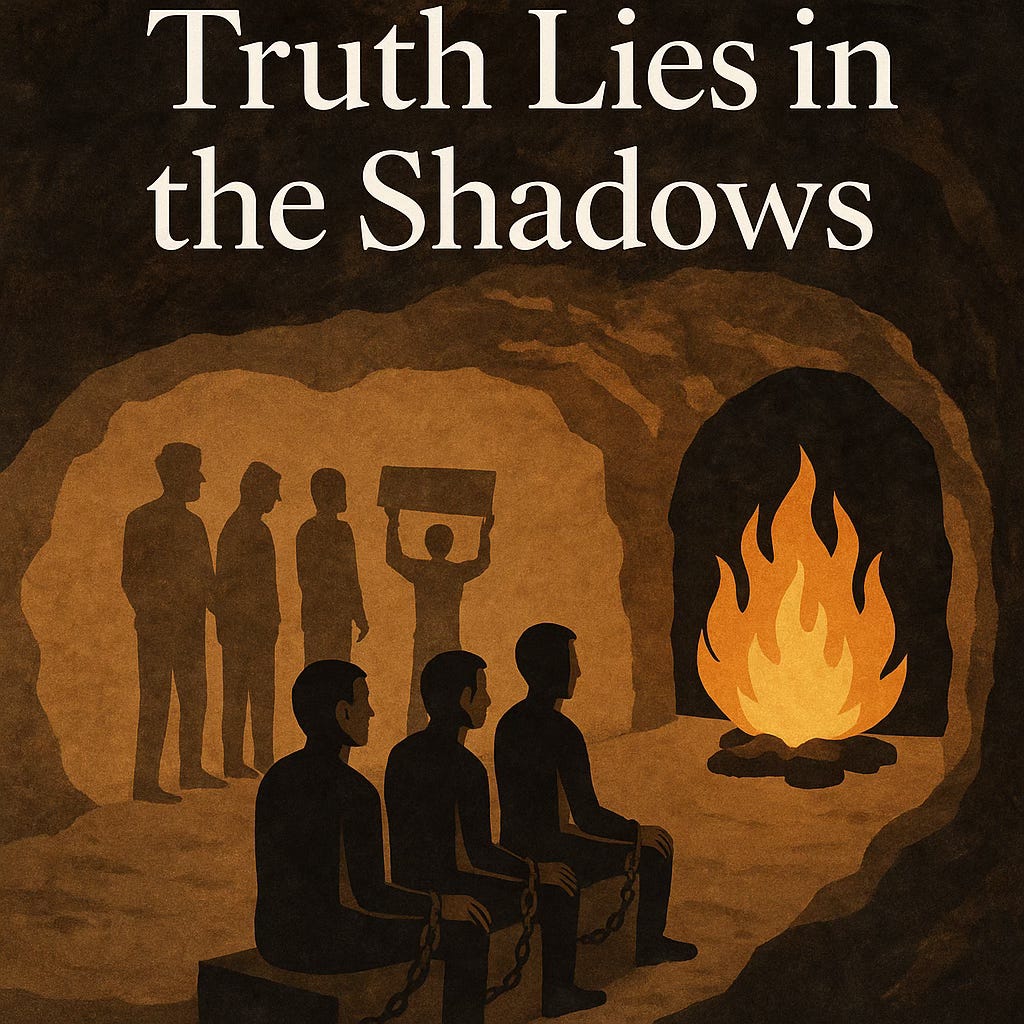
The Greek philosopher Plato told us a story about prisoners chained in a cave, forced to watch shadows on a wall and mistake them for reality. They never saw the fire behind them, let alone the actual figures casting the shadows. The lesson was clear: truth is not what flickers in front of your eyes, but what lies hidden in the shadows, waiting to be sought and revealed.
Today the Gaza war has its own cave. And the shadows have grown darker still. This week, the world’s leading authority on food crises, the Integrated Food Security Phase Classification, formally declared a famine underway in Gaza City. It is the first such declaration in the Middle East. More than half a million people are said to be in catastrophic conditions, with children suffering the brunt of hunger and disease. Innocent civilians are paying a horrendous price for a war they did not choose.
The suffering is undeniable. But the shadows still mislead. A famine in Gaza does not prove Israel has adopted a deliberate policy of starvation, which would be a heinous war crime. It shows instead how Hamas’s diversion of aid, Israel’s ill considered policy halts, and the collapse of international coordination have converged into a man made catastrophe. The fire behind the shadows is still there, but few are willing to turn their heads toward it. And Bibi’s denials only fan the flames that cast even darker shadows.
Israel made a huge strategic error when it briefly stopped all aid from entering Gaza in early March 2025. Yes, there was an estimated six month surplus of supplies already inside the territory, (a fact ignored or buried by the media) but the optics were catastrophic. Even if the cutoff was temporary and no Gazan would have gone without food for months, the policy gave Hamas a propaganda gift wrapped in blood red ribbon. Headlines screamed starvation while omitting mention of those warehouses.
At the same time, Israel and its U.S. backers rolled out the Gaza Humanitarian Foundation, positioning it as a replacement for UN led aid. It was a strategy I once agreed with, bypassing UN pathways that Hamas had long manipulated. But its execution was disastrous. Instead of restoring impartial aid and running the new system in parallel, the GHF’s militarized, centralized distribution centers, complete with biometric screening and contractor guarded hubs, became choke points. Aid groups rebelled, demanding a return to the UN system. The optics were worse than the March cutoff, and the media ran with the shadow: Israel weaponizing hunger. The fire behind the wall never got seen.
Plato’s allegory reminds us that escaping the cave requires confronting reality, not shadows. A powerful voice bringing some of that reality is Eitan Fischberger, writing recently in Future of Jewish Substack. After spending time embedded with the IDF inside Gaza, she described walking past “pallets of flour, bottled water, diapers, medical supplies, and jars of baby food — provided by the World Food Programme, UNICEF, and donor countries — sat untouched while people just miles away searched for their next meal.” Those supplies weren’t blocked by Israel. They had already cleared the checkpoints. They were stalled because the United Nations refused to deliver them. Fischberger’s argument is blunt: “The supreme aim for the UN isn’t helping Gazans; it’s maintaining control over the humanitarian system that keeps it relevant.”
She also pointed to UNRWA’s longstanding entanglement with Hamas, from employing staff linked to terrorism to storing weapons in schools and clinics. Whether or not every Israeli intelligence claim holds up, the evidence of deep rot is undeniable. Her conclusion is clear: famine in Gaza is driven not only by war, but by an aid ecosystem that Hamas exploits and the UN refuses to reform.
That conclusion reinforces the larger point: this crisis is not Israel’s singular moral failure but the collapse of a corrupt aid structure that international institutions refuse to confront. And yet, in the cave of global opinion, the shadow projected is that of an Israeli policy of starvation.
From that moment, the accusation hardened into a permanent narrative: Israel is deliberately starving Gaza. The UN repeats it, human rights groups echo it, and especially The New York Times gives it journalistic weight. But scratch beneath the surface, and the framework collapses.
Israel has allowed tens of thousands of trucks carrying food, water, and medicine into Gaza since October. Egypt and Jordan have participated in distribution. The real choke point is Hamas, hijacking convoys, hoarding fuel, taxing aid to fund its terror infrastructure. Satellite images and eyewitness accounts confirm warehouses brimming with relief while civilians queue outside. Yet The New York Times prints front page photos of skeletal children paired with captions like “Aid fails to reach Gaza.” Fails to reach because what? The subject, Hamas, is excised. Language becomes propaganda.
Enter Nicholas Kristof, columnist for the New York Times. To be fair, Kristof is not a hack or a cynic. He is, by most measures, a compassionate man with honorable intentions. He has spent decades shining light on forgotten atrocities, often when no one else was looking. Right now, he is one of the few prominent voices consistently calling out the real genocide unfolding in Sudan, and for that he deserves credit. Kristof actually gives a damn, and unlike many of his colleagues, he has put his career on the line more than once to cover stories most readers would rather ignore.
But even good men can be misled by shadows on the cave wall. In his recent column, Kristof thundered:
“Israel has killed an estimated 18,000 children and is starving a population.”
It was a thunderous charge. To back it up, Kristof leaned on a July 24 New York Times article that has since been thoroughly debunked. That story quoted “Gazan doctors” and “aid officials” who painted a picture of systematic famine orchestrated by Israel. What it failed to mention was the Hamas affiliation of many of those sources, the existence of massive warehouses filled with food, and the systematic diversion of aid by Hamas itself.
Kristof, instead of interrogating these omissions, repeated them. And because of his reputation for compassion and integrity, his words carried even more weight. Shadows became reality for millions of readers. The correction? None. The damage? Immense.
And Kristof is not alone. Just a few months ago, the UN’s own humanitarian chief Tom Fletcher told the BBC that “14,000 babies could die in the next 48 hours unless we can reach them.” The statement spread across the globe in headlines. Within days, the UN admitted it was false — the real projection referred to children at risk of severe malnutrition over the course of a year, not imminent death within days. Fletcher himself expressed regret over his lack of precision, but the shadow remained on the cave wall. Thousands of readers never saw the correction, only the original, horrifying claim.
This is the tragedy of the cave: even the most honorable prisoners can be fooled by the shadows if they are not allowed to turn their heads toward the fire.
The Kristof episode, the Fletcher debacle, and the litany of uncorrected headlines are part of a pattern. Every Hamas health ministry casualty figure is printed as fact. Every accusation of indiscriminate bombing becomes front page headline. When the narrative unravels, the retraction is buried.
Remember the Al Ahli hospital explosion? Hamas blamed Israel, claiming 500 killed. The Times ran it uncritically. Only later did intercepted communications, forensic evidence, and independent intelligence confirm it was a misfired Palestinian rocket. But the world had already turned, and the shadow remained. The retraction? Just a footnote.
On the battlefield, Israel has degraded Hamas, destroyed tunnels, and decapitated leaders. But in the global court of opinion, Israel bleeds. Democracies are held to impossible standards. Terrorist groups are graded on a curve. Hamas is expected to sacrifice its own people. Israel is expected to avoid all civilian harm.
Part of the loss is Israel’s failure to tell its story as effectively as Hamas tells its lies. Hamas films funerals, orphaned children, cries famine. Israel shows graphs, convoys, and cautious press briefings, and wonders why the cave wall has more clickbait than the fire.
If Plato’s cave is to be broken open, one obvious step is to let the light in. That means Israel must allow independent journalists to work freely inside Gaza, so the famine and its causes can be documented truthfully. Independent journalism would not sanitize Israel’s mistakes, and it would not disguise the human suffering in Gaza. What it would do is separate fact from propaganda, the fire from the shadows. Without it, the world continues to rely on numbers and anecdotes filtered through Hamas, NGOs with political agendas, or headlines crafted in New York conference rooms. With it, the prisoners chained to the cave wall might finally turn their heads toward the fire.
Truth is not flattering. Civilians are suffering. Children are hungry. A famine has been confirmed, and that reality cannot be brushed away. But famine is not the same as a deliberate policy of starvation. It is the grim byproduct of a terror group that hijacks food, a government in Jerusalem that made catastrophic mistakes like halting aid and botching the Gaza Humanitarian Foundation rollout, and a world media ecosystem that amplifies shadows rather than exposing fire.
In my opinion, the only real starvation occurring in Gaza is that of the poor innocent hostages who are emaciated, denied contact with the outside world, and in some cases forced to dig their own graves. That is not a shadow on a cave wall. That is the unvarnished reality of Hamas’s barbarism.
Behind every photo of a desperate child is a Hamas operative diverting aid. Behind every Kristof column is a debunked story masquerading as fact. Behind every “Israel blockades Gaza” headline is a warehouse full of food Hamas will not release.
Israel has not lost its morality. It has lost control of the cave. Until more prisoners turn toward the fire, the shadows will keep winning.
Until then, stay out of the shadows and stay in the sunlight, but make sure you wear your sun screen, and as always, be safe out there everyone. And try to enjoy the weekend.
Brad out.
 Jew News Review