
Shabbat shalom.
JNR readers may have noticed that I have not been doing my usual roundup of the news in recent posts. My reason for doing so is that for the last few months, the issues facing Jews seem so awful, so dire and existential, that brief summaries don’t seem appropriate. So I take up my pen with the honorable intention of trying to express my own feelings and point of view on whatever is garnering major headlines of the week, pick one, and attempt to go a little deeper rather than wide.
This week, with Nut-and-yahoo’s latest pivot for full “occupation” of Gaza, I have been doing some thinking about how Israel might win the battle, win the war, get our hostages back, and win back the hearts and minds of Jews and non-Jews around the globe, if that is still possible. Optimist that I am, I believe it still is.
Andrew Fox, a British military expert, recently noted in his Substack “Occupation of Gaza” that Israel has now formally declared what amounts to a military occupation of the Strip, short of annexation, but unmistakably a hard pivot toward control. The idea is to dismantle Hamas’s infrastructure, restore a measure of security, and then hand off governance without getting bogged down in Gaza’s civic administration. It is a tactician’s plan, meant to secure the battlefield while avoiding the political and economic quicksand of permanent rule. It is about as popular as a fart in a phone booth. This plan is opposed by a majority of Israelis, the relatives of hostages in Gaza — who yesterday protested outside the security cabinet’s meeting draped in chains — and the international community, including allies like Germany. Even the IDF has come out publicly against it.
But here’s my take on the problem: “Occupation” is the wrong frame if Israel wants to win not just the war, but the peace. And winning the peace, if we are honest, will take decades, not months.
We have seen this movie before. In World War II, the Allies did not storm France, Belgium, and Germany as occupiers. They came as liberators, ousting fascism, dismantling Nazi power, and setting the stage for rebuilding civil life. In France, Belgium, the Netherlands and elsewhere in Europe, liberation meant the return of legitimate local governance. In Germany and Japan, it meant total de-Nazification and de-militarization, followed by a painstaking reconstruction that took a generation to bear fruit. The lesson is clear: liberation is not a soft alternative to occupation, it is occupation with a moral purpose and an exit plan.
But let’s be blunt: we do not have a trustworthy Palestinian partner. Poll after poll shows that a majority of Palestinians still support Hamas or its genocidal policies toward Jews and Israel. Many celebrated October 7. That is not a population ready to sign onto a two-state solution that offers security and mutual recognition. To get there, Gaza needs more than physical rebuilding. It needs de-radicalization on a scale that parallels what the Allies did in postwar Germany and Japan, uprooting the ideological rot, dismantling the propaganda machinery, rewriting the textbooks, and creating civic and political institutions that reject the old hatreds. That is not a one-year project. That is a 20- to 30-year generational slog. But it is doable, and there is recent success in the UAE and Saudi Arabia to prove the point.
An occupation signals control for control’s sake. Or as in the West Bank, control for security’s sake. It is the language of checkpoints, curfews, and barbed wire. A liberation signals the dismantling of a tyranny so civilians can live without fear, and yes, even without hating their neighbors. A liberation posture would make clear to Gazans and the watching world: Israel is not there to colonize, Israel is there to remove a violent, corrupt, death-cult regime, and Israel will secure the territory until it is safe for a new, non-Hamas governance structure to take root. It also gives Israel the moral high ground. Occupiers are easy to demonize. Liberators are harder to smear.
Postwar Germany and Japan did not just “get over” fascism. The Allies imposed strict controls, purged leadership, banned hate propaganda, and physically rebuilt infrastructure while introducing democratic norms. For years, the United States and its allies ran schools, media, and civic organizations in ways that replaced authoritarian myths with new narratives of citizenship and peaceful coexistence. Gaza needs that same rigor. Remove Hamas from power and, crucially, from the hearts and minds of the next generation. End the sermons that sanctify murder. End the “pay for slay” terrorist policies. Rewrite the schoolbooks that erase Israel. Open space for independent media and genuine civic debate.
As Daniel Clarke-Serret argues in his latest post “Pax Arabica”, any lasting peace will require shattering the polite fiction that the Arab world can remain on the sidelines while Palestinian extremism festers. The so-called “Pax Arabica,” a patchwork of religious posturing and secular cynicism, has allowed moderate Arab regimes to talk about peace while doing precious little to build it. A true liberation of Gaza must include Jordan, Egypt, Lebanon, Saudi Arabia, the UAE, and other moderate Arab states in the liberating alliance. Not as symbolic backers, but as active participants, committing resources, political capital, and legitimacy to the process of rebuilding and de-radicalizing Gaza. Without them, the Arab street remains unchallenged in its Hamas sympathies, and the illusion of “Pax Arabica” limps on, feeding the next generation of October 7s.
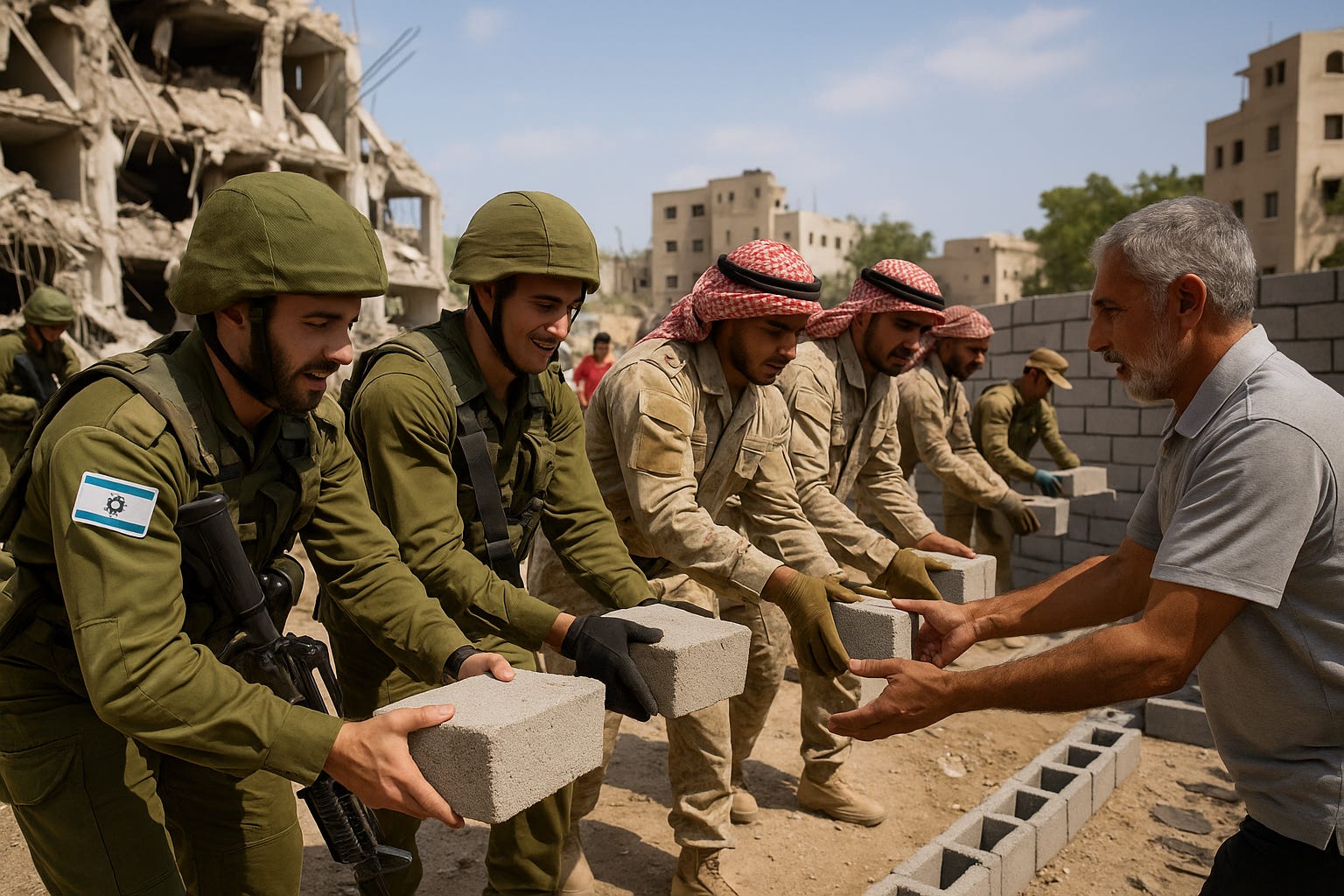
Gaza’s streets, power grid, hospitals, and water systems are wrecked. If Israel truly intends to liberate, rebuilding is not charity, it is strategic warfare. Every school rebuilt without a tunnel underneath it, every functioning hospital not run by Hamas, is a blow against their narrative of victimhood and martyrdom. Reconstruction can be a weapon to prove that life without Hamas is not only possible, it is better. The Allies understood this in 1945. They did not just put up flags and leave. They poured resources into infrastructure, industry, and education. That is why today, Germany and Japan are peaceful allies, not simmering enemy camps.
Liberation without an exit is just a slow-motion quagmire. The goal must be clear from the start: get our hostages back, destroy Hamas militarily and politically, form a transitional civil administration ideally Arab-led with Israel and international backing, implement a de-radicalization program alongside reconstruction, and hand over governance to credible, non-Hamas Palestinian leaders when it is safe to do so. That timeline may not fit into a single prime minister’s career. It might take as long as the Marshall Plan did. But without it, we are just repeating the cycle that led to October 7.
Right now, Israel’s stated posture is “control without permanent rule.” It is a hedge, and it sounds cautious. But it is also hollow. Without a liberation framework that includes Arab partners, moral clarity, and a generational de-radicalization plan, we risk losing both the war’s moral narrative and the peace that could follow it. Occupation will be judged by the checkpoints it erects. Liberation will be judged by the schools, hospitals, and markets it leaves behind.
In World War II, liberation did not mean naively trusting former Nazis. It meant removing them from power, prosecuting them, and building a society that would not produce them again. That is the real challenge in Gaza, and the only way to ensure there will not be another October 7.
Be safe out there everyone.
Brad out.
 Jew News Review