
Shabbat shalom!
In the aftermath of October 7, the world shifted—and yet, some cling to expired solutions. Chief among them is the so‑called “two‑state solution,” a diplomatic zombie at best, a strategic liability at worst. Once heralded as Israel’s only hope for peace, today it is not just obsolete but dangerous: counter‑productive, out of step with regional realpolitik, and likely to cost Israel its chance to reshape the Middle East through strength and practical alliances.
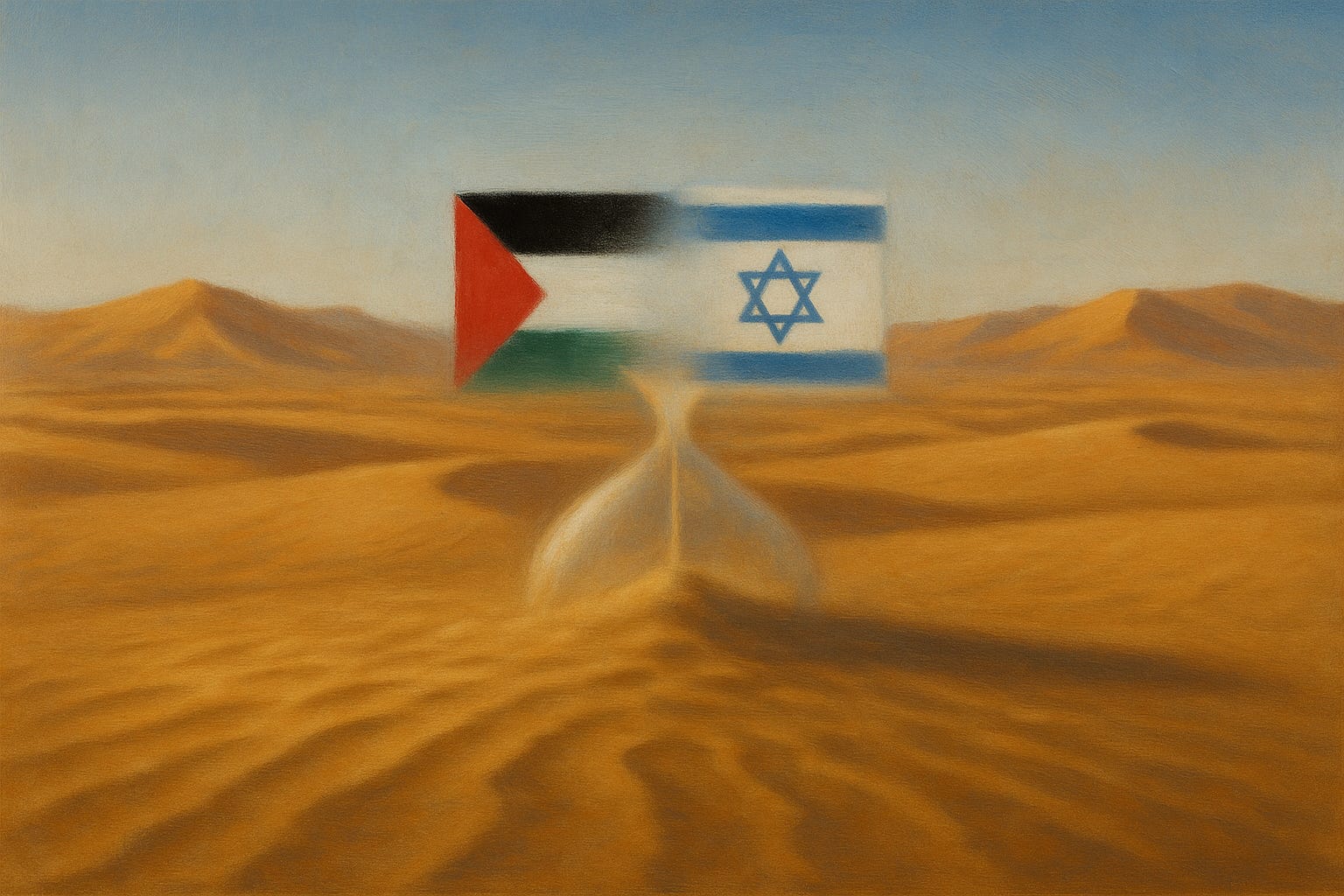
That said, call me crazy, (I’m sure my Israeli friends certainly will) let me admit something clearly and personally: I still believe in a two-state solution. Not because it’s remotely viable right now, but because I’m an optimist—a Middle East realist who sees the glass as half full. I believe that, eventually, Israelis and Palestinians will share this land with dignity and some degree of self-determination. But getting there requires sober recognition of where we are today—and today, the two-state slogan is a mirage. Repeating it now doesn’t advance peace. It distracts from the very real opportunities Israel has in front of it—and the crises it must confront.
Let’s start with the fire that’s burning hottest. The humanitarian catastrophe unfolding in Gaza isn’t just tragic—it’s strategically disastrous. Images of starving children, aid trucks under siege, and “walking corpses” haunt the front pages of much of the media, from The Guardian to The New York Times to CNN to The Times of India. UN officials, not very credible, describe the Strip as a famine zone. Air drops are now replacing convoys. The world’s sympathy and support, once squarely (if momentarily) with Israel after Hamas’s butchery, is evaporating with every headline and grim picture.
The plan to replace UNRWA with the newly envisioned Gaza Humanitarian Foundation was sound in principle. I was an early advocate. UNRWA had become politicized, compromised, and in some cases infiltrated. But the execution of this transition has been catastrophic. Aid isn’t reaching the people who need it. Infrastructure for distribution has collapsed. Chaos rules.
Is that Israel’s fault? Hamas’s fault? Both? Possibly neither?
The honest answer is: we don’t know—because we don’t have independent journalists working freely inside Gaza. Until we do, truth itself remains hostage, buried beneath spin, propaganda, and wartime censorship. This isn’t just a humanitarian concern—it’s a narrative vacuum that the world is rushing to fill, and Israel has pretty much already lost the narrative, if it ever had it.
Meanwhile, something extraordinary has taken shape beneath the horror, the headlines and the fog of war. Since October 7, Israel has racked up strategic victories on nearly every front:
- Hamas’s military capability has been shattered, its tunnels exposed and command structure decimated.
- Hezbollah is bleeding, having suffered direct and sustained Israeli strikes with impunity.
- Iran’s proxy network is fractured, its assets in Syria repeatedly neutralized.
- And perhaps most importantly, Israel has retained and even expanded security cooperation with key Arab states.
This is not an accident—it is the dividend of deterrence. The Abraham Accords weren’t an outlier; they were a signal that parts of the Arab world were ready to move on from performative anti-Zionism in favor of economic and security partnerships. Egypt, Jordan, the UAE, Bahrain, Morocco—and yes, even Saudi Arabia—see Iran (and now Turkey, too) as the real threat, and view Israel as a partner, not a pariah.
And yet, as the humanitarian situation in Gaza collapses, Israel’s moral and diplomatic standing is eroding, threatening to undermine this rare window for regional realignment.
A sovereign Palestinian state—peaceful, democratic, and demilitarized—remains, in theory, the best-case scenario. But let’s not pretend it’s just around the corner. There is no partner. Hamas is genocidal. Fatah is feckless. And the younger generation in Gaza has been radicalized by hopelessness, not trained for governance. It will take a generation or two, and consistent de-radicalization, to move the peace train forward.
In the short term, peace will not come from partition. It will come from leverage, alliances, and hard-headed realism. Israel should double down on regional normalization. Push for an Arab custodianship model in Gaza for an initial period of time. Prioritize economic development and security cooperation. Lead on humanitarian access—not just because it’s right, but because power without moral leadership breeds isolation.
This is the moment to play the long game—with vision and with strength. This is no time for wishful thinking. The dream of two states must remain a long-term goal. But in the here and now, Israel must lead wisely, act humanely, and speak clearly. The region is shifting. The world is watching. The double standard for Israel has only gotten worse and anti-semitism and anti-zionism is cranking up all around the globe. If Israel fails to match its military power with moral vision, it will miss the chance to transform not just the map—but the future.
Bibi, bubala, the glass is half full. Let’s not spill it.
Let’s be careful out there everyone, and enjoy the weekend!
Brad out.
 Jew News Review