
Shabbat shalom.
It was a revealing week on opposite sides of the globe. In the United States, the Epstein email release dominated the news cycle like a chemical spill from a septic tank, confirming yet again that many of our “pillars of society” were actually just frequent-flyer degenerates with expensive legal teams. The documents didn’t expose anything the country didn’t already suspect; they merely reminded us how comfortably powerful men fit into systems that protect their appetites. It was a week drenched in decadence and denial — the smell of a nation losing its shit.
Six thousand miles away, something very different was unfolding. Not rot, not spectacle, not the familiar choreography of American scandal, but clarity — the kind that only emerges in a democracy fighting for its life.
In Israel, attention returned to Rafah, where hundreds of Hamas fighters remain trapped like rats in the smuggling and assault tunnels they once believed made them untouchable. The Israel Defense Forces control the ground above them. The exits are sealed. The oxygen is dwindling. The only thing left down there is bad air, bad choices, and the overdue bill for October 7th taped to the wall.
While diplomats shuttle between hotel lobbies in Doha and Cairo proposing ceasefire plans that seem drafted by an un-trained ChatGPT, Israel confronts a reality that cannot be massaged or negotiated away: no political or humanitarian plan is credible as long as Hamas remains intact as a military or governing force.
That fact is obvious in Israel. It is radioactive in Washington.
This contrast — America rotting at the top while Israel fights for its life — gives the week its larger meaning. One country at peace is rotting from within; one country at war is rediscovering its moral core. The contrast could not be more stark.
Israel’s war has generated the usual flood of Western “expert” proposals, many of them well-meaning but detached from the physics and reality on the ground. International ‘stabilization zones’ that no nation is willing to staff. A refurbished Palestinian Authority that exists only in PowerPoint. ‘Technocratic transition bodies’ that dissolve on contact with oxygen. And the evergreen favorite: the ‘permanent ceasefire now, negotiations later’, an idea that would make sense only if Hamas were a misunderstood Scandinavian political party.
These are not realistic solutions. Not a single country has so far agreed to put their soldiers at risk and die defending Israel. Urban-warfare experts can theorize about ‘bubble zones’ and Kosovo lessons all day, but my muscle memory goes straight to Afghanistan, Somalia, and Iraq — the graveyard of every elegant Western stabilization theory.
Israel, meanwhile, is confronting reality without euphemism. It is doing so while rescuing hostages, fighting on multiple fronts, absorbing rocket fire, burying its dead, and navigating the political aftershocks of the country’s worst intelligence failure in decades. And yet something unexpected — almost astonishing — is happening inside Israeli society.
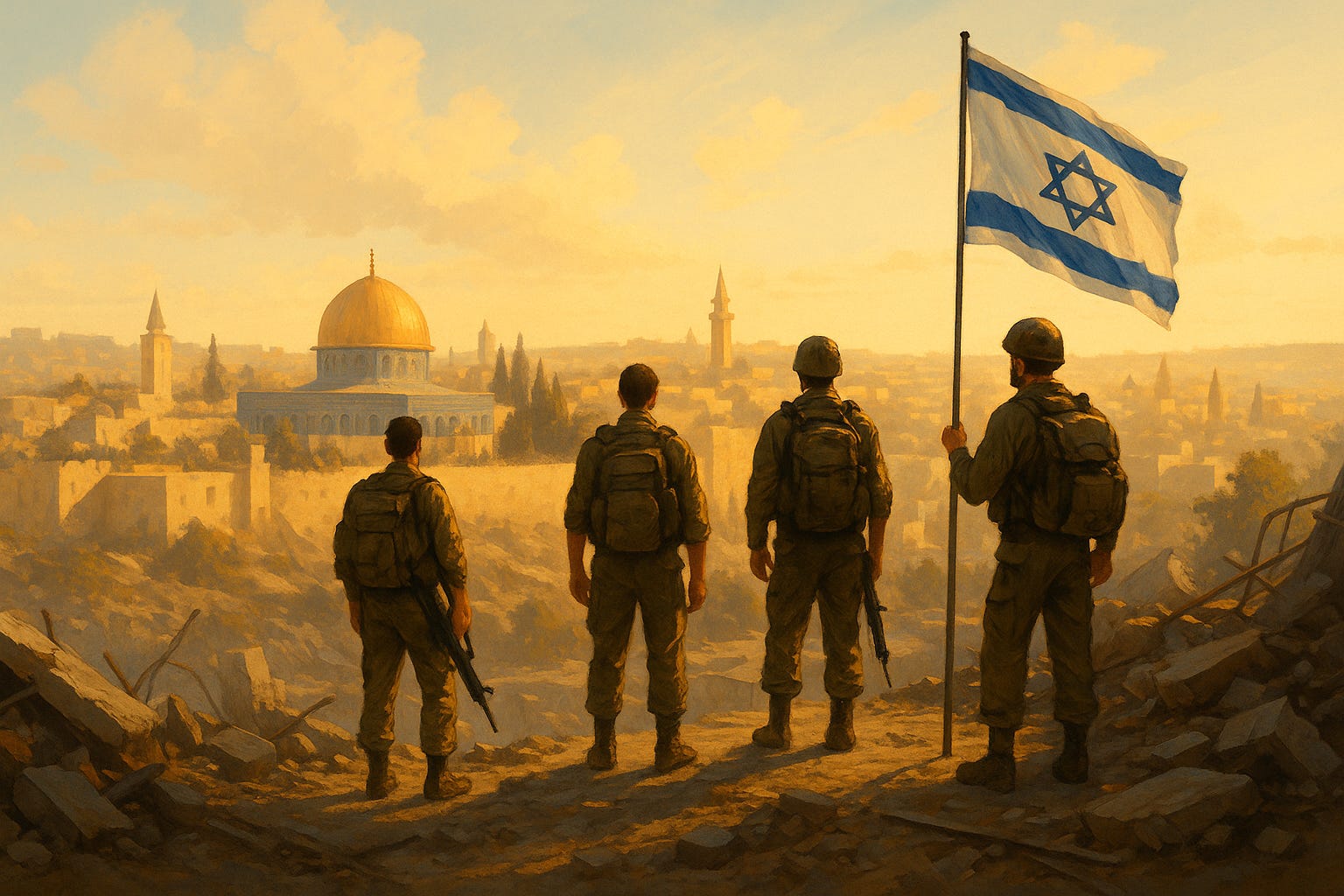
The young soldiers and reservists returning from the battlefield are not coming home radicalized or more entrenched in their ideological corners. They are coming home chastened, wiser, and, as writer Yossi Klein Halevi has observed, newly sensitive to the dangers of internal division. They understand that the catastrophe of October 7 was not simply an external attack. It was an attack that exploited the fractures Israel allowed to widen within itself.
These young Israelis — the ones who actually fought, who broke down doors and carried out evacuations and sat in tanks for days on end — are returning with a profound hunger for unity. They are returning home with a moral seriousness that makes Israel’s current leadership look painfully small. They want fewer ideological knives and more shared purpose. They want a country that argues, as Israel always has, but argues toward a future rather than toward rupture.
They are rediscovering the original spirit of ingathering: not merely the physical return of Jews from around the world, but the gathering of the full spectrum of Jewish ideas — secular, religious, left, right, traditional, experimental — into a single, complicated national story. Israeli society has always been the place where Jewish history argues with itself. What’s new is that a generation of Israelis now wants to argue differently.
And they bring extraordinary resources to that task. Israel remains, as Halevi points out, a society with a density of talent unmatched anywhere else: intellectually serious, emotionally mature, morally alert. As Halevi puts it with characteristic clarity:
“You meet a kid here, you meet high school students. The level of conversation that you could have with them, the level of their engagement, is very, very deep and profound. October 7th, if it did anything, it made Israelis realize that our existence is not self-evident and that we have to work on it.
And that we have to show up and what type of country we’re gonna have is gonna be in our hands. There isn’t a sense of powerlessness amongst the Israeli. Now, one of the challenges is how does this density of talent then translate itself on the political realm and demanding of our politicians, you know, as that general said at the beginning of the war in Gaza, you have to be worthy of these soldiers.”
That is the new standard. Not political survival. Not coalition math. ‘Worthiness’.
The question now — the one that will define Israel’s political future — is whether this newfound unity and moral seriousness can be translated into leadership.
Israel’s political decay did not begin on October 7, but the rebirth of its civic spirit might have. While the West frets, equivocates, and indulges its most unserious impulses, Israel is emerging from crisis with a new generation that understands the stakes — and understands that the country must be rebuilt not only physically but morally, politically, and spiritually.
When the war ends, Israel will face choices more consequential than any battlefield decision. It will have to decide whether to rebuild its political life with the same clarity, courage, and unity that its young soldiers carried into battle. If it can meet that moment — if it can forge leaders worthy of those who showed up when history called — then October 7 will be remembered not only as a day of horror but as the beginning of Israel’s next great story.
Not a story written in tunnels.
Not a story written in darkness.
A story written in daylight — where Israel has always chosen to stand.
The question now is whether Israel will choose leaders who can stand there with it
That’s all for the week. Enjoy the weekend everyone, and as usual, be safe out there.
Brad out.
 Jew News Review