
Shabbat shalom.
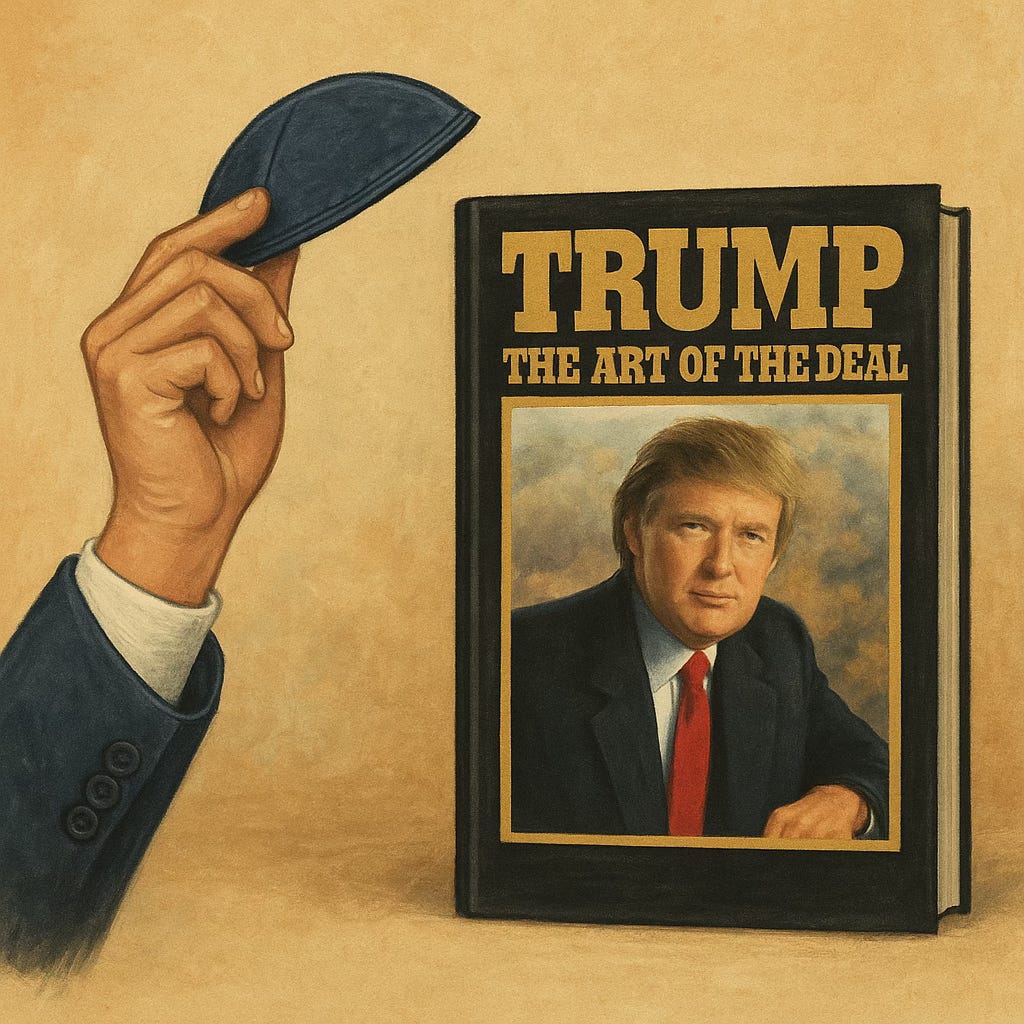
Political junkie David Axelrod once quipped that he wasn’t sure if history had a sense of justice, but that it certainly had a sense of humor. I’m starting to think history also has the social skills of a drunk uncle at a bar mitzvah. So, despite the challenge to my gag reflex, a reluctant “tip of the kippah” to President Trump, the orange man-child who somehow took Biden’s mothballed peace framework, blew off the Gaza dust, and shoved it back onto center stage. Not through diplomacy or empathy, but through the only tools he’s ever trusted: a Rolodex full of autocrats, the subtlety of a leaf blower, and an ego that treats applause as oxygen.
Whatever his motivation might be, a Nobel, his incessant need to control the conversation, or simply stopping the killing, I think there’s a dark grace in all this. Sometimes history’s instruments are ugly. Sometimes the necessary work arrives wearing the wrong orange face. Maybe the Almighty’s sense of irony runs so deep She sent a peace deal through an orange man child who can achieve detente in the middle east but declares war on blue cities back home.
Then, as if on cue, the Nobel Committee handed this year’s Peace Prize to Maria Corina Machado, the Venezuelan opposition leader fighting her own quiet revolution for democracy. Trump’s dream of being crowned the world’s greatest dealmaker died in Oslo before the shrimp cocktail at Mar-a-Lago was even served. Somewhere between Palm Beach and Norway, an aide is probably drafting an executive order declaring the Nobel Committee a “woke globalist terror cell.”
But let’s not get too cute. Phase One of this twenty-one-point plan deserves genuine, unsarcastic gratitude. The hostages coming home isn’t a talking point; it’s a moral and emotional overhaul on shattered families and a national nightmare given back its first small measure of justice. It lifts a tremendous weight off the exhausted shoulders of the Israeli people. The reunions will be a blessing. The photos and videos precious. Celebrate them. No irony required.
But let’s not pretend these concessions were given for free. Trump didn’t just lean on Qatar, Turkey, and Egypt with moral suasion. He dusted off The Art of the Deal and went full sequel. Qatar got a NATO-lite promise of American protection, Turkey got the return of its coveted F-35s and the quiet lifting of sanctions, and Egypt got what it has always wanted most: secure borders and a guarantee that the chaos of Gaza would not spill into Sinai. These were not magnanimous gestures. They were bribes disguised as diplomacy, The Art of the Deal translated into Arabic, Turkish, and bureaucratese. Trump doesn’t charm; he leverages. He doesn’t negotiate; he corners. And for once, that instinct may have served the cause of peace. It took Israeli military might along with Trump’s bullying to get this done, a combination that President Biden could never have delivered.
Still, beneath the handshakes and the headlines lies a truth so obvious it hurts to say out loud: both sides are being asked to swallow poison. For Israel, it means watching some 250 convicted murderers and terrorists, the architects of massacres, the bomb-planters, the knife-wielders, walk out of their cells in exchange for hostages. The same men who shattered Israeli families will stroll into hero’s welcomes on the streets of Gaza and Nablus. It’s a nauseating calculus, but that’s what this peace required – a deal made with the unbearable.
And even as Hamas signs on the dotted line, Israel knows the organization’s playbook by heart: regroup, rearm, and repeat. A movement built on annihilation doesn’t become a governing partner overnight. It bides its time. It trains its next generation of “martyrs.” It waits for the world’s attention to drift. And when it does, the cycle begins again, another October 7, another pogrom, another reminder that evil doesn’t retire. Another such reminder took place just the other day in the streets of Gaza. When the ceasefire was announced, thousands poured into the rubble to celebrate what they believed was a Hamas victory. Amid the jubilation came an old chant: “Khaybar, Khaybar ya Yahud, jaish Muhammad sa-ya’ud!” — “Jews of Khaybar, Muhammad’s army will return.” The war may have paused, but the hatred hasn’t even broken a sweat.
The next generation of Palestinian leadership. At least they look well fed.
And while Gaza commands the world’s sympathy, the next act of this uneasy peace will play out across Judea and Samaria, the West Bank, a patchwork of divided towns, armed factions, and fading authority. The Palestinian Authority (PA), bloated by corruption and discredited by years of impotence, is supposed to serve as the political scaffolding for the future Palestinian state envisioned in Phase Two of Trump’s plan. But it’s a scaffolding missing more than a few planks and half its bolts. Mahmoud Abbas governs little more than Ramallah, and even there, he’s about as popular as a traffic ticket.
The next phase demands that the PA prove it can govern without graft, pay teachers instead of militias and martyrs, and articulate a vision of self-rule that doesn’t hinge on Israel’s erasure. Meanwhile, Israel will be asked to loosen its grip on parts of Area C, the territory that is both strategically vital and spiritually loaded. That’s not likely to happen.
And here, in my humble opinion, lies the bleak truth: Phase Two contains irreconcilable differences that no amount of diplomacy can resolve. According to many experts, the ceasefire’s strategic trajectory points toward renewed conflict rather than sustainable peace. The agreement’s fundamental contradictions—Hamas disarming itself, governance transition challenges, Israeli withdrawal contingent on security that won’t exist, statehood aspirations incompatible with Israeli policy—represent a “bigly” risky bet that cannot be resolved through negotiation because they reflect genuinely irreconcilable positions. Hamas survives militarily degraded but still intact. Its ideology, that Israel’s destruction is both possible and required, remains unchanged. Its external leadership continues operating from Doha. Its military commander in Gaza survived. Its institutional infrastructure, though damaged, retains the capacity for rebuilding.
More broadly and philosophically speaking, one side views the land as divinely promised, the other as divinely stolen. The borders aren’t just drawn on maps, they’re etched into scripture and identity. No summit, no joint communique, no “mutual recognition clause” can untangle that. At best, the world can broker pauses, moments of exhausted coexistence and hostage/prisoner swaps. But peace? Peace is a word that will always sound aspirational here, at least until Palestinians care more about loving their own children than killing Jews.
So, no kenahoras, he artfully negotiated a deal to get the hostages back. But alas, the orange man child didn’t get his Nobel. He’s too busy calling Democrats “enemies of the state” on Truth Social, sending troops into blue cities, cutting aid and life saving vaccines to poor countries, and avoiding the Epstein files while brokering an uneasy peace in the Middle East. But if this bizarre cocktail of ego and grievance somehow drags us through a successful Phase Two, if his need for applause outlasts his need for vengeance, then I’ll do the unthinkable….
I’ll nominate him for the Nobel myself.
Be careful out there and try to, with all due respects, control your gag reflexes.
Brad out.
 Jew News Review