
Shabbat shalom!
And a huge tip of the kippah to the returning hostages and their families and friends!
The images are impossible to forget. The faces of the living hostages stepping back onto Israeli soil, thin, pale, trembling, collapsing into the arms of parents and children who had long stopped believing in miracles. The pure joy, the tears, the sound of breath finally released after months of suffocation.
But joy has its shadow, and as Rachel Goldberg-Polin reminded those gathered in Hostage Square, “there’s a time to sob, and a time to dance, and we have to do both right now.” For every hostage who came home alive, there were others who returned in body bags, and others still who remain missing, their fate a living wound on the conscience of the world. Some may yet become pawns in a terrorist chess game that plays cruelty as strategy and human lives as pieces to be traded.
Among the returned are real heroes. There is Evyatar David, abducted from the Nova Music Festival and forced into starvation and dehumanizing captivity, including digging his own grave, who walked out after more than two years determined to live again. There is Rom Braslavski, who survived more than seven hundred days in captivity, starved and beaten, told he could eat if only he would renounce his faith and convert to Islam. His answer, recalled by his mother, was simple: “I am Jewish. I am strong. I will not break.” These stories of endurance, courage, and unimaginable grace remind us that survival itself can be an act of defiance and can breathe new life into the cliché of Israeli resilience.
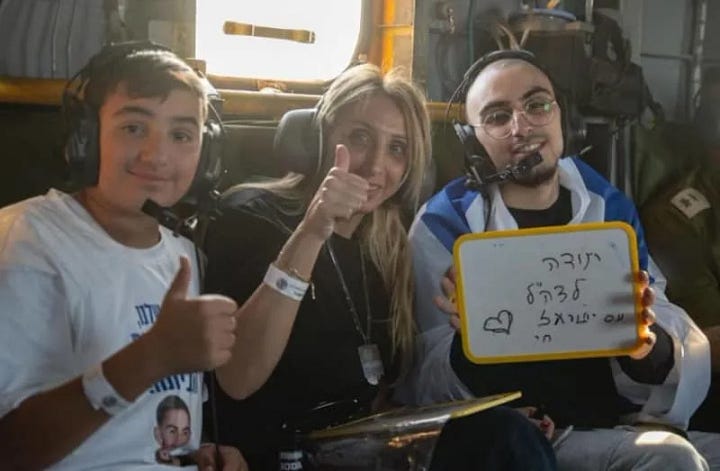
But the story of heroism does not end with the hostages. It continues in the hospitals, the rehab centers, and the homes where healing has only just begun. There, a quieter kind of courage is at work, doctors tending to scars that medicine cannot measure, therapists helping captives relearn freedom, and families learning how to live again with what they have lost.
The late and great Rabbi Jonathan Sacks once said, “To heal a fractured world is not to do extraordinary things. It is to do ordinary things with extraordinary love.”
Rabbi Sacks captured something I have been seeing up close over the last few brutal months. Friends and family I love are fighting illnesses that are moving faster than medicine, and I find myself watching the people around them, spouses, siblings, children, friends, who show up every day to lift, to listen, to hold. They may not be seeking miracles; they are performing them.
They are the quiet heroes, keeping a shattered world stitched together with small gestures: an Ensure shake, a gentle touch, a kiss on the forehead, nights of lost sleep offered to someone else’s comfort and care. These are the quiet acts of chesed, loving-kindness, that keep us grounded and human in an often inhuman world.
Maybe what Rabbi Sacks meant was that the work of repairing the world begins not in parliaments or churches or synagogues, but in hospital rooms and living rooms and kitchens. We all live in the fragile space between what we can change and what we must endure. Sometimes we cannot stop the illnesses that inevitably come our way, but we can choose how we show up for them. And in those moments, when someone wipes a brow, listens to a fear, or, as my rabbi told me, simply sits beside another human being in silence, the fractured world becomes, if only for a heartbeat, whole again.
So to the caregivers, the quiet heroes, including those I know and love, who keep vigil in the night and whisper comfort into the darkness: you are the proof that love, though powerless to cure, is still powerful enough to heal.
Brad out.
 Jew News Review