
A “tip of the kippah” this week to Fyodor Dostoevsky, patron saint of tortured souls and men who overthink everything except their own violence. His masterpiece, Crime and Punishment, begins with a murder, but the real brutality isn’t the axe, it’s the moral derangement that follows. Raskolnikov commits the crime; the world behaves as if the victim should apologize for being in the way. And the punishment, the true punishment, isn’t administered by the courts but by the conscience: the slow, sickening realization that guilt, real guilt, has serious emotional burdens.
And for readers who haven’t cracked open Dostoevsky since college, here’s the heart of it: Raskolnikov’s real sentence isn’t the years he spends in a Siberian labor camp — it’s the collapse of his own psyche. The murder breaks something inside him. The novel’s point is brutally simple: without conscience, punishment is just paperwork. Guilt is the only force powerful enough to transform a criminal into something other than a repeat offender.
Which brings us neatly to the most fucked up diplomacy in modern history, where not only is sanity MIA, but guilt has also gone missing entirely. Putin’s, or Trump’s or whomever’s latest “peace plan” for Ukraine reads like a hostile takeover drafted by the perpetrator — a document in which the criminal offers the terms of his own absolution and the victim is told to be grateful for the privilege of signing. It’s Crime and Punishment inverted: the crime is Russian, the punishment is Ukrainian, and the conscience has been scrubbed out of the script.
The world’s reaction has been a study in moral whiplash. Some — from European capitals to parts of the GOP to the “Chattering Class” of analysts — responded with appropriate shock, calling Putin’s proposal what it is: extortion with USA letterhead. But too many others, especially among the diplomatic aristocracy of the West, slipped instantly into their familiar verbal gymnastics of “realistic,” “pragmatic,” “a basis for dialogue.” Always the same euphemisms. Always the same expectation that the invaded must accommodate the invader’s emotional needs. This isn’t just a failure of accountability. It’s a failure of conscience — the absence of guilt that makes justice impossible.
The Gaza Ceasefire Parallel
Jews know this psychological inversion intimately — the eternal demand that the wounded express empathy for the one who wounded them.
That same warped geometry reappears in the Israel–Palestinian ceasefire debate. Hamas commits mass murder. Israel responds to prevent more. And the international chorus, safely insulated from rockets and rape, demands Israeli “restraint,” “concessions,” and “compromise,” as though the entire episode were a zoning dispute rather than a monstrous slaughter. In the Crime and Punishment frame, Hamas becomes Raskolnikov with better PR, and Israel becomes the elderly pawnbroker scolded for being murdered at an inconvenient time.
What unites the debates over Ukraine and Israel is not geography but a growing global appetite for peace without responsibility — a peace negotiated on terms set by the aggressor (and facilitated by a deranged orange man child), while the victim is cast as the obstacle.
Here’s the cleanest way to understand the absurdity: imagine if, during a Netanyahu visit to Washington, the American president sat him down and said, “Bibi, you will accept a Palestinian state. Here are the borders. Withdraw from these 26 settlements. Re-divide Jerusalem. Admit this number of refugees. Get it done by Thursday or we cut off U.S. support.”
That scenario is so inconceivable it isn’t even in the same time zone as reality. Yet that’s exactly the framework now being urged on Ukraine: the aggressor sets the terms, the victim is pressured to comply, and the MAGA world pats itself on the back for calling this diplomacy.
If we lived in a normally moral universe, not today’s ethically inverted one, the next step in the Israel–Hamas conflict would be obvious: Hamas’s leadership would be hauled to The Hague for war crimes and crimes against humanity. Not rewarded with concessions. Not allowed to negotiate over the bodies of kidnapped Israelis. Not permitted to drag out the return of dead hostages to buy time to rebuild, re-arm, and re-brand.
In any sane legal framework, accountability would mean Hamas commanders facing charges for mass rape, torture, and deliberate targeting of civilians; prosecutors presenting the very atrocities Hamas filmed and proudly disseminated; victims’ families confronting the perpetrators in court; and a verdict that names the crime, the criminals, and the communities they destroyed. But even that only addresses the external half of justice. The deeper failure is internal: Hamas feels no guilt, no remorse, no moral break in the psyche — the very precondition for any real reckoning.Without guilt, accountability becomes a procedural performance instead of a path to peace.
But why is there no guilt? Because guilt depends on the belief that the victim has moral standing. And neither Hamas nor the Kremlin grants their victims that dignity.
For Hamas, the absence of guilt is baked into its founding documents, which fuse political extremism with a theology that sanctifies martyrdom and demonizes Jews as cosmic adversaries. A worldview that casts violence as divine mandate cannot produce remorse; it can only produce more violence. In that framework, guilt isn’t just absent, it is considered heresy.
Putin’s Russia, meanwhile, is anchored in a nationalist mythology that denies Ukraine’s legitimacy altogether. If a neighboring nation has no right to exist, then no crime against it is possible. Guilt cannot emerge where the victim’s humanity has been ideologically erased.
This is why neither actor experiences guilt: not because they are uniquely monstrous, but because their worldviews render guilt conceptually impossible.
Instead, Hamas is incentivized away from any form of reckoning whatsoever. Every “pause” becomes a tactical reset. Every concession becomes a precedent. Every extension becomes a subsidy for the next round of violence. This isn’t justice. It’s a protection racket blessed by the grown-ups at the diplomatic table.
Dostoevsky understood what our diplomats refuse to: guilt is the catalyst that makes peace possible. Without guilt, there is no reckoning. Without reckoning, there is no healing. Without healing, there is no peace — only a temporary suspension of hostilities rebranded as progress. Russia is not grappling with guilt. Hamas is not grappling with guilt. Their proposals are not apologies; they are continuation strategies in a nicer font.
Meanwhile, the demands placed on Ukraine and Israel border on satire: Ukraine should negotiate its own amputation; Israel should accept a ceasefire that guarantees Hamas time to reload. This is not peacebuilding. This is guilt laundering for aggressors and moral busywork for everyone else.
And it feels so Jewish because Jews have lived inside this inversion for centuries: told to accept violence quietly, defend ourselves gently, and justify our survival politely. Our pain is always negotiable; our security always provocative.
Dostoevsky gave Raskolnikov a path to redemption only when he faced his crime — when he accepted that he, not his victim, was the problem. Imagine if the world demanded anything similar from Russia. Imagine if Hamas were required to begin there rather than end there.
Instead we get paperwork for the next catastrophe. Because in geopolitics, as in literature, the real punishment isn’t the prison sentence. It’s the reckoning. And until the perpetrators in both conflicts face their own guilt, every “peace plan” is just a pause between crimes with no punishment.
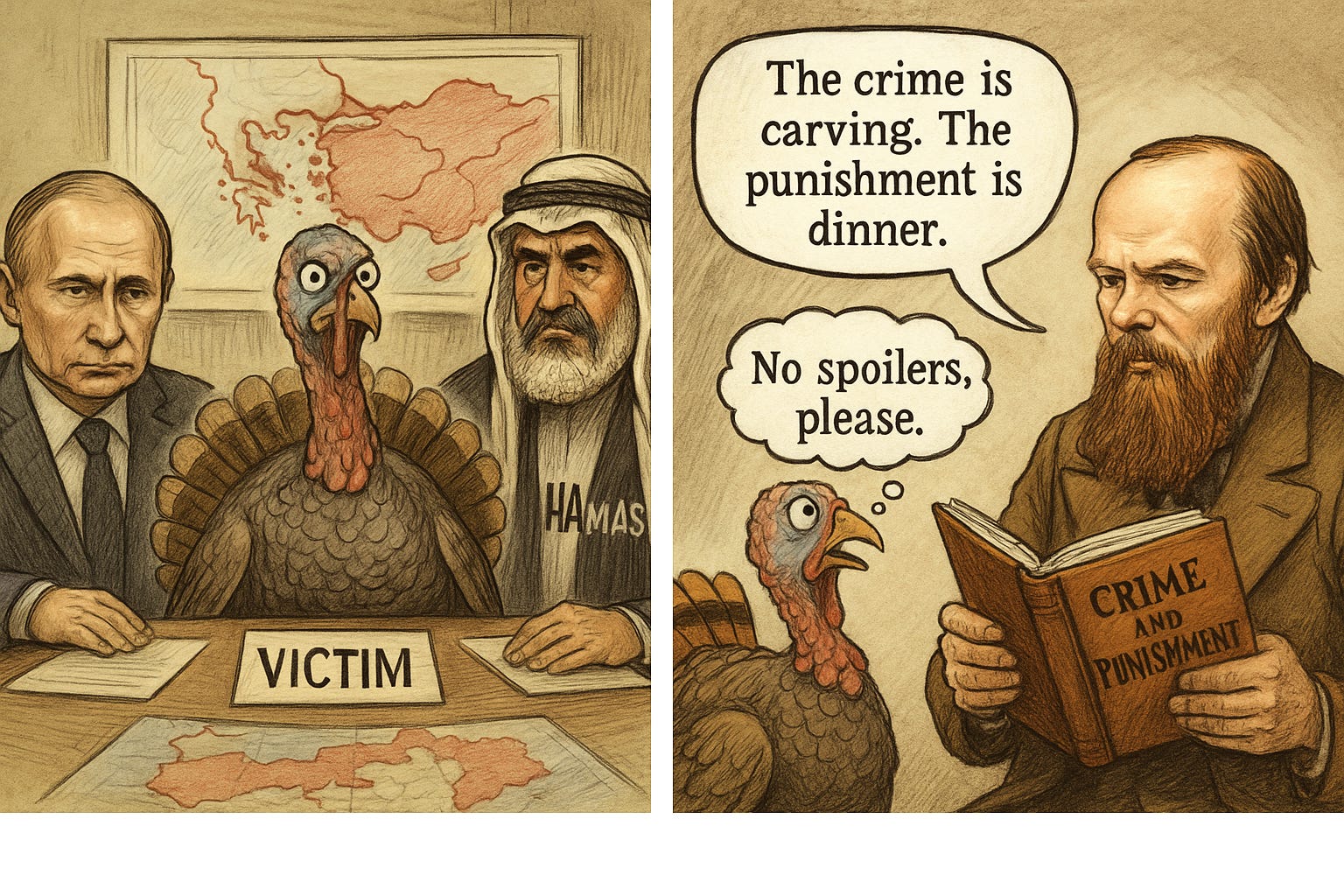
That’s all for this week. Here’s to a Thanksgiving where the only thing carved up is the turkey, not the moral order of the world. Wishing you all warmth, gratitude, and an extra slice of clarity.
Brad out.
 Jew News Review