The Jew News Review – November 29, 2025 – “Startup Nation” or “Exit Nation”?

A tip of the kippah to the architects of Zionism — those stubborn visionaries who believed a battered people could build a modern state out of desert, memory, and sheer human will. They dreamed of a country that would gather Jews from around the world and give them safety, dignity, and a shared future. What they didn’t dream of was an Israel where the most talented and ambitious citizens were quietly searching for one-way flights to Lisbon.

The rupture of October 7 is the unavoidable backdrop to everything that follows. The attacks shattered not only lives but the national psyche, ripping open wounds that still haven’t begun to heal. Israel entered a war of necessity, fought with remarkable resolve, but the psychological aftershocks were immediate and profound. For many Israelis, especially young families and the globally mobile professionals who power the country’s economy, the sense of existential vulnerability didn’t fade once the bombs stopped falling. It lingered. It metastasized. And in that atmosphere of fear, uncertainty, and political dysfunction, the idea of building a life elsewhere shifted from unthinkable to merely tragic.

Yet that is where the country finds itself in 2025: the “Startup Nation” has become, alarmingly, the “Exit Nation.”

The data is unambiguous. From 2015 to 2021, Israeli emigration stayed within a familiar band, roughly 22,000 to 28,000 departures annually, normal for a developed country with global mobility. Then came 2022, when 55,000 people left, a 46 percent jump driven largely by the judicial overhaul crisis. In 2023, the figure climbed to roughly 64,000. And in 2024, the number exploded to nearly 83,000 Israelis leaving – the highest level ever recorded. Meanwhile, return migration and new immigration have not kept pace; Israel saw a net loss of roughly 27,000 to 30,000 people last year.

But the real story is not the quantity… it’s the quality. Those leaving are not the fringe, the disaffected, or the economically desperate. They’re engineers, cybersecurity specialists, software founders, medical professionals, researchers, academics, and young secular families. They are, in other words, the beating heart of Startup Nation. The people whose skills, taxes, and innovation have powered the country’s extraordinary success. When a nation’s creative and professional class votes with its feet, that’s not a demographic drift. It is a crisis of confidence.

Ask these emigrants why they’re leaving, and a pattern emerges. October 7 didn’t merely expose security failures, it shattered a foundational covenant. Israelis send their children to the army under a simple promise: the state will keep them safe. That promise was broken in ways too traumatic and too public to ignore, and trust cannot be restored with slogans or spin.

Add to that the political chaos of the judicial overhaul, which many Israelis saw not as a policy disagreement but as an attempted power grab that threatened the democratic character of the state. Add the corrosive, long-festering issue of Haredi draft exemptions, which send an unmistakable message to secular families: your children will serve; others will not. No modern democracy can sustain such an imbalance without consequence. And then there’s the cost of living. Tel Aviv is now so expensive that even well-paid families feel they are living in a parody of middle-class life. It’s a perfect storm of insecurity, inequity, and exhaustion.

But beneath these factors lies the deeper, unavoidable truth: Israel’s crisis is a crisis of leadership. The country has been governed for fifteen of the last sixteen years by Benjamin Netanyahu, a man who long sold himself as “Mr. Security” and the steady hand on the wheel. Under his tenure, Israel experienced its gravest security disaster in half a century, its most perilous internal fissures in decades, an unprecedented wave of emigration among its most talented citizens, and the rise of extremist coalition partners shaping national policy. This isn’t a partisan judgment; it’s a matter of observable outcomes. The prime minister has become so consumed by political survival – legal, electoral, and personal – that he has forfeited the one thing a leader must possess: the trust of his people.

To be clear, none of this erases the fact that Benjamin Netanyahu has steered Israel through the most harrowing chapter of its modern history. Whatever one thinks of him politically, his post–October 7 wartime execution has been formidable. He coordinated an immensely complex military campaign, held together a fragile emergency coalition, managed international pressure, and maintained operational clarity under unimaginable strain. Israel has asked much of him, and he has delivered more than many expected. But even great wartime leaders must know when their chapter is over. Netanyahu has earned the right to take a bow, and Israel has earned the right to turn the page. The country does not need him to disappear; it needs him to pass the torch so the political and generational renewal Israel desperately requires can finally begin.

And yet, for all the gloom, there is a path forward because Israel’s political future is not a barren field. There is a bench of leaders who have demonstrated competence and seriousness. Naftali Bennett, whatever one thinks of his ideology, governed without theatrics or corruption and showed that pragmatic coalition-building is not a lost art. Benny Gantz still commands broad public trust, especially among Israelis who want stability more than slogans. Gadi Eisenkot carries the gravitas of a security professional who has put country above career, and Yair Lapid and Tel Aviv’s longtime mayor Ron Huldai remain viable options for a public hungry for competence and calm. None is perfect, but perfection is not the job requirement. Israel needs leaders who prioritize the country over their careers, not the other way around.

And beyond the familiar names, a younger generation is beginning to stir, the first real sign that Israeli politics might yet free itself from the long shadow of its twentieth-century protagonists. Figures like Yonatan Shamriz, a rising social-entrepreneur-turned-public leader, represent a cohort that came of age after Oslo, after the Second Intifada, and now after October 7 — Israelis shaped less by ideology than by pragmatism and the lived experience of instability. There is a growing bench of under-50 activists, technologists, and civil-society leaders who emerged from the 2023–24 protest movements: people fluent in security realities but unwilling to accept the fatalism of the old guard; people who understand both code and combat. Their names are not yet household fixtures, and none has the machinery of a major party behind them, but they are already changing the tone of Israeli public life. If Israel is going to restore itself as Startup Nation rather than slide deeper into Exit Nation, the renewal may well come from this rising generation: leaders with no corruption cases, no coalition debts, and no nostalgia for a political era that has outlived its usefulness.

A nation can survive war, economic strain, even political division. What it cannot survive is the erosion of belief in its own trajectory. Herzl famously declared, “If you will it, it is no dream.” The current government has delivered an unintended counterpoint: “if you break it, they will leave”.

Israel stands at a crossroads. One path leads to renewal, new leadership, restored trust, a repaired social covenant, and a return to the creative dynamism that made the country the envy of the world. The other path leads to departure gates, LinkedIn updates announcing relocations, and a slow, corrosive hollowing-out of the very population that made Israel thrive.

The choice is stark. Startup Nation can still be saved. But only if Israelis, and their leaders, recognize that the country’s greatest risk is not external enemies. It is the internal failure of leadership. It is time for the political equivalent of aliyah: not people moving to Israel, but leadership rising to meet the moment.

Israel must decide what it wants to be: the nation that gathers its people, or the one that drives them away.

That’s all for the week. As usual, be safe out there.

Brad out.
The Jew News Review – Special Diplomacy Issue – November 25, 2025 – “Gaza, Ukraine and Dostoevsky: Crimes Without Punishment”

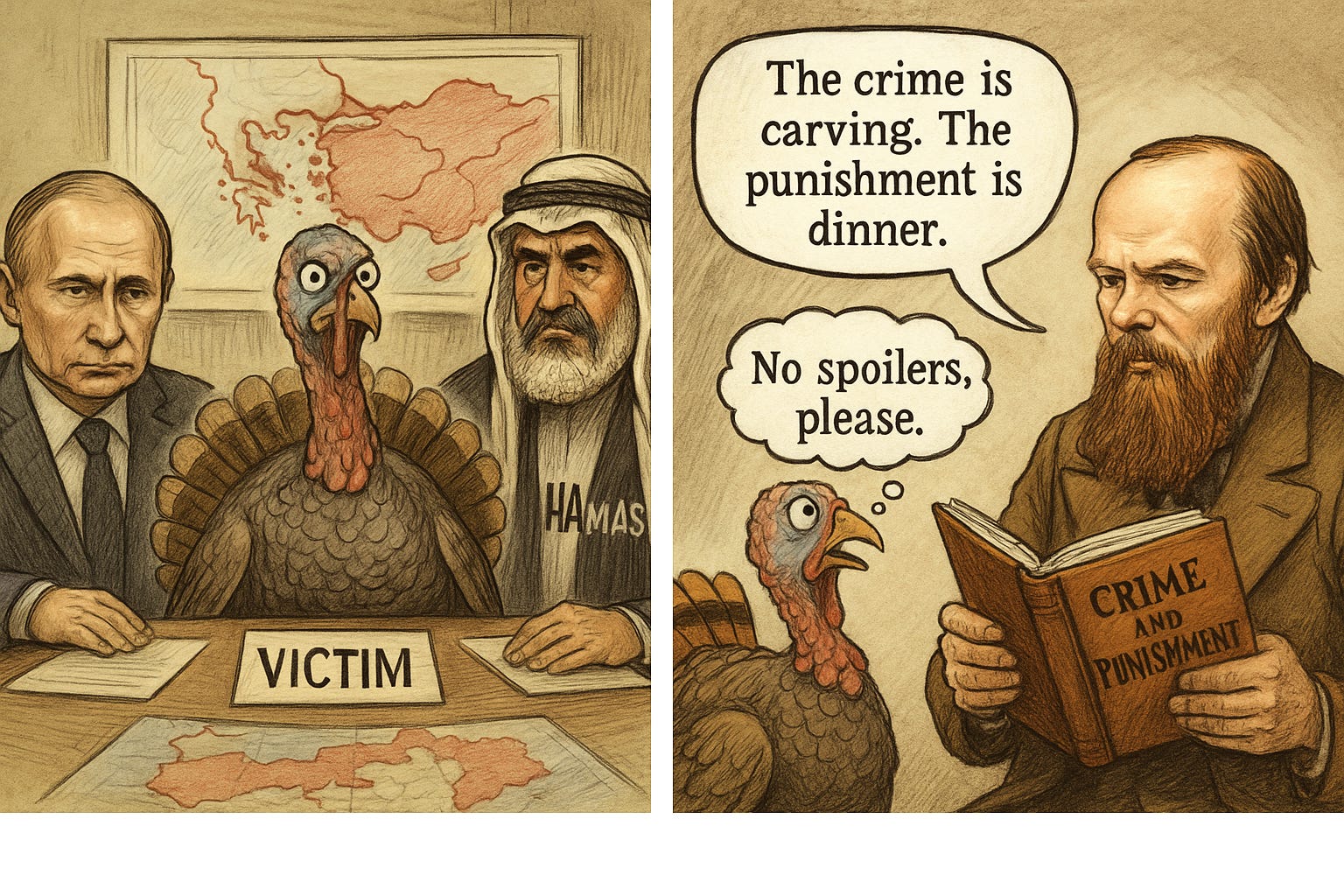
A “tip of the kippah” this week to Fyodor Dostoevsky, patron saint of tortured souls and men who overthink everything except their own violence. His masterpiece, Crime and Punishment, begins with a murder, but the real brutality isn’t the axe, it’s the moral derangement that follows. Raskolnikov commits the crime; the world behaves as if the victim should apologize for being in the way. And the punishment, the true punishment, isn’t administered by the courts but by the conscience: the slow, sickening realization that guilt, real guilt, has serious emotional burdens. 

And for readers who haven’t cracked open Dostoevsky since college, here’s the heart of it: Raskolnikov’s real sentence isn’t the years he spends in a Siberian labor camp — it’s the collapse of his own psyche. The murder breaks something inside him. The novel’s point is brutally simple: without conscience, punishment is just paperwork. Guilt is the only force powerful enough to transform a criminal into something other than a repeat offender.

Which brings us neatly to the most fucked up diplomacy in modern history, where not only is sanity MIA, but guilt has also gone missing entirely. Putin’s, or Trump’s or whomever’s latest “peace plan” for Ukraine reads like a hostile takeover drafted by the perpetrator — a document in which the criminal offers the terms of his own absolution and the victim is told to be grateful for the privilege of signing. It’s Crime and Punishment inverted: the crime is Russian, the punishment is Ukrainian, and the conscience has been scrubbed out of the script. 

The world’s reaction has been a study in moral whiplash. Some — from European capitals to parts of the GOP to the “Chattering Class” of analysts — responded with appropriate shock, calling Putin’s proposal what it is: extortion with USA letterhead. But too many others, especially among the diplomatic aristocracy of the West, slipped instantly into their familiar verbal gymnastics of “realistic,” “pragmatic,” “a basis for dialogue.” Always the same euphemisms. Always the same expectation that the invaded must accommodate the invader’s emotional needs. This isn’t just a failure of accountability. It’s a failure of conscience — the absence of guilt that makes justice impossible.

The Gaza Ceasefire Parallel

Jews know this psychological inversion intimately — the eternal demand that the wounded express empathy for the one who wounded them.

That same warped geometry reappears in the Israel–Palestinian ceasefire debate. Hamas commits mass murder. Israel responds to prevent more. And the international chorus, safely insulated from rockets and rape, demands Israeli “restraint,” “concessions,” and “compromise,” as though the entire episode were a zoning dispute rather than a monstrous slaughter. In the Crime and Punishment frame, Hamas becomes Raskolnikov with better PR, and Israel becomes the elderly pawnbroker scolded for being murdered at an inconvenient time.

What unites the debates over Ukraine and Israel is not geography but a growing global appetite for peace without responsibility — a peace negotiated on terms set by the aggressor (and facilitated by a deranged orange man child), while the victim is cast as the obstacle.

Here’s the cleanest way to understand the absurdity: imagine if, during a Netanyahu visit to Washington, the American president sat him down and said, “Bibi, you will accept a Palestinian state. Here are the borders. Withdraw from these 26 settlements. Re-divide Jerusalem. Admit this number of refugees. Get it done by Thursday or we cut off U.S. support.”

That scenario is so inconceivable it isn’t even in the same time zone as reality. Yet that’s exactly the framework now being urged on Ukraine: the aggressor sets the terms, the victim is pressured to comply, and the MAGA world pats itself on the back for calling this diplomacy.

If we lived in a normally moral universe, not today’s ethically inverted one, the next step in the Israel–Hamas conflict would be obvious: Hamas’s leadership would be hauled to The Hague for war crimes and crimes against humanity. Not rewarded with concessions. Not allowed to negotiate over the bodies of kidnapped Israelis. Not permitted to drag out the return of dead hostages to buy time to rebuild, re-arm, and re-brand.

In any sane legal framework, accountability would mean Hamas commanders facing charges for mass rape, torture, and deliberate targeting of civilians; prosecutors presenting the very atrocities Hamas filmed and proudly disseminated; victims’ families confronting the perpetrators in court; and a verdict that names the crime, the criminals, and the communities they destroyed. But even that only addresses the external half of justice. The deeper failure is internal: Hamas feels no guilt, no remorse, no moral break in the psyche — the very precondition for any real reckoning.Without guilt, accountability becomes a procedural performance instead of a path to peace.

But why is there no guilt? Because guilt depends on the belief that the victim has moral standing. And neither Hamas nor the Kremlin grants their victims that dignity.

For Hamas, the absence of guilt is baked into its founding documents, which fuse political extremism with a theology that sanctifies martyrdom and demonizes Jews as cosmic adversaries. A worldview that casts violence as divine mandate cannot produce remorse; it can only produce more violence. In that framework, guilt isn’t just absent, it is considered heresy.

Putin’s Russia, meanwhile, is anchored in a nationalist mythology that denies Ukraine’s legitimacy altogether. If a neighboring nation has no right to exist, then no crime against it is possible. Guilt cannot emerge where the victim’s humanity has been ideologically erased.

This is why neither actor experiences guilt: not because they are uniquely monstrous, but because their worldviews render guilt conceptually impossible.

Instead, Hamas is incentivized away from any form of reckoning whatsoever. Every “pause” becomes a tactical reset. Every concession becomes a precedent. Every extension becomes a subsidy for the next round of violence. This isn’t justice. It’s a protection racket blessed by the grown-ups at the diplomatic table.

Dostoevsky understood what our diplomats refuse to: guilt is the catalyst that makes peace possible. Without guilt, there is no reckoning. Without reckoning, there is no healing. Without healing, there is no peace — only a temporary suspension of hostilities rebranded as progress. Russia is not grappling with guilt. Hamas is not grappling with guilt. Their proposals are not apologies; they are continuation strategies in a nicer font.

Meanwhile, the demands placed on Ukraine and Israel border on satire: Ukraine should negotiate its own amputation; Israel should accept a ceasefire that guarantees Hamas time to reload. This is not peacebuilding. This is guilt laundering for aggressors and moral busywork for everyone else.

And it feels so Jewish because Jews have lived inside this inversion for centuries: told to accept violence quietly, defend ourselves gently, and justify our survival politely. Our pain is always negotiable; our security always provocative.

Dostoevsky gave Raskolnikov a path to redemption only when he faced his crime — when he accepted that he, not his victim, was the problem. Imagine if the world demanded anything similar from Russia. Imagine if Hamas were required to begin there rather than end there.

Instead we get paperwork for the next catastrophe. Because in geopolitics, as in literature, the real punishment isn’t the prison sentence. It’s the reckoning. And until the perpetrators in both conflicts face their own guilt, every “peace plan” is just a pause between crimes with no punishment. 

That’s all for this week. Here’s to a Thanksgiving where the only thing carved up is the turkey, not the moral order of the world. Wishing you all warmth, gratitude, and an extra slice of clarity.

Brad out.

The Jew News Review – November 21, 2025 – “Good bye, Bro”

Shabbat shalom.

The JNR is pausing for the week. I’ll be at my brother Billy’s celebration of life — honoring a man who lived with Dude-level grace, humor, and heart. Even in grief, the Dude abides. I’ll be back next week.

So long Bro, at least for now. Someday, hopefully not too soon, “I’ll catch you on down the trail”.

Brad out.

The Jew News Review – November 15, 2025 – “American Decay vs. Israeli Renewal: A Tale of Two Democracies”

Shabbat shalom.

It was a revealing week on opposite sides of the globe. In the United States, the Epstein email release dominated the news cycle like a chemical spill from a septic tank, confirming yet again that many of our “pillars of society” were actually just frequent-flyer degenerates with expensive legal teams. The documents didn’t expose anything the country didn’t already suspect; they merely reminded us how comfortably powerful men fit into systems that protect their appetites. It was a week drenched in decadence and denial — the smell of a nation losing its shit. 

Six thousand miles away, something very different was unfolding. Not rot, not spectacle, not the familiar choreography of American scandal, but clarity — the kind that only emerges in a democracy fighting for its life.

In Israel, attention returned to Rafah, where hundreds of Hamas fighters remain trapped like rats in the smuggling and assault tunnels they once believed made them untouchable. The Israel Defense Forces control the ground above them. The exits are sealed. The oxygen is dwindling. The only thing left down there is bad air, bad choices, and the overdue bill for October 7th taped to the wall. 

While diplomats shuttle between hotel lobbies in Doha and Cairo proposing ceasefire plans that seem drafted by an un-trained ChatGPT, Israel confronts a reality that cannot be massaged or negotiated away: no political or humanitarian plan is credible as long as Hamas remains intact as a military or governing force.

That fact is obvious in Israel. It is radioactive in Washington.

This contrast — America rotting at the top while Israel fights for its life — gives the week its larger meaning. One country at peace is rotting from within; one country at war is rediscovering its moral core. The contrast could not be more stark. 

Israel’s war has generated the usual flood of Western “expert” proposals, many of them well-meaning but detached from the physics and reality on the ground. International ‘stabilization zones’ that no nation is willing to staff. A refurbished Palestinian Authority that exists only in PowerPoint. ‘Technocratic transition bodies’ that dissolve on contact with oxygen. And the evergreen favorite: the ‘permanent ceasefire now, negotiations later’, an idea that would make sense only if Hamas were a misunderstood Scandinavian political party.

These are not realistic solutions. Not a single country has so far agreed to put their soldiers at risk and die defending Israel. Urban-warfare experts can theorize about ‘bubble zones’ and Kosovo lessons all day, but my muscle memory goes straight to Afghanistan, Somalia, and Iraq — the graveyard of every elegant Western stabilization theory. 

Israel, meanwhile, is confronting reality without euphemism. It is doing so while rescuing hostages, fighting on multiple fronts, absorbing rocket fire, burying its dead, and navigating the political aftershocks of the country’s worst intelligence failure in decades. And yet something unexpected — almost astonishing — is happening inside Israeli society.

The young soldiers and reservists returning from the battlefield are not coming home radicalized or more entrenched in their ideological corners. They are coming home chastened, wiser, and, as writer Yossi Klein Halevi has observed, newly sensitive to the dangers of internal division. They understand that the catastrophe of October 7 was not simply an external attack. It was an attack that exploited the fractures Israel allowed to widen within itself.

These young Israelis — the ones who actually fought, who broke down doors and carried out evacuations and sat in tanks for days on end — are returning with a profound hunger for unity. They are returning home with a moral seriousness that makes Israel’s current leadership look painfully small. They want fewer ideological knives and more shared purpose. They want a country that argues, as Israel always has, but argues toward a future rather than toward rupture.

They are rediscovering the original spirit of ingathering: not merely the physical return of Jews from around the world, but the gathering of the full spectrum of Jewish ideas — secular, religious, left, right, traditional, experimental — into a single, complicated national story. Israeli society has always been the place where Jewish history argues with itself. What’s new is that a generation of Israelis now wants to argue differently.

And they bring extraordinary resources to that task. Israel remains, as Halevi points out, a society with a density of talent unmatched anywhere else: intellectually serious, emotionally mature, morally alert. As Halevi puts it with characteristic clarity:

“You meet a kid here, you meet high school students. The level of conversation that you could have with them, the level of their engagement, is very, very deep and profound. October 7th, if it did anything, it made Israelis realize that our existence is not self-evident and that we have to work on it.

And that we have to show up and what type of country we’re gonna have is gonna be in our hands. There isn’t a sense of powerlessness amongst the Israeli. Now, one of the challenges is how does this density of talent then translate itself on the political realm and demanding of our politicians, you know, as that general said at the beginning of the war in Gaza, you have to be worthy of these soldiers.”

That is the new standard. Not political survival. Not coalition math. ‘Worthiness’.

The question now — the one that will define Israel’s political future — is whether this newfound unity and moral seriousness can be translated into leadership.

Israel’s political decay did not begin on October 7, but the rebirth of its civic spirit might have. While the West frets, equivocates, and indulges its most unserious impulses, Israel is emerging from crisis with a new generation that understands the stakes — and understands that the country must be rebuilt not only physically but morally, politically, and spiritually.

When the war ends, Israel will face choices more consequential than any battlefield decision. It will have to decide whether to rebuild its political life with the same clarity, courage, and unity that its young soldiers carried into battle. If it can meet that moment — if it can forge leaders worthy of those who showed up when history called — then October 7 will be remembered not only as a day of horror but as the beginning of Israel’s next great story.

Not a story written in tunnels.

Not a story written in darkness.

A story written in daylight — where Israel has always chosen to stand.

The question now is whether Israel will choose leaders who can stand there with it

That’s all for the week. Enjoy the weekend everyone, and as usual, be safe out there.

Brad out.
The Jew News Review – November 8, 2025 – “Foist on Our Own Petard: How the Soft Caliphate is Conquering the West Without a Shot”

Shabbat shalom. 

In his latest dispatch, the usually calm and grounded analyst, Andrew Fox, recounts being shocked by a WhatsApp message from a friend: Jewish Israelis had been banned from attending a soccer match in Britain. One minute they were heading to the stadium, the next they were told no entry “for safety reasons.” The official line: public order. The subtext: Jewish fans weren’t protected; they were excluded.

For Fox, it wasn’t just a sports story. It was a turning point. That WhatsApp exchange forced a deeper reckoning: how did Britain, cradle of fair play and free expression, reach a point where Jews are told to stay home, and the system shrugs? He puts it bluntly:

“How the hell did we get here? How did the country of Wellington, Nelson and Churchill reach the point where Islamist gangs dictate who goes where? How did the nation, whose under-siege hearts rose to the roar of a Spitfire’s Merlin engine, reach the point where British men and women of Jewish faith debate how best to attend a sporting event in safety?”

His conclusion was stark. This wasn’t an accident or an isolated act of cowardice. It was the end stage of something long in motion: the infiltration of Islamism into the civic bloodstream of Western democracies. Not the violent strain that detonates bombs, but the bureaucratic strain that files motions, drafts bylaws, and claims “equity” as it erodes equality.

I think he’s right. We are watching a slow-motion coup play out in the open. Not with bombs, but bylaws. Not with jihadists, but joiners. Islamism has learned what the Soviets never could: that the fastest way to destroy a liberal democracy isn’t to attack it from without, but to burrow in, speak its language, file its paperwork, and sue it for “discrimination” when anyone notices. And the West, self-congratulatory, guilt-ridden, and addicted to the narcotic of tolerance, keeps holding the door open.

We built the perfect system for the patient subversive: a society that elevates process over prudence, speech over judgment, compassion over courage. That’s what made it great, and now unfortunately, what now makes it defenseless. The modern Islamist doesn’t need to hijack planes; he hijacks institutions. He joins the school board, opens a “human-rights” NGO, and learns to weaponize the West’s allergy to offense.

Britain’s security services now call this the “lawful but corrosive” threat: activism that stays inside the legal lines but eats away at liberal foundations like rust under paint. After decades of denial, the UK finally faced reality in 2024 when it rewrote its definition of extremism. No longer limited to violence, it now includes movements that “undermine, overturn, or replace the UK’s system of liberal parliamentary democracy.” Translation: you don’t have to blow up Parliament to destroy it. You just have to make it irrelevant.

Groups like Hizb ut-Tahrir, banned across much of the Middle East, operated legally in Britain for years, holding rallies, publishing manifestos, training activists to argue that democracy itself was haram. They did it all under the banner of free speech, and only this year were they finally proscribed, after radicalizing a generation under the radar. For decades, Western governments treated such movements as fringe sideshows. But as Britain’s Prevent program now reports record levels of radicalization, it’s clear: the playbook was hiding in plain sight.

Sweden, once the global symbol of humanitarian virtue, is learning the same hard lesson. A 2025 French government report revealed how the Muslim Brotherhood built networks across Swedish schools, mosques, and charities, turning the country’s tolerance into a vulnerability. Sweden’s prime minister, Ulf Kristersson, put it bluntly: “We’ve allowed actors to use our freedoms to spread hatred.” The government has now launched an inquiry into Islamist infiltration and is moving to ban foreign extremist funding. It’s the right move, decades late.

Across the globe, Australia’s intelligence chief Mike Burgess is saying out loud what most Western leaders won’t: groups like Hizb ut-Tahrir and neo-Nazis are “two sides of the same extremist coin.” Both exploit democracy’s open spaces to erode it from within. Both rely on intimidation masked as activism. And both count on liberal societies to be too polite, too guilt-ridden, or too distracted to call them out. “Open societies,” Burgess warned in his 2025 security address, “are being used by those who would close them.” Australia is now considering listing Hizb ut-Tahrir as a terrorist organization, finally acknowledging that the absence of violence does not mean the absence of threat.

And then there’s the United States, still convinced it’s immune to the maladies that have already infected its allies. We tell ourselves that the First Amendment is a shield strong enough to protect us from ideologues who see “rights” as blasphemy. But look around. The ADL reports the highest number of antisemitic incidents in American history. On campuses, Jewish faculty and students are boycotted, hounded, and doxxed under the guise of “activism.” Muslim Brotherhood-linked organizations, some cloaked as civil-rights groups or humanitarian charities, use America’s nonprofit system to fundraise, recruit, and mainstream Islamist narratives.

This isn’t paranoia; it’s pattern recognition. The Brotherhood’s strategy, refined over decades, is simple: build a web of legitimate-looking civic and educational institutions, use them to shape public opinion, and gradually shift the moral vocabulary of the country toward sharia-based norms. Germany’s domestic intelligence service calls Islamism “an essential ideological current aimed at abolishing the free democratic basic order.” In America, we call it “community engagement.”

The visible part of this threat, the protests, the antisemitic slogans and violence, the occasional terror plot, is just the tip of the iceberg. Beneath the surface lies something far more sophisticated: organizational capture, where charities and civic groups become vehicles for illiberal activism; funding pipelines, where Western aid finds its way into Islamist coffers; narrative warfare, where “Islamophobia” becomes a bludgeon to silence dissent; and institutional paralysis, where universities, media, and governments freeze for fear of being labeled intolerant. This is how democracies die now, not with coups, but with compliance.

And if you wonder where the money comes from, follow the trail east to Doha. Qatar, that glittering hub of contradictions, isn’t just hosting World Cups and luxury real estate expos; it’s bankrolling Islamist-aligned networks across Europe and the West. Between 2004 and 2019, Qatar distributed over $1 billion to 288 organizations in Europe alone, many with links to the Muslim Brotherhood and its affiliates. Its state-backed Qatar Charity financed mosques, schools, and cultural centers later flagged by European intelligence agencies as hotbeds of Islamist separatism. According to research by ISGAP, “substantial Middle Eastern funding (primarily from Qatar)” has flowed into U.S. universities creating influence vectors. At nearly $6 billion into American higher education since 1981, with hundreds of millions more coursing through U.S. lobbying firms, the scale of Qatar’s investment in America’s civic infrastructure is now impossible to ignore.

This is not old-school covert terror-funding. It’s open, structural, formalized — another illustration of the “lawful but corrosive” threat. None of this is underground, it’s happening under the halo of philanthropy, precisely because the soft caliphate thrives on the plausible deniability of benevolence. Ignore the funding stream and you miss the method.

The examples we can see are fragments of a much larger structure. Underneath is a coordinated ideological movement with global funding, digital strategy, and a patience honed over centuries. We are not facing lone radicals but a multinational political theology with an MBA in Western governance. And if we don’t confront it now, our descendants won’t just inherit rising antisemitism, they’ll inherit a civilization that still calls itself “free,” but only in the nostalgic sense.

Substack writer RtS calls it a “global Caliphate.” I’d add the adjective soft—because this isn’t conquest by force, but by form. It’s a Caliphate not imposed by sword, but by structure. Not declared, but implied. Not the terroristic fantasy of ISIS, but the bureaucratic reality of institutional capture, from London borough councils to New York classrooms to Stockholm’s welfare programs. The genius of this strategy is that it uses our own moral vocabulary, “justice, equality, inclusion”, as camouflage. It teaches Western liberals to confuse tolerance with surrender.

The Western woke mind, conditioned to see oppression only through the lens of colonialism, can’t process the idea that anti-colonial movements can themselves become colonizers of the spirit. And so the soft Caliphate grows, unopposed, funded by our taxes and defended by our journalists.

We can still stop it, but only if we reclaim the moral confidence that built the West in the first place. We must end government partnerships with organizations that reject liberal democracy in their charters or leadership. Free speech is sacred, but it doesn’t entitle anyone to a taxpayer subsidy. We must cut off foreign funding for extremist-linked religious institutions. We must draw red lines between faith and theocratic activism, and defend those who stand on the front lines—Jews, women’s-rights advocates, ex-Muslims, reformist imams. They’re the canaries in this democratic coal mine, and when they fall silent, the air’s already gone bad.

And let’s address the obvious attack head-on: this isn’t Islamophobia. It’s evidence. To criticize an ideology is not to condemn a people. The Muslim world, in all its diversity, contains millions who reject this totalitarian strain, many of them its first victims. The problem isn’t faith, it’s the political weaponization of faith. Liberal societies survive only when they can tell the difference. To conflate legitimate scrutiny with bigotry is to abandon reason itself, and reason, not sentiment, is what separates civilization from chaos.

Moral clarity is not hate speech; it’s self-defense. To say that Islamism is not Islam, that it is a totalitarian political movement masquerading as faith, is not prejudice, it’s precision. If we can’t speak plainly about that distinction, then our silence is already surrender.

The petard we designed to hang tyranny has been turned against us. Our tolerance has become the weapon of our undoing. We have mistaken restraint for virtue and allowed fanaticism to hide behind its mask. The West was built on the courage to say no—to kings, to popes, to dogmas. If we’ve forgotten how, we’d better relearn fast. Because the soft Caliphate doesn’t need to conquer us; it just needs us to keep apologizing for existing.

And when that happens, when our rights become our ropes, it won’t matter whether we call it sharia or shame. Either way, we’ll have hung ourselves.

That’s all for the week. Stay healthy everyone, and be safe out there. 

Brad out. 

The Jew News Review – November 1, 2025 – “From WTF to Action: Why We Must Retell the Jewish Story”

When it comes to antisemitism in the U.S., and across the so-called enlightened West, I keep asking myself: how much worse could it get? WTF, indeed.

If you want to know how bad things have gotten, look no further than New York City, the beating heart of the Jewish diaspora, where Assemblyman Zohran Mamdani is now likely to win the contest for mayor. Mamdani isn’t some fringe crank; he’s a rising progressive star, the poster child of a movement that wraps radicalism in virtue. 

Mamdani has repeatedly taken public positions that Jewish leaders call problematic, especially in a city with the largest Jewish population outside Israel. The list of horribles is long, but here are a few more notorious: He’s declined to commit to visiting Israel if elected, breaking a 75-year tradition for NYC mayors. He has refused to affirm the existence of the Jewish state as a Jewish state, calling instead for equal rights for all in the land. He’s flagged for using rhetoric tied to the slogan “globalize the intifada”, language many Jewish New Yorkers regard as a dog whistle for anti-Jewish violence.

Meanwhile, antisemitic incidents in NYC are already rising: in the first quarter of 2025, hate crimes targeting Jews made up 62% of all reported hate crimes city-wide.

And yet, Mamdani’s own words drip with a familiar poison:

“The push is defund the NYPD and refund all of these different social services and things that actually create safety. And so I think that when we need to connect the struggles against austerity with the struggle against the funding of Israeli apartheid.” (Mamdani 2021)

And this:

“We have to make clear that when the boot of the NYPD is on your neck, it’s been laced by the IDF. Especially in New York City, you have so many opportunities to make clear the ways in which that struggle over there is tied to capital’s interest over here.” (Mamdani 2023)

In a city where Jewish cops have died protecting synagogues, where Holocaust survivors still walk the streets, the suggestion that “the boot on your neck has been laced by the IDF” isn’t criticism — it’s malicious libel. Yet he’s poised to win.

The alarms are blaring. And not just in New York City. All over the world, the “Pro-Palestine” movement is growing, and getting scary. My synagogue, here in Sharon, now has a full time security guard watching the Jewish School at all times when in session. 

Outrage Isn’t Enough – We Need a New Educational Imperative

The line between anti-Zionism and antisemitism has disappeared. And if the world’s most Jewish city can flirt with a mayor who paints Jews as militarized oppressors, then outrage isn’t enough.

It’s time for a new kind of education, one that teaches Jews and non-Jews alike not just what is happening, but why. Our current responses — security guards, hashtags, press releases — are defensive. What’s needed now is offensive: a re-education of the worldon the meaning and mission of Jewish civilization.

Enter Dara Horn, author of “People Love Dead Jews” and her new educational imperative.

Dara Horn’s Tell Institute calls for retelling the story from its roots. Judaism didn’t just introduce monotheism; it introduced a political revolution, the idea that no ruler is divine, no empire eternal, and no human authority absolute. 

That’s the story that once taught the world that freedom requires law, and that law requires moral responsibility. And it’s the story our modern culture — whether woke, populist, or nihilist — has completely forgotten.

Horn is helping to redefine the roots of antisemitism and how best to deal with it. In her own words:

Anti Semitism is directly related to the challenge that the Jewish people have always posed to the ideas of conformity and tyranny. Anti Semitism is a lie that people use to maintain power. The big lie of antisemitism is that Jews are the obstacle to what you value most, and the only variant through history is what you value most. Recognizing how this pattern works and how it’s consistently worked for millennia is the key to understanding antisemitism today and how to respond to it.

If Horn diagnoses the disease, Joshua Hoffman offers the cure. In his essay ‘Progressive or Zionist — The Jewish Left’s False Binary,’ Hoffman makes the case to stop letting others define the Jewish narrative through imported ideological frameworks. Stop measuring Jewish survival on the spectrum between “oppressor” and “oppressed.” Reclaim complexity, peoplehood, and particularism without apology.

Together, Horn and Hoffman point the way toward what might be called a Critical Zionist Theory — an educational model that doesn’t beg for acceptance but demands understanding. One that tells Jews, “Your story is not an accident of persecution,” and tells the world, “This is what freedom under moral law looks like.”

The Living Rebuttal: Israel

If antisemitism is the cult of resentment, Israel is the culture of responsibility.

Look at the numbers.

A nation the size of New Jersey leads the world in cybersecurity, medical innovation, water recycling, and renewable tech. Israeli artists headline at Venice, Israeli scientists win Nobels, Israeli startups outnumber entire continents. The same people once accused of poisoning wells are now desalinating the Mediterranean.

That success isn’t luck — it’s legacy. It’s the application of 3,000 years of moral engineering to a small patch of desert that now exports ideas instead of excuses.

And that’s precisely why the tyrants and the Twitter mobs hate it: because Israel proves that survival doesn’t have to be static. It can be creative, defiant, productive — the opposite of Palestiniasm, the global cult of eternal grievance that mistakes victimhood for virtue.

Israel’s greatest sin, to its critics, is not occupation but competence. It succeeds where others prefer to suffer. It builds where others burn. It turns exile into energy.

The Jewish story, properly told, isn’t about what was done to us — it’s about what we’ve built since. And until we teach that story — unapologetically, proudly, relentlessly — we’ll keep ceding moral ground to those who mistake destruction for justice.

Tip of the Kippah

Begrudgingly, a nod to Zohran Mamdani — for proving, in real time, that the Pharaohs never left. They just switched boroughs. 

Enjoy the weekend everyone. Go Jays! And as always, be careful out there.

Brad out.

The Jew News Review – October 25, 2025 – “Oy, I need a break”

Shabbat shalom!

I’m taking the week off to visit with family. 

There really wasn’t much to write about anyway, just the incredibly horrendous shit which is now considered “normal”: Masked ICE agents snatching people off the street, the National Guard sent into major cities on the obviously false pretense that these cities are shit holes under siege, the U.S. military brazenly blowing up people on the high seas, huge tariffs that will inflict heavy economic burdens and that have already destroyed alliances that took generations to build. And lets not forget that green energy and clean tech have been eviscerated, revenge and vindictive prosecutions are now the norm, many millions are on course to lose their health insurance, and the orange man child, in addition to stealing $230 million from taxpayer coffers and posting memes of himself showering half the country with literal shit, has also decided to raze the historic East Wing of the White House and replace it with a gilded monster ballroom without any review or approvals by anyone. Just another normal week.

As Andrew Sullivan noted in his weekly post, “The bottom has already fallen out of any semblance of public dignity for the United States government.”

So, forget about all that “winning”, try to enjoy the weekend, and take comfort in over 8 million of us taking to the streets to express our dissent in watching our democracy get demolished like a wing of the White House. 

And to make you feel even better about things, here is some Jew News of the week, courtesy of Nellie Bowles, (wife of Bari Weiss), who writes a weekly sarcastic punch at the news for The Free Press.

 News of the Jews: You know the situation is bad. I know the situation is bad. Yes, I will tell you when I pack a go-bag.

One interesting thing to know is that our commentariat are true hardcore Hamasniks, like even within Gaza they would be on the militant side. Rima Hassan, a member of the European Parliament from France, seemed to celebrate the news that Hamas was hunting down dissidents in Gaza. She posted a story about how “groups in Gaza that collaborated with the Israeli army” are being killed by Hamas during the ceasefire and added the caption: “one by one.” Like, go get ’em all, boys! Bushra Shaikh, a popular British media personality, had this to say: “People who betrayed their countries to support the Nazis after WWII faced severe consequences, including execution. This is no different. . . . Hamas are only doing what they have to, for the little stability Palestinians have.” Right.

Over in audio media, Louis Theroux, the beloved British journalist, has fallen. Here he is this week on a podcast, claiming that Jewish national identity has become a role model for all racism, the inspiration for all ethno-religious nationalism around the world.

There’s an even more macro lens which you can put on it which is that Jewish identity in the Jewish community, as expressed in Israel, has become almost like an acceptable quote, unquote, way of understanding ethno-nationalism. And so it’s like they’re prototyping an aggressive form of ethno-nationalism, which is then rolled out, whether it’s by people like Viktor Orbán in Hungary or Trump in the U.S. . . . . It’s become sort of this certain sense of post-Holocaust Jewish exceptionalism or Zionist exceptionalism, has become a role model on the national stage for what these white identitarians would like to do in their own countries.

The feeling I have now is similar to the one I had during the height of #MeToo, when every morning brought news of another famous mogul who had been trapping interns in his car, or a beloved actor who turned out to have a rape button under his desk. Now, I wake up each day to another person I respected who suddenly has a lot of rage toward one very specific group of people, who suddenly thinks the world’s ills can be put on this one little group. Et tu, Theroux?

Theroux has a similar philosophy to Irish actress Denise Gough, who argued that if we destroy Israel, then every evil nation in the world will snap into goodness: “The Death Star apparently has a place in it that if you shoot through that specific place in the Death Star, you explode the entire Death Star,” Denise explained. “And so somebody said Palestine is that place, and the construction, the Death Star, is like all of it: Sudan, Congo, all of it, everywhere, Nigeria now, everywhere. If we can free Palestine, it explodes everything.” Love this logic. Really sophisticated stuff.

Another to fall is moderate Seth Moulton, a nice congressman in Massachusetts. Rep. Moulton last week announced he’d be returning all AIPAC money donated to him and would no longer accept AIPAC donations, which is, of course, fine, if that were a blanket rule of his, but he accepts donations and even a junket from Qatari advocacy groups, but who cares about that. AIPAC is also the Death Star.

Over at Pomona College in Southern California, a campus Jewish group was hosting an October 7 survivor to speak about his experience in captivity and resilience and whatever else you can imagine someone might say to make sense of life after that happens. The talk was interrupted by masked protesters dressed in pseudo-Hamas garb (keffiyehs over their faces except for little eye slits), who attempted to storm the room. You see, the idea of a Jewish man escaping Hamas is infuriating (how dare he!). So kids in America put on the clothing of his attackers to scream at him. Across the world, pretty little blond boy Oxford students are now this week chanting: “Gaza, Gaza, make us proud, put the Zios in the ground.”

Tucker Carlson did an episode on Covid with Dr. Andrew Huff, where Tuck was sure to imply that Covid has a Jewish angle to it: “I remember Bobby Kennedy got into a great deal of trouble because he said at some event. . . that Covid could be tailored, that for whatever reason Covid had disparate effects on populations,” Tuck said, prodding his guest: “What does that mean? Which populations suffered less from Covid?” The answer, per our guest: Ashkenazi Jews. The implication is obvious. Even though Covid was made in China, by the Chinese, with some funding from America, Tucker is managing to sprinkle a little Maybe it was the Jews on top. That pangolin wore a yarmulke!

And because no week is complete without checking in on Candace Owens, now she’s claiming that Kirk’s assassination was a plot involving Turning Point USA, the U.S. military, the CIA, Mossad, the Mormons, and many paid actors. “I actually believe that this was a military hit that involved foreign actors, and also literal actors. I believe that that day ran something akin to JFK’s assassination. I believe that there were therefore multiple decoys on the ground.” I’m terrified of Candace, but I also can’t get enough of her. It’s all the theories, all at once. Something feels off, and therefore everyone is an actor in Candace’s world. Must be stressful.

And that was this week’s news of the Jews.

Yikes.

If you are looking for something to make you laugh this week, here is a link to a post from Shalom Auslander’s Fetal Position, called , “Bris Amiss”a funny satire on one of RFK Jr’s most recent stupid claims, that Tylenol given for circumcision increases the likelihood of autism. As Shalom says, “Maybe yarmulkas cause brain tumors.”

Be safe out there everyone.

Brad out. 

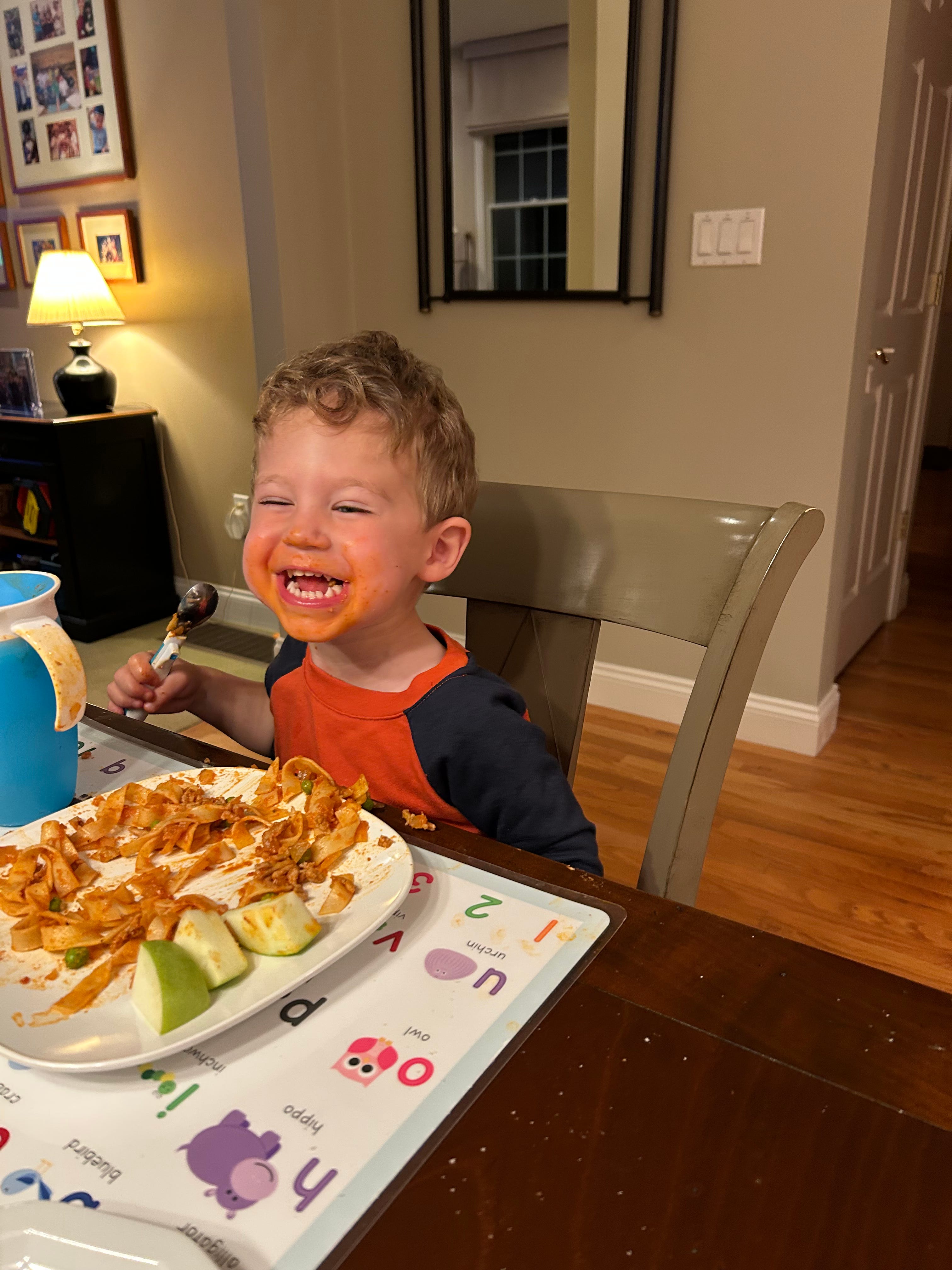
Here is something to make you smile: one of our little nachas machines, Cam, who really enjoyed my pasta dish!

The Jew News Review – October 18, 2025 – “On Survival, Healing, and the Quiet Heroism of Care”

Shabbat shalom!

And a huge tip of the kippah to the returning hostages and their families and friends! 

The images are impossible to forget. The faces of the living hostages stepping back onto Israeli soil, thin, pale, trembling, collapsing into the arms of parents and children who had long stopped believing in miracles. The pure joy, the tears, the sound of breath finally released after months of suffocation.

But joy has its shadow, and as Rachel Goldberg-Polin reminded those gathered in Hostage Square, “there’s a time to sob, and a time to dance, and we have to do both right now.” For every hostage who came home alive, there were others who returned in body bags, and others still who remain missing, their fate a living wound on the conscience of the world. Some may yet become pawns in a terrorist chess game that plays cruelty as strategy and human lives as pieces to be traded.

Among the returned are real heroes. There is Evyatar David, abducted from the Nova Music Festival and forced into starvation and dehumanizing captivity, including digging his own grave, who walked out after more than two years determined to live again. There is Rom Braslavski, who survived more than seven hundred days in captivity, starved and beaten, told he could eat if only he would renounce his faith and convert to Islam. His answer, recalled by his mother, was simple: “I am Jewish. I am strong. I will not break.” These stories of endurance, courage, and unimaginable grace remind us that survival itself can be an act of defiance and can breathe new life into the cliché of Israeli resilience.

Left: Rom Braslavski with family on his way in a helicopter to hospital. Right: Evyatar’s emotional reunion with family. 

But the story of heroism does not end with the hostages. It continues in the hospitals, the rehab centers, and the homes where healing has only just begun. There, a quieter kind of courage is at work, doctors tending to scars that medicine cannot measure, therapists helping captives relearn freedom, and families learning how to live again with what they have lost.

The late and great Rabbi Jonathan Sacks once said, “To heal a fractured world is not to do extraordinary things. It is to do ordinary things with extraordinary love.” 

Rabbi Sacks captured something I have been seeing up close over the last few brutal months. Friends and family I love are fighting illnesses that are moving faster than medicine, and I find myself watching the people around them, spouses, siblings, children, friends, who show up every day to lift, to listen, to hold. They may not be seeking miracles; they are performing them.

They are the quiet heroes, keeping a shattered world stitched together with small gestures: an Ensure shake, a gentle touch, a kiss on the forehead, nights of lost sleep offered to someone else’s comfort and care. These are the quiet acts of chesed, loving-kindness, that keep us grounded and human in an often inhuman world.

Maybe what Rabbi Sacks meant was that the work of repairing the world begins not in parliaments or churches or synagogues, but in hospital rooms and living rooms and kitchens. We all live in the fragile space between what we can change and what we must endure. Sometimes we cannot stop the illnesses that inevitably come our way, but we can choose how we show up for them. And in those moments, when someone wipes a brow, listens to a fear, or, as my rabbi told me, simply sits beside another human being in silence, the fractured world becomes, if only for a heartbeat, whole again.

So to the caregivers, the quiet heroes, including those I know and love, who keep vigil in the night and whisper comfort into the darkness: you are the proof that love, though powerless to cure, is still powerful enough to heal.

Brad out.

The Jew News Review – October 11, 2025 – “The Art of the Uneasy Peace”

Shabbat shalom.

Political junkie David Axelrod once quipped that he wasn’t sure if history had a sense of justice, but that it certainly had a sense of humor. I’m starting to think history also has the social skills of a drunk uncle at a bar mitzvah. So, despite the challenge to my gag reflex, a reluctant “tip of the kippah” to President Trump, the orange man-child who somehow took Biden’s mothballed peace framework, blew off the Gaza dust, and shoved it back onto center stage. Not through diplomacy or empathy, but through the only tools he’s ever trusted: a Rolodex full of autocrats, the subtlety of a leaf blower, and an ego that treats applause as oxygen. 

Oy, gag me with a spoon. 

Whatever his motivation might be, a Nobel, his incessant need to control the conversation, or simply stopping the killing, I think there’s a dark grace in all this. Sometimes history’s instruments are ugly. Sometimes the necessary work arrives wearing the wrong orange face. Maybe the Almighty’s sense of irony runs so deep She sent a peace deal through an orange man child who can achieve detente in the middle east but declares war on blue cities back home.

Then, as if on cue, the Nobel Committee handed this year’s Peace Prize to Maria Corina Machado, the Venezuelan opposition leader fighting her own quiet revolution for democracy. Trump’s dream of being crowned the world’s greatest dealmaker died in Oslo before the shrimp cocktail at Mar-a-Lago was even served. Somewhere between Palm Beach and Norway, an aide is probably drafting an executive order declaring the Nobel Committee a “woke globalist terror cell.”

But let’s not get too cute. Phase One of this twenty-one-point plan deserves genuine, unsarcastic gratitude. The hostages coming home isn’t a talking point; it’s a moral and emotional overhaul on shattered families and a national nightmare given back its first small measure of justice. It lifts a tremendous weight off the exhausted shoulders of the Israeli people. The reunions will be a blessing. The photos and videos precious. Celebrate them. No irony required. 

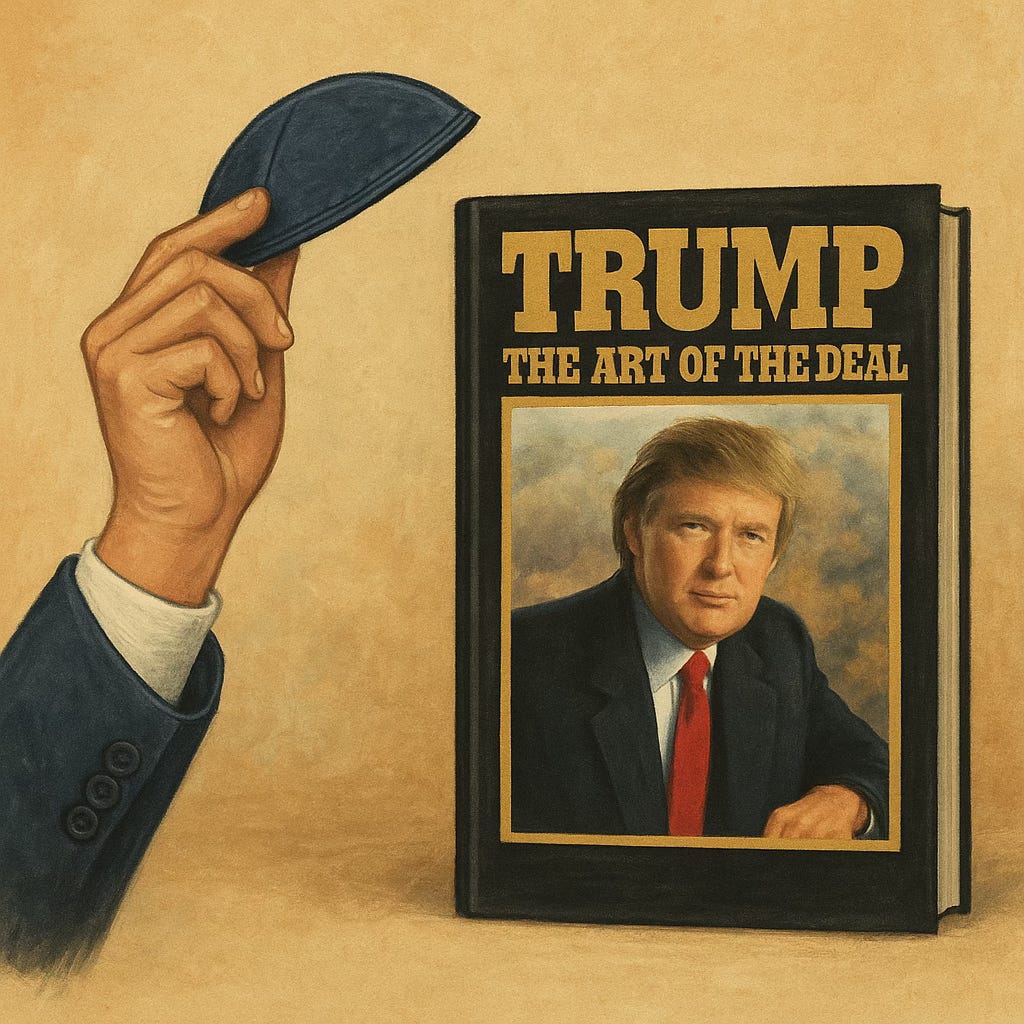
But let’s not pretend these concessions were given for free. Trump didn’t just lean on Qatar, Turkey, and Egypt with moral suasion. He dusted off The Art of the Deal and went full sequel. Qatar got a NATO-lite promise of American protection, Turkey got the return of its coveted F-35s and the quiet lifting of sanctions, and Egypt got what it has always wanted most: secure borders and a guarantee that the chaos of Gaza would not spill into Sinai. These were not magnanimous gestures. They were bribes disguised as diplomacy, The Art of the Deal translated into Arabic, Turkish, and bureaucratese. Trump doesn’t charm; he leverages. He doesn’t negotiate; he corners. And for once, that instinct may have served the cause of peace. It took Israeli military might along with Trump’s bullying to get this done, a combination that President Biden could never have delivered. 

Still, beneath the handshakes and the headlines lies a truth so obvious it hurts to say out loud: both sides are being asked to swallow poison. For Israel, it means watching some 250 convicted murderers and terrorists, the architects of massacres, the bomb-planters, the knife-wielders, walk out of their cells in exchange for hostages. The same men who shattered Israeli families will stroll into hero’s welcomes on the streets of Gaza and Nablus. It’s a nauseating calculus, but that’s what this peace required – a deal made with the unbearable.

And even as Hamas signs on the dotted line, Israel knows the organization’s playbook by heart: regroup, rearm, and repeat. A movement built on annihilation doesn’t become a governing partner overnight. It bides its time. It trains its next generation of “martyrs.” It waits for the world’s attention to drift. And when it does, the cycle begins again, another October 7, another pogrom, another reminder that evil doesn’t retire. Another such reminder took place just the other day in the streets of Gaza. When the ceasefire was announced, thousands poured into the rubble to celebrate what they believed was a Hamas victory. Amid the jubilation came an old chant: “Khaybar, Khaybar ya Yahud, jaish Muhammad sa-ya’ud!” — “Jews of Khaybar, Muhammad’s army will return.” The war may have paused, but the hatred hasn’t even broken a sweat.

The next generation of Palestinian leadership. At least they look well fed. 

And while Gaza commands the world’s sympathy, the next act of this uneasy peace will play out across Judea and Samaria, the West Bank, a patchwork of divided towns, armed factions, and fading authority. The Palestinian Authority (PA), bloated by corruption and discredited by years of impotence, is supposed to serve as the political scaffolding for the future Palestinian state envisioned in Phase Two of Trump’s plan. But it’s a scaffolding missing more than a few planks and half its bolts. Mahmoud Abbas governs little more than Ramallah, and even there, he’s about as popular as a traffic ticket.

The next phase demands that the PA prove it can govern without graft, pay teachers instead of militias and martyrs, and articulate a vision of self-rule that doesn’t hinge on Israel’s erasure. Meanwhile, Israel will be asked to loosen its grip on parts of Area C, the territory that is both strategically vital and spiritually loaded. That’s not likely to happen.

And here, in my humble opinion, lies the bleak truth: Phase Two contains irreconcilable differences that no amount of diplomacy can resolve. According to many experts, the ceasefire’s strategic trajectory points toward renewed conflict rather than sustainable peace. The agreement’s fundamental contradictions—Hamas disarming itself, governance transition challenges, Israeli withdrawal contingent on security that won’t exist, statehood aspirations incompatible with Israeli policy—represent a “bigly” risky bet that cannot be resolved through negotiation because they reflect genuinely irreconcilable positions. Hamas survives militarily degraded but still intact. Its ideology, that Israel’s destruction is both possible and required, remains unchanged. Its external leadership continues operating from Doha. Its military commander in Gaza survived. Its institutional infrastructure, though damaged, retains the capacity for rebuilding. 

More broadly and philosophically speaking, one side views the land as divinely promised, the other as divinely stolen. The borders aren’t just drawn on maps, they’re etched into scripture and identity. No summit, no joint communique, no “mutual recognition clause” can untangle that. At best, the world can broker pauses, moments of exhausted coexistence and hostage/prisoner swaps. But peace? Peace is a word that will always sound aspirational here, at least until Palestinians care more about loving their own children than killing Jews. 

So, no kenahoras, he artfully negotiated a deal to get the hostages back. But alas, the orange man child didn’t get his Nobel. He’s too busy calling Democrats “enemies of the state” on Truth Social, sending troops into blue cities, cutting aid and life saving vaccines to poor countries, and avoiding the Epstein files while brokering an uneasy peace in the Middle East. But if this bizarre cocktail of ego and grievance somehow drags us through a successful Phase Two, if his need for applause outlasts his need for vengeance, then I’ll do the unthinkable….

I’ll nominate him for the Nobel myself. 

Be careful out there and try to, with all due respects, control your gag reflexes.

Brad out.

The Jew News Review – Special Edition – October 7, 2025 – “The Test Within The Test”

(October 7, Two Years Later)

Two years after October 7, the test is no longer just for Israel’s survival, but for the soul of the Jewish people — whether we still stand together when the world looks away.

Two years ago this week, the gates of hell opened on a Saturday morning. It was the day after Simchat Torah, a day meant for dancing, and instead the music stopped and horror ensued. What began as a massacre became a test: not only of Israel’s defenses, but of the world’s conscience, and of Jewish faith itself.

Now, as we approach the second anniversary of October 7, there is a peace deal on the table. We all pray it succeeds. But prayer, as the families of the hostages know too well, is not a strategy. And hope is not a plan. Hamas has broken every ceasefire it has ever agreed to, and no one should doubt its willingness to use this one, if it happens, to inflict more psychological torment on the people it already brutalized.

Still, the greater test this year may not be on the battlefield. It may be that the greater test is in the hearts of Jews everywhere, Jews who are staring down unbearable questions about loyalty, justice, and identity.

For me, that test has been personal. I began The Jew News Review to rediscover and reclaim my own Jewish identity, a part of myself that had gone quiet. By sharing that journey here, I hoped to celebrate and pass forward that Jewish DNA to family, friends, readers, and future generations. That goal has not changed. But as the Gaza war grinds on, as Israel grows more isolated and Jews around the world face rising hostility, the questions have grown heavier: questions of faith, of morality, of spirit. On that test, I still believe in the righteousness of Israel’s cause, in the courage of our people, and in the unbreakable spirit that binds Israelis and Jews in every corner of the world.

For me, and probably for many of you, the second anniversary feels less like a commemoration than a reckoning. We are not just remembering what happened to us, rather, we are questioning who we have become since.

In synagogues, on campuses, and across family tables, I fear there is a quiet crisis of faith unfolding, not just in God but in Israel itself. Among Jews who grew up believing in tikkun olam, universal justice, and coexistence, the prolonged war and how Israel is conducting it, has strained that idealism to the breaking point. It is one thing to fight a just war; it is another to live in one that kills so many and refuses to end.

And yet, this is the moral hazard of the moment: that Jews, in the pursuit of moral comfort, will abandon Israel and the hostages during a war Israel did not ask for. That we will confuse compassion with complicity, and distance with dignity.

Because that’s what’s happening in real time. Too many mistake performative empathy for moral depth — as if mourning loudly for Palestinians while whispering about Hamas somehow makes one more humane. And too many believe that staying “neutral” or “balanced” in the face of barbarism preserves their dignity, when in fact it only preserves their comfort.

You can see it in Hollywood’s red-hand brigade, those actors who pinned on fake bloody hand pins at award shows to show how deeply they “care,” while remaining silent about the real blood spilled on October 7, or the hostages still enduring it every day. That kind of moral theater isn’t courage. It’s camouflage. A way to look righteous without risking anything real. Silence may look dignified from a safe distance, but it feels like betrayal to those still under fire.

But Israel cannot move on. Not from children burned alive. Not from women raped and paraded. Not from families still waiting for a knock at the door that could mean death or deliverance.

Even more disturbing, a recent Washington Post poll found that nearly 40 percent of American Jews believe Israel has committed “genocide” against Palestinians in Gaza. This is beyond absurd; it is obscene. Jews, of all people, should know better than to casually weaponize that word. To accuse the one Jewish state on Earth of genocide is not just ignorance, it is moral betrayal. To compare Israel’s fight for survival to the machinery of annihilation that murdered our grandparents is to desecrate memory itself.

The age of post-Holocaust sympathy has faded under the bright lights of mainstream media misinformation, social media algorithms feeding Hamas propaganda to the TikTok generation, and real atrocities being committed in Gaza. The world’s brief reverence for Jewish suffering has given way to its old reflexes – suspicion, resentment, and moral inversion. The Jewish People are once again being tested, not by whether we can assimilate, but by whether we can withstand.

As Dara Horn wrote in The World Loves Dead Jews, the world has always found comfort in Jewish tragedy but discomfort in Jewish survival. It applauds our suffering but resents our strength. It builds memorials to our ashes but condemns our defenses. October 7 reminded us that Jewish power is not a moral flaw. It is a moral necessity. Because the lesson of our history, from Egypt to Europe to Sderot, is that Jewish survival has never depended on the world’s approval.

The war in Gaza has made one truth unavoidable: the Jewish story has never been about comfort. It has always been about courage. It’s about showing up for one another when the world turns away. That is the test within the test. Not whether Israel will survive, but whether we, scattered and weary as we are, will remember who we are and why we endure.

To be Jewish after October 7 is to hold fast to faith even when faith feels impossible. It is to long for and weep for peace and still stand for justice. It is to know that the world may never love us for surviving, but to survive anyway.

Stay safe out there everyone.

Brad out.