This week on The Jew News Review, we take a break from doomscrolling anti-Israel op-eds and reanimated Nazi rhetoric on Instagram to honor a real milestone: the 50th anniversary of Jaws, the movie that made Americans terrified of swimming and turned a 27-year-old Jewish kid from Cincinnati into the king of Hollywood.
Yes, JNR readers, Jaws is having a birthday. And like all great Jewish birthdays, it involves a lot of people screaming, a poorly understood monster, and no one listening to the guy who actually knows what’s going on.
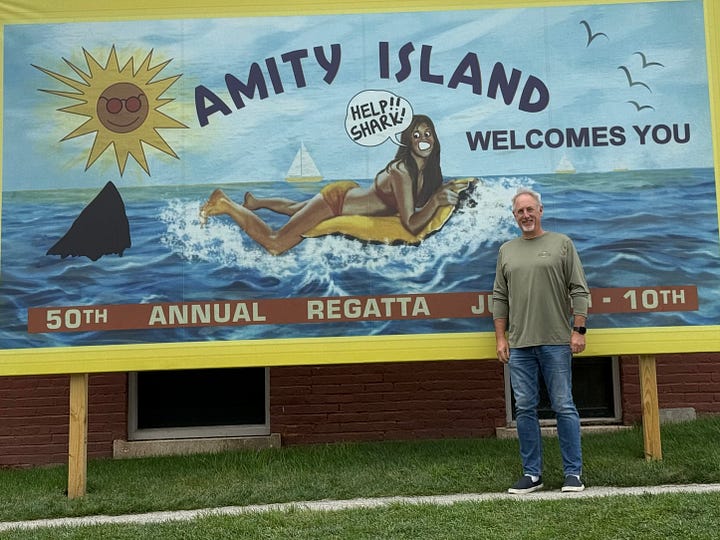
We are on Martha’s Vineyard for the weekend, attending the Island’s bi-annual Book Festival, taking place in the “up island” tented woke-sphere of Chilmark, MA. We arrived early Friday, so we had time to do a quick visit to the Martha’s Vineyard Museum where an exhibit of Jaws, the summer blockbuster filmed on the island 50 years ago, was pulling in crowds of all ages interested in learning a bit of folk lore around the movie and, like myself, wanting a few good goofy tourist pictures.
Let’s explore, just for giggles, the Jewish roots of Jaws, and why, half a century later, it still might resonate with the broader Jewish community.
Start with the obvious: Steven Spielberg, director of Jaws, is a card-carrying MOT (Member of the Tribe). Born to an Orthodox Jewish family in Ohio, Spielberg spent much of his early life feeling like an outsider — bullied and marginalized.
He famously said that as a kid, “being a Jew meant that I was different.” And what does the young 27 year old Spielberg do with that alienation? He gives us Jaws: a film where the protagonist is the outsider no one listens to, the monster is an unstoppable force of destruction, and the local authorities are in full “please stop making trouble” mode.
Let’s take a quick look at the three main characters: Sheriff Brody is the outsider. He sees the threat clearly and tries to warn everyone, but the locals shut him down because he’s ruining the vibe. Hooper, played by Richard Dreyfuss (another MOT), is the nerdy marine biologist who actually knows what a great white can do—but gets dismissed as hysterical. He’s too smart for the room, too nasal for the mayor, and too Jewish to be listened to. Then there’s Quint. Rough. Scarred. A little unhinged. He’s the muscle. You could say he’s the retired IDF general of the bunch, traumatized by war and willing to do the dirty work no one else wants to.
By the end, these three archetypes—the diaspora Jew, the intellectual Jew, and the warrior Jew—team up to kill the shark. I’m not saying it’s a Zionist allegory. But if the shark had launched rockets from a tunnel under a kids beach volleyball court, it wouldn’t be off-script.
Later in his career, Spielberg stopped hiding the Jewish themes. Schindler’s List. Munich. The Fabelmans. But Jaws was his first sermon in disguise. A parable for the Jewish experience in America: be smart, be strong, be ready, and don’t expect anyone else to save you. Because Jaws isn’t about vampires, ghosts, or zombies. It’s about the unseen thing beneath the surface. It’s about worry. About what might be out there. It’s the movie version of your mother saying, “Don’t go too far, you don’t know what’s in the water.” That’s Jewish horror: a creeping sense of dread backed by very good reasons. And the town only listens when the blood is on the surface. That’s the lesson. That’s the warning.
So, as you head to the beach this weekend, reapply sunscreen for the fifth time, and decide against going in the water more than waist-deep, take a moment to raise your oat milk latte to Steven Spielberg: the nice Jewish boy who taught America that the scariest thing in the world is what you don’t see. And sure, the shark may have terrified America, but it was Spielberg, a Jewish kid with a busted prop and a vision bigger than the ocean, who made it swim.
France has given the world so much to admire. The Enlightenment. Impressionism. The croissant. Existentialism, cinema, Sartre. And diplomacy itself, la diplomatie, not just in practice but in vocabulary. From détente to rapprochement, from chargé d’affairesto coup d’état, France has authored the lexicon of conflict resolution and international civility. It’s no accident that diplomats once trained in French and conducted negotiations in the language of Voltaire. Even the word “protocol” traces its roots to the French bureaucratic tradition.
And so it’s with no small irony, no grande ironie, if you will, that the nation that gave us the language of diplomacy has chosen this moment to obliterate its meaning.
In September, when the UN convenes to vote on Palestinian statehood, France’s Macron has stated that it will vote yes. That’s not just a vote for statehood. That’s a vote to canonize mass murder. That’s a vote to reward Hamas with legitimacy for the butchery of Israeli civilians on October 7. It’s as if France took a long, hard look at the blood-soaked massacre of Jews, the beheadings, the burnings, the hostage-taking, and concluded: oui, ça mérite un drapeau.
So let’s drop the facade of entente cordiale and respond in the only diplomatic French phrase America ever truly perfected:
“Fuck you, France.”
Let’s say this plainly: France, and any liberal democracy following in its misguided footsteps (I’m thinking of you Canada, Norway, Spain and Ireland), is preparing to validate a statehood bid born not out of diplomacy, peace-building, or governance, but from the ashes of pogroms live-streamed in HD. We’re not talking about recognition of some theoretical democratic Palestine from the Oslo Accords era, with handshakes on the White House lawn and Nobel Peace Prize photo-ops. We’re talking about now, post-October 7, when Hamas terrorists filmed themselves laughing while executing children and abducting grandmothers. That is what France is legitimizing.
And here’s where the French vocabulary fails entirely. Because there is no savoir-fairein Hamas leadership, no grande stratégie in launching rockets from schoolyards, and certainly no haute diplomatie in using raped hostages as bargaining chips. This isn’t a state-in-waiting. It’s a death cult with a press office.
Of course, the pro-recognition crowd will tell you this is about “hope” for the Palestinian people. And yes, Palestinians deserve hope, and dignity, and freedom from both occupation and the jackboot of Hamas. But giving them a state run by Hamas or even under the shadow of its terror apparatus isn’t hope, it’s abandoning them to another generation of ruin. It’s feeding a broken system with global legitimacy. It’s giving the keys to the asylum to the arsonists inside.
And don’t fall for the diplomatic sleight of hand. France will insist that it supports a two-state solution, but only one state, Israel, is ever asked to make sacrifices. Only one state is expected to bury its dead and then get over it. Only one state is scrutinized for its self-defense, while the other side can massacre civilians and be greeted with standing ovations in university lecture halls.
Let’s be clear about the historical narrative this vote could cement: If October 7 becomes the first chapter in the founding story of the Palestinian state, then the message to the world’s terrorists is simple: kill Jews, get land. Hostage-taking becomes a tactic of statecraft. Pogroms become policy. And liberal democracies, those paragons of moral superiority, become the enablers.
If France votes “yes,” it won’t just be voting to recognize Palestine. It will be voting to normalize Hamas. To elevate them. To institutionalize their ideology. It will be drawing a straight line from the ashes of Nir Oz to the flags at the UN Plaza.
History is watching. And if it records that the first sovereign act of the Palestinian state was the murder of 1,200 Jews, then this isn’t diplomacy. It’s complicity.
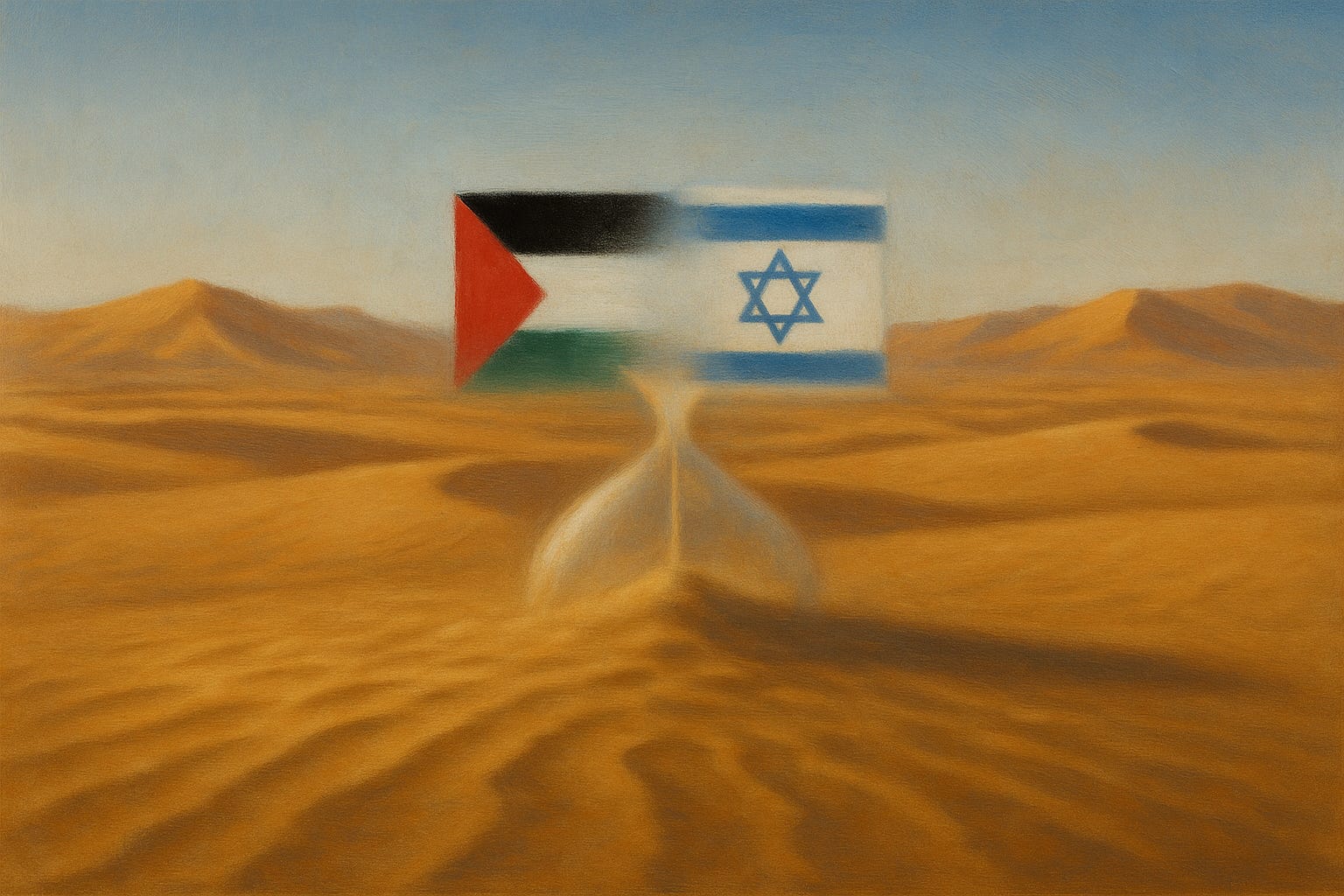
And yet, I still believe in peace. And I still believe, naively, stubbornly, optimistically, that a two-state solution is possible. But not this one. Not one born in blood and barbed wire, not one midwifed by Hamas and cheered on by the morally disoriented in Paris. A Palestinian state should arise from negotiations, not nightmares; from co-existence, not carnage. Until then, France and the UN aren’t building a future, they’re desecrating a grave.
So it will fall to the United States, who, despite being led by an orange man child, is still the adult in the room with the veto power to stop this grotesque performance. If it chooses, it can kill this diplomatic farce before it becomes precedent. If it chooses, it can stand up for the idea that Jewish lives are not a bargaining chip. The orange man child, who moved the embassy to Jerusalem, now has a choice: veto a Palestinian state born of massacre… or go down in history as the schmuck who gave Hamas a seat next to Luxembourg.
I bristle whenever I write this, but I will be rooting for the orange man child to make the right decision.
In the aftermath of October 7, the world shifted—and yet, some cling to expired solutions. Chief among them is the so‑called “two‑state solution,” a diplomatic zombie at best, a strategic liability at worst. Once heralded as Israel’s only hope for peace, today it is not just obsolete but dangerous: counter‑productive, out of step with regional realpolitik, and likely to cost Israel its chance to reshape the Middle East through strength and practical alliances.
Is the two state solution merely a mirage?
That said, call me crazy, (I’m sure my Israeli friends certainly will) let me admit something clearly and personally: I still believe in a two-state solution. Not because it’s remotely viable right now, but because I’m an optimist—a Middle East realist who sees the glass as half full. I believe that, eventually, Israelis and Palestinians will share this land with dignity and some degree of self-determination. But getting there requires sober recognition of where we are today—and today, the two-state slogan is a mirage. Repeating it now doesn’t advance peace. It distracts from the very real opportunities Israel has in front of it—and the crises it must confront.
Let’s start with the fire that’s burning hottest. The humanitarian catastrophe unfolding in Gaza isn’t just tragic—it’s strategically disastrous. Images of starving children, aid trucks under siege, and “walking corpses” haunt the front pages of much of the media, from The Guardian to The New York Times to CNN to The Times of India. UN officials, not very credible, describe the Strip as a famine zone. Air drops are now replacing convoys. The world’s sympathy and support, once squarely (if momentarily) with Israel after Hamas’s butchery, is evaporating with every headline and grim picture.
The plan to replace UNRWA with the newly envisioned Gaza Humanitarian Foundation was sound in principle. I was an early advocate. UNRWA had become politicized, compromised, and in some cases infiltrated. But the execution of this transition has been catastrophic. Aid isn’t reaching the people who need it. Infrastructure for distribution has collapsed. Chaos rules.
Is that Israel’s fault? Hamas’s fault? Both? Possibly neither?
The honest answer is: we don’t know—because we don’t have independent journalists working freely inside Gaza. Until we do, truth itself remains hostage, buried beneath spin, propaganda, and wartime censorship. This isn’t just a humanitarian concern—it’s a narrative vacuum that the world is rushing to fill, and Israel has pretty much already lost the narrative, if it ever had it.
Meanwhile, something extraordinary has taken shape beneath the horror, the headlines and the fog of war. Since October 7, Israel has racked up strategic victories on nearly every front:
Hamas’s military capability has been shattered, its tunnels exposed and command structure decimated.
Hezbollah is bleeding, having suffered direct and sustained Israeli strikes with impunity.
Iran’s proxy network is fractured, its assets in Syria repeatedly neutralized.
And perhaps most importantly, Israel has retained and even expanded security cooperation with key Arab states.
This is not an accident—it is the dividend of deterrence. The Abraham Accords weren’t an outlier; they were a signal that parts of the Arab world were ready to move on from performative anti-Zionism in favor of economic and security partnerships. Egypt, Jordan, the UAE, Bahrain, Morocco—and yes, even Saudi Arabia—see Iran (and now Turkey, too) as the real threat, and view Israel as a partner, not a pariah.
And yet, as the humanitarian situation in Gaza collapses, Israel’s moral and diplomatic standing is eroding, threatening to undermine this rare window for regional realignment.
A sovereign Palestinian state—peaceful, democratic, and demilitarized—remains, in theory, the best-case scenario. But let’s not pretend it’s just around the corner. There is no partner. Hamas is genocidal. Fatah is feckless. And the younger generation in Gaza has been radicalized by hopelessness, not trained for governance. It will take a generation or two, and consistent de-radicalization, to move the peace train forward.
In the short term, peace will not come from partition. It will come from leverage, alliances, and hard-headed realism. Israel should double down on regional normalization. Push for an Arab custodianship model in Gaza for an initial period of time. Prioritize economic development and security cooperation. Lead on humanitarian access—not just because it’s right, but because power without moral leadership breeds isolation.
This is the moment to play the long game—with vision and with strength. This is no time for wishful thinking. The dream of two states must remain a long-term goal. But in the here and now, Israel must lead wisely, act humanely, and speak clearly. The region is shifting. The world is watching. The double standard for Israel has only gotten worse and anti-semitism and anti-zionism is cranking up all around the globe. If Israel fails to match its military power with moral vision, it will miss the chance to transform not just the map—but the future.
Bibi, bubala, the glass is half full. Let’s not spill it.
Let’s be careful out there everyone, and enjoy the weekend!
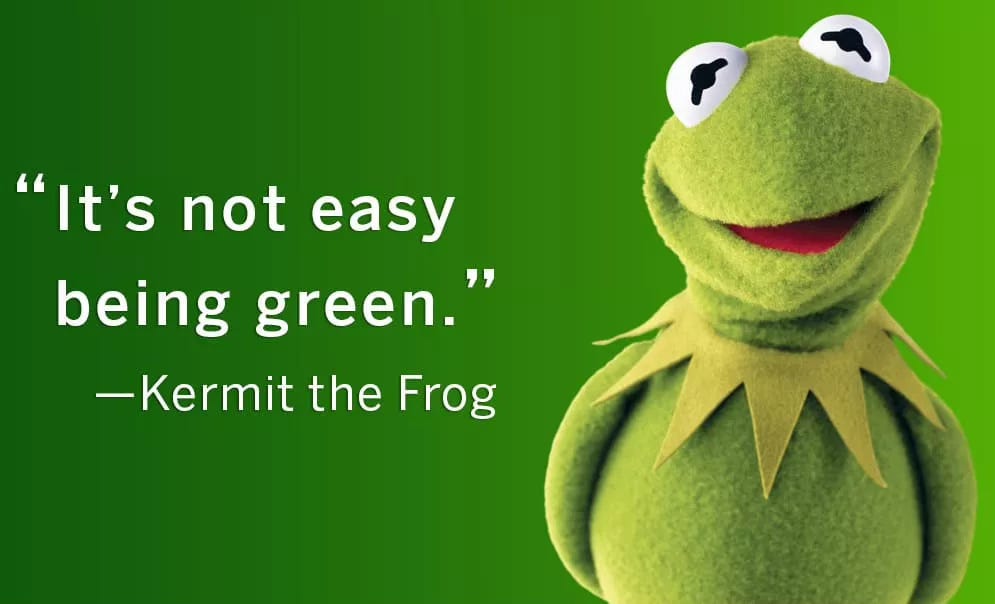
While the orange man continues his efforts to cancel Sesame Street, I thought it would be fitting to dedicate the theme of this post to one of my favorite Sesame characters, Kermit the Frog.
Thanks for reading The Jew News Review! Subscribe for free to receive new posts and support my work.
Kermit first sang those words in 1970, his felt forehead creased with existential gloom. It was a melancholy little number about feeling invisible, overlooked, burdened by a difference no one seemed to value. Green, he sang, “blends in with so many other ordinary things.” But deep down, the song wasn’t about blending in. It was about being othered—about learning, eventually, to be proud of what sets you apart, even when the world makes you pay for it.
Over half a century later, Kermit’s lament has taken on new meaning. For diaspora Jews in 2025, it’s no longer just a Sesame Street singalong—it’s a mood, a metaphor, a whole damn vibe. Because right now, we are living through a moment where the pressure to shrink, to apologize, to blend in has never been more intense. In the span of one week, The New York Times delivered a trifecta of cultural whiplash: first, a scathing long-form essay accusing Prime Minister Benjamin Netanyahu of prolonging the war in Gaza to serve his own political survival; second, an op-ed by Israeli-American historian Omer Bartov, accusing Israel of becoming a “Jewish supremacist” state, one that, in his words, has “come to resemble some of the darkest regimes of the 20th century”; and third, a viral interview on The Daily with actor Mandy Patinkin, who compared Israel’s war in Gaza to his Princess Bride character’s revenge fantasy, and asked: “How could it be done to you and your ancestors, and you turn around and do it to someone else?”
Three different men. One Ivy Tower. One Hollywood/Broadway. One Balfour Street. But the same message: Jewish suffering is real, but Jewish defense is suspect—and Jewish power, even when wielded in the name of survival, is now suspect, too. Bibi Netanyahu’s alleged manipulation of war timelines to preserve his own political power doesn’t just erode trust in Israel’s leadership—it hands ammunition to those already eager to portray the Jewish state as morally bankrupt. They beg the question: “October 7th may have been brutal, but haven’t we become the monsters we once fled?”
In the context of daily reports of civilian casualties, of Palestinians killed while sitting in Church or waiting in line for food or water, the question is getting more and more difficult for Jews to answer. The unbearable weight of October 7 and the ongoing hostage crisis has seared itself into the national psyche. But alongside that trauma, Israel is also absorbing a growing blow to its moral standing in the eyes of the world, as the conduct of the war draws increasing scrutiny. The tension between those two burdens—grief and global judgment—is taking a quiet, corrosive toll on the country’s spiritual well-being.
This is the climate we’re in. This is the soil from which our children and grandchildren are trying to grow Jewishly. And it’s why this week, Kermit’s lament hits harder and different. Because it’s not easy being green. Not when “green” now means Jewish. And not when the very people who once embraced our story are now telling us—firmly, gently, heartbreakingly—to shut up, sit down, and stop being so damn visible.
This is a story about that tension. About how it feels to be a diaspora Jew in a world that has turned on us with shocking speed—and about how, despite it all, we’re still here. Still green. Still growing.
There was a time—not long ago—when diaspora Jews could pretend we had blended in. We became valedictorians, senators, Oscar winners, Supreme Court justices, and stand-up comedians. We put our Hebrew school diplomas in drawers and our mezuzahs up quietly. We changed our names from Goldstein to Greene (oy, the irony) and thought the tide of assimilation would keep the pitchforks at bay. We voted blue, donated to the ACLU, and joined the DEI committees, because we believed in a pluralistic promise: if we fight for everyone else, surely someone will fight for us. We’ve spent decades embedding ourselves in liberal movements, often at great personal and communal cost, hoping to be seen as allies. But when the time came to cash in that moral equity, what did we find? A bounced check.
We marched for Black lives. We stood for LGBTQ rights. We fought Islamophobia and cheered for refugees. But when Jews were slaughtered, raped, burned alive in October 2023, those same movements didn’t just ignore us—they gaslit us. They explained our grief away. They posted infographics about “context” and “power dynamics.” They told us our dead children were political abstractions.
So yes, Kermit, it is really not easy being green. And yes—we are green. Green with rage that the very spaces Jews helped build are now turning us away at the gate.
In publishing, Jewish editors and agents whisper privately that they can no longer advocate openly for Jewish stories—especially ones that don’t paint Israel as the villain. Book proposals from Jews who refuse to denounce Zionism are suddenly “not the right fit.” Award-winning Jewish authors are disinvited from festivals for refusing to issue statements against Israeli “apartheid.” We’ve watched book lists celebrating diversity suddenly find Judaism too complicated, too controversial, too white-adjacent to qualify.
The arts? You mean the industry built by Jews? Where half the great American songbook was written by men named Gershwin and Berlin, where Jewish comics invented late night, where Jewish producers invented Hollywood? That arts world?
That world has decided we’re expendable.
Ask the Jewish playwrights and screenwriters who can’t get their scripts read unless they come prepackaged with a paragraph explaining how they “stand against genocide.” Ask the actors dropped by agents or silenced by PR firms for posting Israeli flags. Ask the gallery owners being boycotted for exhibiting Jewish artists, or the dancers forced to defend their birthright trips like they’re war crimes.
And ask us what it feels like to watch Mandy Patinkin—Inigo Montoya himself, Saul Berenson, the man who carried Yiddishkeit into American living rooms—take to The New York Times Daily to call Israel’s Gaza campaign “unconscionable. There was no mention of Hamas’s October 7th massacre. No political analysis—just the quiet accusation that the Jewish state, in defending itself, has violated its moral soul. For many diaspora Jews, it was like watching a hero unplug from the narrative—like a band’s frontman trashing the stage mid‑concert. You feel abandoned. And it validates the grief many of us have been carrying for months.
Because when even Mandy’s voice joins the chorus questioning the morality of our survival, you know something’s broken. Jews are being made to walk through ideological metal detectors. And the only way through is to disavow your people.
What’s most enraging is that this exclusion is happening not in spite of our contributions, but because of them. Jews helped build these spaces. We helped build the publishing houses, the universities, the studios, the concert halls. We built them because we believed in a shared cultural inheritance—a belief in ideas, in beauty, in books and learning, in progress. And now we are told that our presence is oppressive. That our history is a burden. That our success is a form of theft.
We are not asking for special treatment. We are demanding what everyone else gets: the right to show up fully—visibly, Jewishly, green as hell—and not be punished for it.
But instead, we’re being told that unless we denounce Zionism, unless we disclaim our people, unless we disavow the only Jewish state on Earth, we cannot participate. That is not activism. That is ideological blackmail. We are being cancelled, if that’s still a thing.
So yes. We are green with rage.
And yet, even in this scorched earth moment, we are seeing something remarkable: growth. Green shoots, poking up even through the Gaza rubble and the cracks in the sidewalks of the diaspora world. Sprouts of solidarity, courage, and unapologetic Jewish pride.
Jewish students are forming new campus coalitions like New Zionist Congress and Jews on Campus to push back against the tide. At Brandeis University, the administration banned Students for Justice in Palestine, drawing a moral line others were too scared to draw.
Digital creators like Julia Jassey, Miriam Anzovin, and Noa Tishby are using TikTok and Instagram to reach millions with a message of Jewish resilience, history, and unfiltered truth. On stages around the world, Israeli artists are refusing to self-cancel. Internationally known acts like Matisyahu have returned to the spotlight with renewed urgency, performing openly Jewish and Zionist anthems in defiance of boycott pressure. At the Eurovision Song Contest, Eden Golan stood tall while crowds outside chanted for her country’s death. She sang anyway.
The Combat Antisemitism Movement, StandWithUs, The Jewish Leadership Project, and #EndJewHatred are fighting on the legal, educational, and civil rights fronts. Meanwhile, The Free Press and Sapir Journal are telling the stories mainstream media refuses to publish.
Green isn’t just the color of envy or rage. It’s the color of resistance. Of renewal. Of Jewish stubbornness in the face of exile and erasure. And we’re not done growing. We are learning, again, what our grandparents knew: we cannot outsource our dignity. We cannot subcontract our safety. And we certainly cannot beg for our humanity from people who only extend it when it’s politically convenient.
But what we can do—what we’ve always done—is build. Build new spaces. New coalitions. New culture. New stories. And when the old structures collapse under the weight of their hypocrisy, we will still be standing. Green. Glorious. Unapologetically alive.
If you want us to be silent, you picked the wrong people. And if you thought this moment would make us fade into assimilation or step out of the spotlight? You obviously haven’t met our mothers and grand mothers.
And maybe here’s the twist Kermit never saw coming: maybe green doesn’t need to blend in. Maybe green should stand out. Maybe it should flash like an emergency beacon—a color that demands attention, that says “We are here, we are proud, and we are not going anywhere.”
Maybe being green is the whole point.
So this weekend, as you sip your oat milk latte while reading the JNR and consider whether to wear your Star of David necklace outside your shirt, remember Kermit’s second verse—the one we forget. He realizes, eventually, that green is beautiful. “It’s beautiful,” he sings, “and I think it’s what I want to be.”
Yes. It’s not easy being green. And yes, it aint easy being Jewish these darkened days. But it’s still worth it.
And I think it’s what I want to be.
Be safe out there everyone. And have a great weekend!
Let’s travel in the wayback machine to London, circa 1967. It’s just before the curtain rises on Fiddler on the Roof at a London theater, when Chaim Topol—Israel’s iconic Tevye—steps out before the audience. War had broken out back home. The Jewish state, surrounded by Arab armies vowing its destruction, was under existential threat. Topol announces he is leaving the production to join his fellow citizens in defense of Israel. The audience leaps to its feet in wild, thunderous applause. Not a slow clap of moral confusion. Not a begrudging acknowledgment that “it’s complicated.” No, this is real, heartfelt and sincere. They understand that this is a moment of moral clarity. The Jews had learned, finally, how to fight back.
Thanks for reading The Jew News Review! Subscribe for free to receive new posts and support my work.
Flash forward to June 2025’s Glastonbury Festival. Same island, different universe. Bob Vylan, a self-styled punk duo with more slogans than melodies, leads a crowd of well-fed, fashionably radical British festivalgoers in a chant: “Death to the IDF! Death to the IDF!” The crowd roars and chants along with them in approval—ecstatic, righteous, dripping with the performative adrenaline of a revolutionary LARP. It’s Woodstock for antisemites in bucket hats.
What the hell happened? As David Byrne of the Talking Heads once asked, “This is not my beautiful house…..How did we get here”?
It’s tempting to mark 1973’s Yom Kippur War as one of the inflection points in Israel’s historic fall from public grace . But while the trauma of that war certainly helped reshape Israeli politics internally, it didn’t flip the world’s moral compass just yet. Israel was still seen as a democracy fighting for its life. Sympathy remained strong, and U.S. support deepened. My generation was still happy to donate money to plant trees in Israel and help turn the desert green.
By the 1980s, anti-Zionism had found a cozy home on the left. Once the province of neo-Nazis and Soviet propagandists, it was now stylish among campus radicals and armchair revolutionaries. The Palestinian cause became a kind of moral coat rack—everyone could hang their politics on it. Marxists, Islamists, anarchists, even Christian pacifists. Palestine became a litmus test for leftist virtue. And Israel? It became a dirty word. Even worse, “Zionist” became a slur. The fact that nearly half the world’s Jews live in Israel? Minor detail. The fact that Zionism is the Jewish movement for national liberation? Too inconvenient.
But according to some historians, the real pivot came in 1982, when Israel invaded Lebanon in response to PLO attacks. What started as a defensive maneuver spiraled into a grinding war. Then came the Sabra and Shatila massacre, committed by Phalangist allies but blamed on Israeli complicity. The moral high ground—held tightly since the Holocaust—began to erode.
By 1987, the First Intifada made matters worse. Palestinian children throwing stones were televised daily, and suddenly Israel—the survivor state—was cast as the overarmed occupier. “Occupation” became the dominant narrative, amplified through Western media and the budding academic left.
By the time we hit the early 2000s, Israel was being accused of apartheid by people who couldn’t find the Negev Desert on a map. In 2001, the Durban Conferenceformalized the shift. What was supposed to be a UN anti-racism conference devolved into a Jew-hating echo chamber where “Zionism equals apartheid” became institutional orthodoxy. Then came BDS, social media, viral misinformation, and the seamless fusion of anti-Zionism with every woke buzzword from the DEI handbook.
Let’s not forget the summer of 2006. Israel was dragged into a war with Hezbollah—a genocidal, Iranian-backed terror group camped out in southern Lebanon and using civilians as shields. Western media coverage? A steady drumbeat of “both sides-ism” journalism, creating a moral equivalence between a sovereign democracy and a terrorist army whose stated goal is to eliminate that democracy. Dead Lebanese civilians were front-page news. Dead Israelis were usually buried on page ten—if mentioned at all. The BBC, now a bastion of Israel bashing, called it a “conflict” with “complex causes.” As if complexity is a substitute for judgment.
In 2014, during yet another round of Hamas-triggered violence, the shift in public discourse became fully digitized. Twitter, Facebook, Instagram—each became a firehose of misinformation, out-of-context photos, and viral lies. Images of Syrian casualties were passed off as “Israeli war crimes.” Protests erupted in cities from Paris to Toronto. Synagogues were vandalized. Jews beaten in the street. All because Israel dared to respond to rockets being launched from schoolyards and hospitals.
We reached the point where the existence of Jewish grief—real grief—was seen as a threat to the dominant narrative. In 2023, when Hamas carried out the most horrific massacre of Jews since the Holocaust, killing over 1,200 civilians in southern Israel, the sympathy window lasted about 48 hours. Then came the “context.” Then came the equivocation. Then came the “yes, but occupation.” As if babies burned in safe rooms somehow bore responsibility for geopolitics.
And now we have Glastonbury 2025. Bob Vylan, a duo of self-proclaimed “Black anarchists,” gleefully chanting for the death of Jewish soldiers—many of whom are barely old enough to drink. Many of whom are women, minorities, and refugees. The crowd? Cheering like it’s a soccer match. It’s a farce, but it’s also a funeral for the moral compass of the West.
The IDF—the army that sends texts and leaflets before strikes, that operates field hospitals for its enemies, that routinely risks its own soldiers to avoid civilian deaths—is branded the world’s evil. Meanwhile, terrorist groups that behead civilians and hide behind children are seen as “resistance.” This isn’t just moral confusion. It’s inversion. It’s perversion.
The Nut-and-Yahoo Factor
But you can’t trace the decline of Israel’s global image without stopping at Benjamin Netanyahu’s office door.
Just like our orange man, his name alone is enough to turn Thanksgiving tables into war zones. For his supporters, he’s the Churchill of the Middle East, a bulldog standing between Western civilization and theocratic obliteration. For his critics, he’s a right-wing populist who turned Israel from a moral cause into a partisan wedge—domestically divisive and internationally radioactive.
In 1967, Israel’s leaders were secular, socialist war heroes. Think Ariel Sharon and Moshe Dayan—men of gravelly voices and gravitas, not Twitter feeds and think tank talking points. They weren’t saints, but they spoke the language of sacrifice, shared burden, and national unity. Fast forward to the Bibi era—Netanyahu’s reign began in the late ’90s, then came roaring back in the 2000s, eventually metastasizing into the longest-serving prime ministership in Israeli history.
Under Bibi, the tone changed. He didn’t invent Israeli nationalism, but he branded it—with American-style fear-mongering, evangelical alliances, and Fox News finesse. He turned Israel into a partisan football in the U.S., aligning it closely with the Republican right and alienating generations of liberal American Jews in the process. He embraced far-right coalition partners, flirted with judicial dismantling, and governed through crisis as if crisis were the point.
To many in the West—especially young progressives raised on Occupy Wall Street and Black Lives Matter—Netanyahu became the face of Israeli militarism. They didn’t see a Holocaust survivor state trying to survive in a hostile region. They saw Bibi grinning at Trump in the White House, shaking hands with Viktor Orbán, and enabling settler violence in the West Bank. They saw Gaza airstrikes but ignored the rockets. They saw occupation, not terrorism. Netanyahu became a symbol—one that obscured far more than it revealed.
But here’s the problem: symbols are sticky. Once Netanyahu became the avatar of Israel abroad, everything Israel did—every justified strike, every real security need—was viewed through the lens of Bibi. If he did it, it must be cynical. If he supported it, it must be immoral. Even October 7—when Hamas butchered babies and livestreamed it—some corners of the left framed it as “blowback” to Netanyahu’s policies. As if 1,200 dead civilians were just a political reaction, not a genocidal ideology.
And yet—Netanyahu, the nationalist king, now finds himself loathed by many in his own country. After October 7, hundreds of thousands of Israelis protested his leadership. Veterans, reservists, centrists, even former Likud voters demanded accountability. It turns out that governing like a permanent campaign has consequences. You can’t tweet your way out of dead hostages and collapsed deterrence.
So when Bob Vylan took the stage in 2025 and led a crowd of thousands in a chant for the death of Israeli soldiers, it didn’t come from nowhere. It came after four decades of unspooling support, a media landscape addicted to binary heroes and villains, algorithms primed to promote pulling dead Palestinian babies out of rubble, the mainstream media propagandizing Hamas bullshit, years of Bibi’s arrogant leadership, and a generation taught that Israel is the final frontier of colonialism.
The IDF—an army that includes women, Muslims, Druze, Ethiopian Jews, and LGBTQ officers—is flattened into a caricature. Terrorist groups that literally behead civilians are hailed as “resistance.” The moral calculus is not just broken, it’s turned upside down and inside out. The more complex the truth becomes, the more aggressively the world seeks a simple lie.
But there is hope.
Despite the noise, a countercurrent is building.
Jewish students, long afraid to say the word “Zionist” out loud, are reclaiming it. Diaspora communities are waking up—not just to antisemitism on the right, but to its new, younger, trendier form on the left. They’re organizing, documenting, posting. They are saying: We are not your trope. We are not your villain. We will not disappear so you can feel morally pure.
Netanyahu, once the master of survival politics, now looks like a man out of time. And in that vacuum, something is stirring. A new generation of leaders—tired of the theatrics, hungry for unity—is emerging from the wreckage. If they succeed, they may do more than repair Israeli democracy. They may begin to restore its moral standing on the world stage.
And there are some silver linings: The same social media networks that spread lies can also spread truth. Survivors of the October 7 massacre have posted firsthand videos and testimonies that are beginning to break through the noise. Young Jews around the world—especially in the diaspora—are rediscovering their voice, their history, their identity. They are no longer content to blend into the progressive blob. They are saying, out loud and with pride: We are Zionists. Deal with it.
In places like Berlin, Paris, New York, and even London, Jews are organizing. Not to apologize. Not to explain. But to stand. And to sing. And to fight. Not with bombs or slogans, but with stories. With art. With memory. With a joy that infuriates the ideologues. They are returning to something ancient. Not just the right to self-defense, but the right to self-respect.
Topol went off to fight for Israel in 1967 and got a standing ovation. Today, a Jewish soldier does the same and gets doxxed on Instagram. But maybe the arc doesn’t just bend toward justice. Maybe it bends toward clarity—eventually. Maybe this new generation of Jews, forged in the fire of October 7 and the betrayal of Glastonbury and a thousand other Glastonburys, will find their way back to center stage. Not to beg for applause. But to demand a hearing.
And if you can’t give us that, we’ll still be here—like Tevye, fiddling on the roof of a world that’s always one pogrom away from collapse, but still managing to play something beautiful.
That’s all for the week. Have a great weekend everyone!
Brad out.
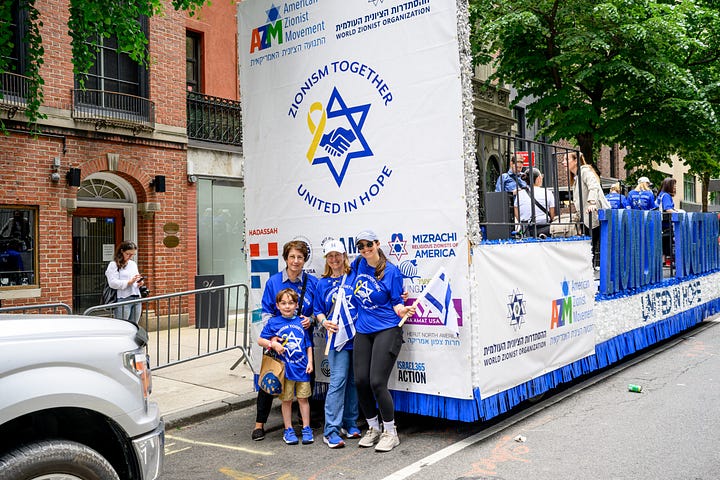
Times Square pulsed with energy on a recent Saturday night as 7,000 Jewish teens from 60 countries transformed it into a powerful display of faith, resilience, and unity.The annual Israel on Fifth Parade took place on Sunday, May 18, 2025, celebrating unity, resilience, and Jewish pride.
Thanks for reading The Jew News Review! Subscribe for free to receive new posts and support my work.
This is a short post this week since we are traveling with family.
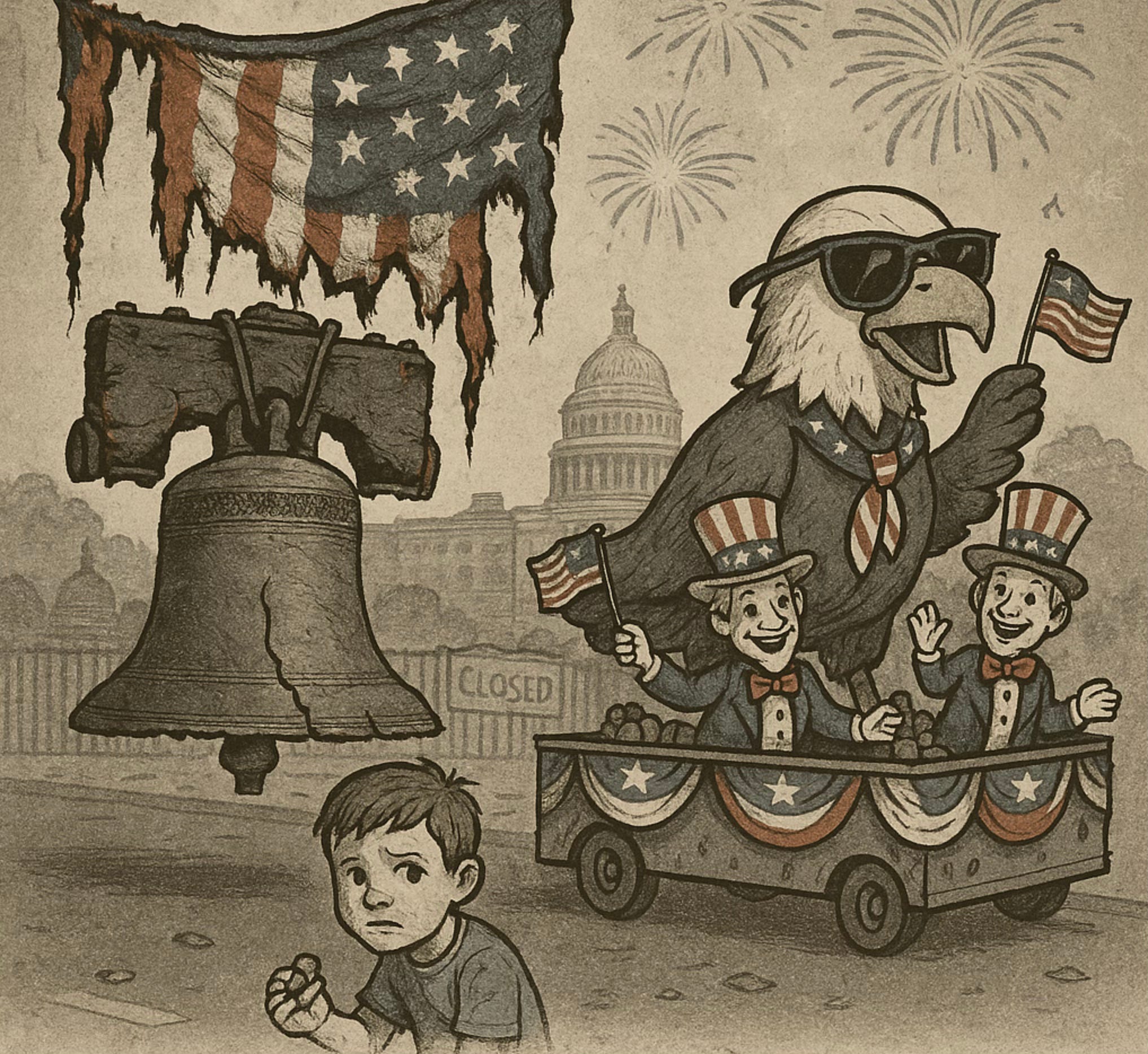
It’s the 4th of July, and we are heading to Staunton center to watch the annual parade of flag draped trucks, local politicians, and kitschy floats. But this year, celebrating our country feels different. While I still love this country, I am not as proud to honor it today, nor to celebrate the liberty it represents. I can’t help but pause—not to celebrate liberty, but to mourn what we’ve allowed it to become. Here we are, just six months into the orange man’s return to power, witnessing a nation unspooling from the inside out.
As we mark 248 years since the Declaration of Independence, the irony makes me want to puke. We are watching the declared values of that document—liberty, equality, the dignity of man—get bulldozed by a regime of oligarchs who believe the government should exist solely to shield and benefit the rich and punish and marginalize the desperate. They are actively dismantling the social safety net, gutting civil rights, and weaponizing immigration policy into something that can only be described, without hyperbole, as proto-fascist. The Billionaire class are cheering the dismantling of food assistance and Medicaid from their vacation compounds. The Department of Justice is now in the business of justifying cruelty with scripture. We now have political influencers gloating—yes, gloating—about building concentration camps for undocumented immigrants and the sick fucks even brand them with disgusting and sickening swag. And while all of this degradation is taking place, the orange man continues his debasement of the office by launching a perfume brand with a stench of corruption and strong notes of graft.
This is not strong governance. This is not patriotism. It is moral rot wrapped in the flag.
And for American Jews watching this unfold, there should be alarm bells blaring louder than any firework. We would be foolish not to see the parallels. We, a people shaped by exile and atrocity, cannot afford to treat any of this as background noise. We know where this kind of politics leads. We know what happens when cruelty becomes the policy and truth becomes optional.
So no, I won’t be waving a flag today with the same ease and pride as years past. But I will show up—because showing up still matters.
Because loving this country doesn’t mean ignoring what’s broken. It means caring enough to notice, to speak up, to push back when the gap between our ideals and our actions grows too wide.
As I watch the floats roll by and the kids wave their little plastic flags, I’ll be thinking not just about where we’ve been—but where we’re going. And whether we’re willing to do the work of making liberty real for everyone, not just the privileged few.
Because if patriotism means anything, it has to include accountability. And if Jewish memory means anything, it has to include the courage to name injustice, even—especially—when it happens close to home.
This year, I’m not just celebrating independence. I’m remembering what it asks of us.
Enjoy the holiday! And remember, be careful out there.
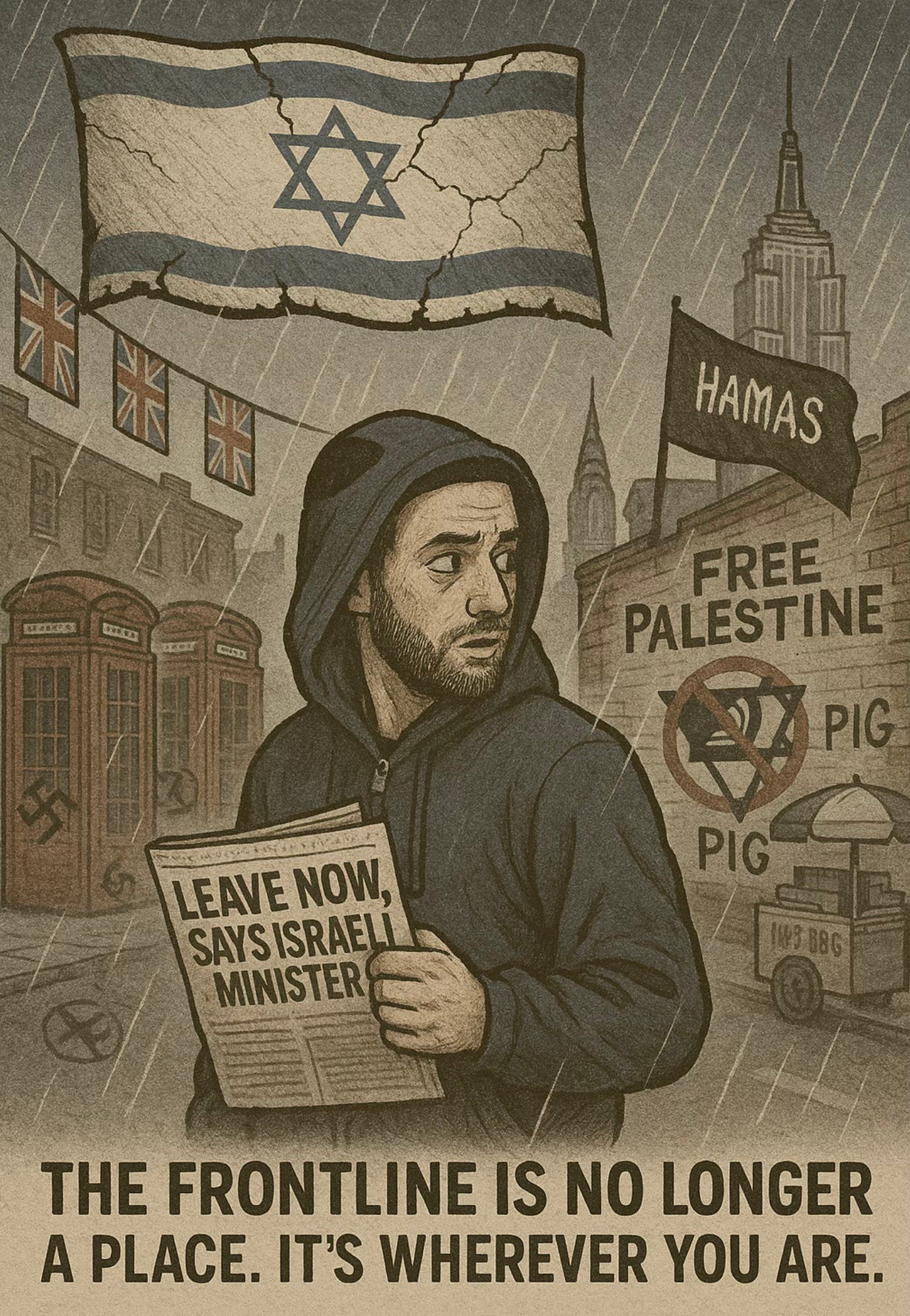
In a scorching recent essay titled “The New Populism of the Judeocidal Left,” British conservative columnist Melanie Phillips warned that Jews in Britain are now less safe than Israelis—and that’s saying something, considering Israelis just survived a 12-day war with Iran, a war that killed dozens of Israelis, and injured thousands from a barrage of a missiles and drones. The British Jewish community, she argues, is being squeezed between the resurgent far-right and an increasingly aggressive left whose anti-Zionism slips easily into antisemitism.
Britain’s Israeli Diaspora Minister, Amichai Chikli, said that Jews were in such danger that they should leave the country and immigrate to Israel. Chikli accused the Labour Government in the United Kingdom of fueling antisemitism and claimed that its voter base consisted of “Hamas sympathisers”. He told the Daily Mail: “Without a dramatic change of course by Britain’s political leadership, I see no future for Jewish life in England.”
Yikes.
That warning isn’t just coming from across the pond anymore. If you thought New York City—a capital of global Jewish life—was immune, think again. The recent Democratic mayoral primary gave New Yorkers two radically different choices: the “ass‑grabbing hack” Andrew Cuomo, and the hyper-progressive darling Zohran Mamdani, whose record on Israel is more than just “troubling”. Much to Jewish chagrin, Mamdani’s “hyper-progressive urbanism” carried the day.
Mamdani didn’t just flirt with anti-Israel rhetoric. He married it, moved in, and started redecorating with Hezbollah flags. He supports the BDS movement. He’s introduced bills to strip nonprofits of their tax-exempt status if they support Israeli settlements. He called the Israeli response to Hamas attacks “genocidal,” and suggested that if Prime Minister Netanyahu visits New York, he should be arrested. Yes, arrested—for defending his country after it was attacked by a terror group that burned babies alive and livestreamed executions. I’m no fan of Nut-and-yahoo, but really?
Most chilling of all, Mamdani refused to disavow the slogan “Globalize the Intifada.”When pressed, he gave the usual weasel words about “context” and “symbolism.” This, even after Jewish leaders across the spectrum warned that intifada means blood in the streets—specifically, Jewish blood.
The U.S. Holocaust Memorial Museum condemned the phrase. Mamdani shrugged.
Even if he sincerely believes the expression is a call for equal rights for Palestinians, as a public figure, he has a responsibility to acknowledge that a lot of people see it as a call for violence, and should denounce it. The New York Post put it right: if you won’t denounce a slogan that’s been used to justify bus bombings and synagogue shootings, you certainly don’t belong anywhere near Gracie Mansion.
Mamdani also refuses to concede that Israel should be an expressly Jewish state. That position, however sincerely held, was expected to cost him dearly in the most Jewish city outside the Levant. Time will tell, but it doesn’t seem so. The 33 year old has captivated young voters, with a smooth manner and sharp political instincts similar to the orange man, he’s saying what he thinks—even if it infuriates critics—and drawing disaffected voters (in this case, young people Democrats are losing) into a coalition. And like Trump, he comes from privilege and has a flair for showbiz.
New York democrats obviously wanted change. And Cuomo, the sleazy, transactional, cynical candidate—turned out to be the “moderate.” The guy who governed like a mob boss in a statehouse sauna was considered the less dangerous option. That’s the measure of our decline. To his credit, Mamdani offered answers to “how the hell can I afford to live in this City?” But I don’t buy AOC’s comment that Mamdani had “demonstrated a real ability on the ground to put together a coalition of working-class New Yorkers” because the results tell a different story — here’s what happens when you sort the results by income:
Jeff Maurer, political hack and humorist, summed it up perfectly:
But evidence suggest that this grassroots movement against elites mostly appeals to…elites. Mamdani did well with high-income voters in high-income areas, especially the upwardly-mobile and highly-educated parts of Brooklyn and Manhattan. And that dynamic would have been even more pronounced had Mamdani not scared away Jewish voters in Upper Manhattan with his “globalize the Intifada”comment.
It’s encouraging to see a young, vibrant and talented politician getting the dems excited again. Lord knows, someone needs to revive the dying democrat patient and the party. If you can see past his anti-Israel nonsense, and drop his inane city owned supermarkets and rent control idiocy, and combine him with more “Abundance” policies, there might be a chance for this guy to pull off an amazing victory in the fall. But the price for Jews, in my humble opinion, is too high. The risk of normalizing “from the river to the sea” and “globalizing the Intifada” would be a disaster and far too big a leap for myself, and I would think, for most Jews to take.
Mamdani’s supporters say the allegations that he is antisemitic are blunted by the support he receives not only from organizations like Jewish Voice for Peace and JFREJ, who largely align with his positions on the Israeli-Palestinian conflict, but also from his relationship with Brad Lander, a longstanding and prominent Jewish elected official in the city and self-described liberal Zionist with close ties to the Jewish community.
I’m not a New Yorker, but my presumption is that for most Jewish New Yorkers, Mamdani’s victory isn’t just ideological—it’s existential. In a city once built by and for immigrants, where Yiddish once echoed through tenement walls and synagogues stood on every other block, the new left has no room for Jews who love Israel. The new lefty litmus test is loyalty to Palestine—unquestioned, absolute, and conveniently blind to Hamas rockets.
The British Jews saw it first. Now it’s landed here. And if Mamdani is the future of progressive politics in America’s most Jewish city, then Melanie Phillips was right: we are all Israelis now.
And now, without further ajieu, here is your weekly smorgasbord of superbly selected semitic stories from sources such as The Forward, JTA, The Times of Israel, Haaretz, Nosher, Kveller, and Jewish Boston to name a few. This week I am adding a title to this section – Diaspora Dispatch – and will include my usual smarmy comments on the headlines. Enjoy.
Diaspora Dispatch:
🇺🇸🇮🇱 Trump & Bibi Lock Lips on ‘Victory Party’ to Celebrate Iran Strikes – Our two favorite authoritarian bros are reportedly planning a White House meet‑and‑greet to “celebrate” their joint strike on Iran’s nuclear sites. The orange man is still gushing about how “historic” it was, while Bibi’s legal team quietly mentions “trial delay.” Just your average buddy‑fest—if your buddy is the ex-liberal world order. In a related story, the orange man took his Bibi friendship to the next level: “Cancel his corruption trial or pardon him, I’ll ‘save Bibi.’” Israeli courts weren’t impressed. Last we checked, “judicial independence” is still a thing, at least for now.
Latest on Iran…
A new poll shows a record number of U.S. voters believe America is too supportive of Israel, following American strikes on Iranian nuclear sites. (JTA)
Trump said the U.S. and Iran will meet next week, claiming a nuclear deal is “no longer necessary” as a tentative ceasefire holds and tensions remain high. (Times of Israel)
Trump officials cited “new intelligence” to defend the Iran strikes as a success, while pushing back on leaked reports downplaying the impact. (Guardian)
Families of hostages held in Gaza are hoping the U.S.-brokered ceasefire between Israel and Iran will pressure a weakened, isolated Hamas to ease its stance in negotiations. (JTA)
A top Hamas official said the terrorist group is ramping up efforts to reach a new ceasefire and hostage deal in Gaza. (BBC)
⚖️ Texas Sued Over Ten Commandments Law, Moses Remains Unavailable for Comment – A group of Texas families and faith leaders filed a federal lawsuit over the state’s shiny new “Thou Shalt Post the Ten Commandments in Every Classroom” law. Governor Abbott said it’s about “faith and freedom,” which is Southern for “our faith, your freedom to shut up.” Plaintiffs argued the law violates church-state separation. Expect tablets to be smashed—again.(AP)
🎬 Lena Dunham Returns to Netflix With “Loud Jewess Energy,” Europe Braces – Lena Dunham’s new Netflix series Too Much follows a “messy, loud, complicated Jewess” who invades London. So basically, it’s Girls, but with more self-awareness and passport stamps. Somewhere, Philip Roth is sighing and pouring a drink.(Hollywood Reporter)
🏡 DOJ Ends Probe Into Muslim Suburb, Says “Jews Welcome Too, Promise” – The Justice Department dropped its investigation into a Muslim-focused housing development outside Dallas, after assurances that it would not be a no-Jews-allowed situation. The developers claimed everyone is welcome, even Reform Jews and vegans. Somewhere, Ben Shapiro’s eyebrows are twitching.(AP)
U.S. envoy Steve Witkoff said Wednesday that more countries — some not previously expected — are likely to join the Abraham Accords, hinting at upcoming announcements. (Times of Israel)
🏨 Trump Towering Over Tel Aviv? What Could Possibly Go Wrong –Trump’s name might soon grace the tallest hotel in Tel Aviv because apparently there aren’t enough real estate deals with unsettling political subtext in this region. The tower’s backers promise it’ll be “world-class” and “a beacon of luxury.” At least it’ll be easy to find on Google Maps if you’re lost and craving gold trim and indictments.
That’s all for this week. As usual, stay safe out there.
Thanks for reading The Jew News Review! Subscribe for free to receive new posts and support my work.
I was thinking of headlining this post with “Iran’s Lesson Learned: Don’t Fuck with these Jews!”, but decided to go with a more socially acceptable version. And, we shouldn’t gloat about the tremendous successes Israel has accomplished in Iran over the last 10 days or so. We are still early on in what could turn into a middle east conflagration, a conflict that now includes the United States, and puts our own soldiers and citizens at risk. And we have no idea how the Iranians will respond.
But bravo for the orange man’s decision to pull the trigger and eliminate the nuclear threat from the Iranian arsenal of terrorist weaponry. I bristle when I write this, but for once the orange lunatic’s erratic decision making worked in his favor, and whatever part of this ruse was scripted, he at least played the part well enough to fool the moronic mullahs. And though he looked ever so cartoon-ish in his press conference last night, I salute his decision and the joint efforts of the Israeli and American military for what appears to be a job well done with no American casualties. For that, we have the Israelis to thank.
There’s a saying in Middle Eastern geopolitics — or, at least there should be — that goes something like this: Don’t start a holy war with people who’ve already survived every kind of hell.
Iran’s ruling regime, in its messianic delusion, seems to have forgotten that. They’ve spent the last four decades funding, arming, and training death cults from Gaza to Beirut, dreaming of the day they could wipe Israel off the map. But with each drone they send, each child bomber they sponsor, and each speech they give about the “Zionist cancer,” they’re not writing history. They’re writing their own obituary.
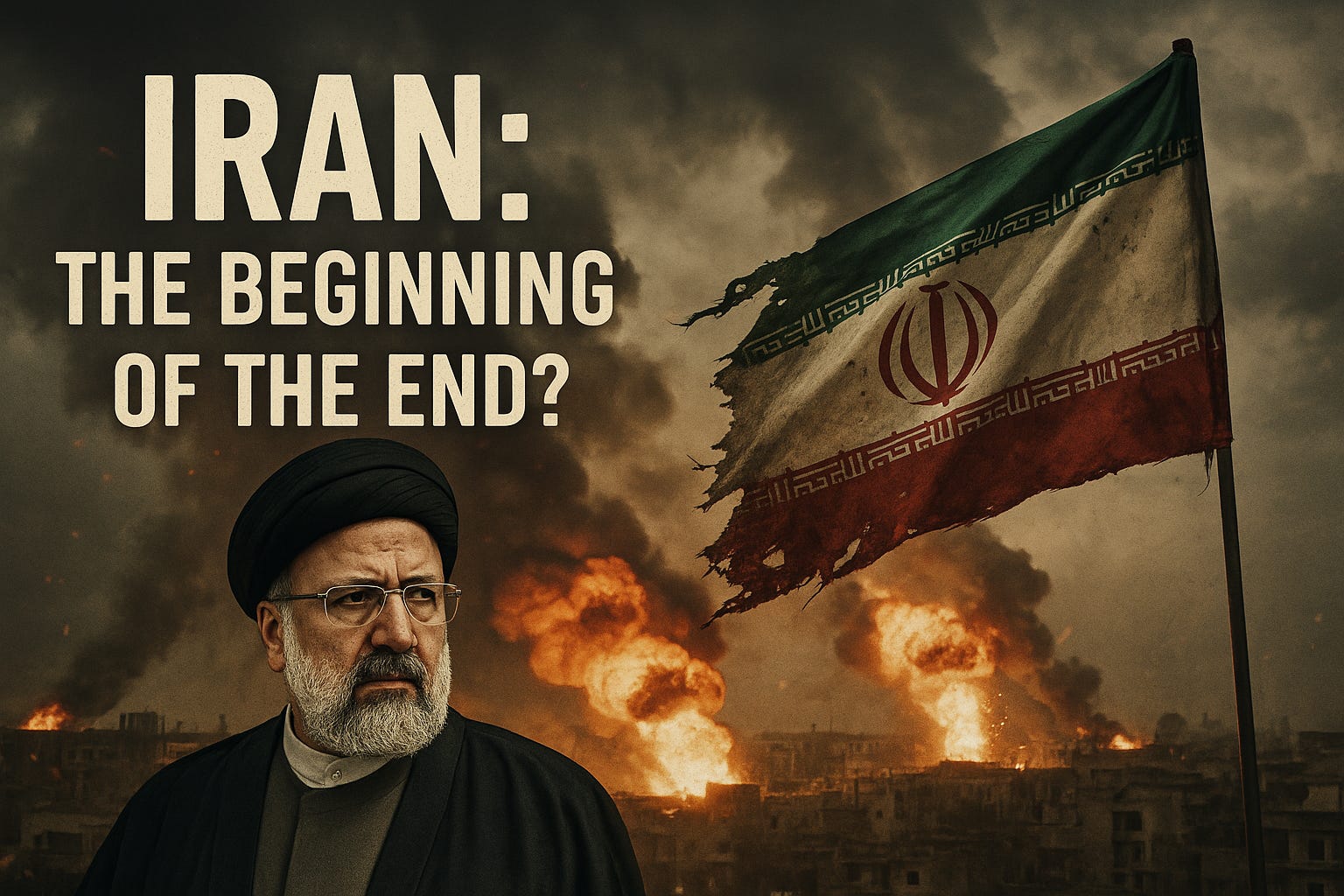
And now that the U.S. has finally dropped the gloves, striking Iranian nuclear facilities with the orange man giving the green light — the question hanging over Tehran isn’t “What’s next?” It’s: Is this the beginning of the end?
Let’s be clear: Iran didn’t become the world’s leading state sponsor of terrorism by accident. It’s a title they earned, the hard way, over 45 years of global mayhem. Since the ayatollahs rolled into Tehran in 1979, Iran has acted less like a sovereign nation and more like a black-market arms dealer crossed with a fundamentalist death cult.
Need a quick refresher on the hits?
1983, Beirut: Iranian-funded Hezbollah blew up the U.S. Marine barracks, killing 241 Americans. A clear message: get out of our sandbox.
1992 & 1994, Buenos Aires: They bombed the Israeli Embassy and AMIA Jewish center, killing over 100 civilians. Why? Because Jews dared to exist on another continent.
1996, Khobar Towers, Saudi Arabia: U.S. Air Force housing was turned to rubble. Iran’s fingerprints? All over it.
2000s, Iraq: Iran’s Quds Force supplied explosively formed penetrators (EFPs) to Shi’ite militias. The result? Hundreds of dead and maimed American soldiers.
Today, they bankroll Hamas, Islamic Jihad, Hezbollah, the Houthis — basically the Joker, the Penguin, and every other lunatic in the jihadist Gotham Asylum.
Iran doesn’t just fund terror. It franchises it. It licenses it out like it’s opening a Chick-fil-A in Hell. And through it all, their motto is the same: Death to America. Death to Israel. Death to the West.
So why would Trump — the most isolationist president in a generation — greenlight a strike on Iran’s nuclear infrastructure? Why would Mr. “End the endless wars” risk starting a new one?
Simple. Even a guy who prefers golf to geopolitics understands this: if Iran gets nukes, the entire region becomes a suicide pact.
Forget the JCPOA fantasy crowd — those who believe mullahs can be appeased with pallets of cash and softly worded communiqués. Trump saw what Iran was really building: not a deterrent, but a weapon of blackmail. A nuke for Hamas to hide under. A nuke for Hezbollah to wave at Tel Aviv. A nuke to turn the Gulf into hostage territory.
And let’s be honest — the orange man, for all his flaws, hates being disrespected. Iran’s 2019 attacks on Saudi oil fields? Their rocket strikes near U.S. bases? The plot to kill a Saudi ambassador on American soil?
Those weren’t just acts of terror. They were insults.
So Trump did what no one expected: he took out Qassem Soleimani, Iran’s terrorist-in-chief, mid-airport. One minute, Soleimani was landing in Baghdad. The next, he was bone dust in the tarmac. And now, with Iran allegedly rebuilding its nuke sites and pushing too far, too fast, the orange man, desperate to shed his TACO image, authorized another round of biblical fireworks and dropped multiple payloads on Iran’s nuclear sites.
Why? Because even our TACO president knows that if you blink at tyrants, you get war. But if you punch first? You might just get peace.
🕎Don’t Fuck with these Jews!
Now, a word to Hamas, Hezbollah, and any other death cult still licking its wounds from the last round of “martyrdom”: You picked the wrong Jews.
Israel isn’t 1943 Warsaw. It’s not even 1973 Yom Kippur. It’s a sovereign, nuclear-armed, tech-savvy, drone-building, Mossad-deploying juggernaut that already has the funeral music queued up for your commanders. You want to know what happens when you rape, kidnap, and slaughter Israelis on October 7?
You get your tunnel networks turned into underground ovens.
You get your leaders hunted across continents.
You get your weapons stockpiles transformed into secondary explosions on live TV.
And that’s before breakfast.
Israel isn’t fighting for land. It’s fighting for the right to exist without becoming a footnote in your genocidal scripture. And it has made one thing uncomfortably clear: it would rather be hated than dead.
So, is this the beginning of the end for Iran’s regime?
Maybe not tomorrow. But the cracks are showing:
The economy is crumbling under sanctions.
The youth are restless — tired of clerics telling them how to live, how to think, how to hate.
Their proxies are overextended, their funds stretched thin, and their narrative exposed as a hollow theology of death.
And their biggest enemies — Israel and the U.S. — are finally acting like they mean business.
You can only hold onto the mantle of “Resistance” for so long before people realize you’re just resisting progress, dignity, and life itself.
The Iranian people deserve better than the corpse cult currently running their country. And if they can’t bring it down from within, maybe it will fall from without — missile by missile, lie by lie.
🕯️A Final Word
History rarely announces its turning points in real time. But if you’re paying attention — if you listen past the talking heads and the NGO moralists — you can feel it. Something is breaking. Not just in Gaza or Tehran, but in the West’s long, toxic tolerance for terror in a turban.
Milton once wrote, “Awake, arise, or be forever fallen.” Maybe, just maybe, we’re awake again.
If this is the beginning of the end for Iran’s theocratic terror state, then let it be known: it didn’t fall because of sanctions. It didn’t fall because of protests. It fell because it finally pushed the wrong people too far.
And the wrong people pushed back.
🕎 Share this with someone who still thinks appeasement is a foreign policy. Or someone who needs a reminder: Jewish survival is not negotiable.
As a Journalism/English major in college, I was required to take a course on Major British Writers where I had my first exposure to John Milton and his epic poem, Paradise Lost, which is all about the biblical fall of man. “The mind is its own place, and in itself / Can make a Heaven of Hell, a Hell of Heaven,” he wrote.
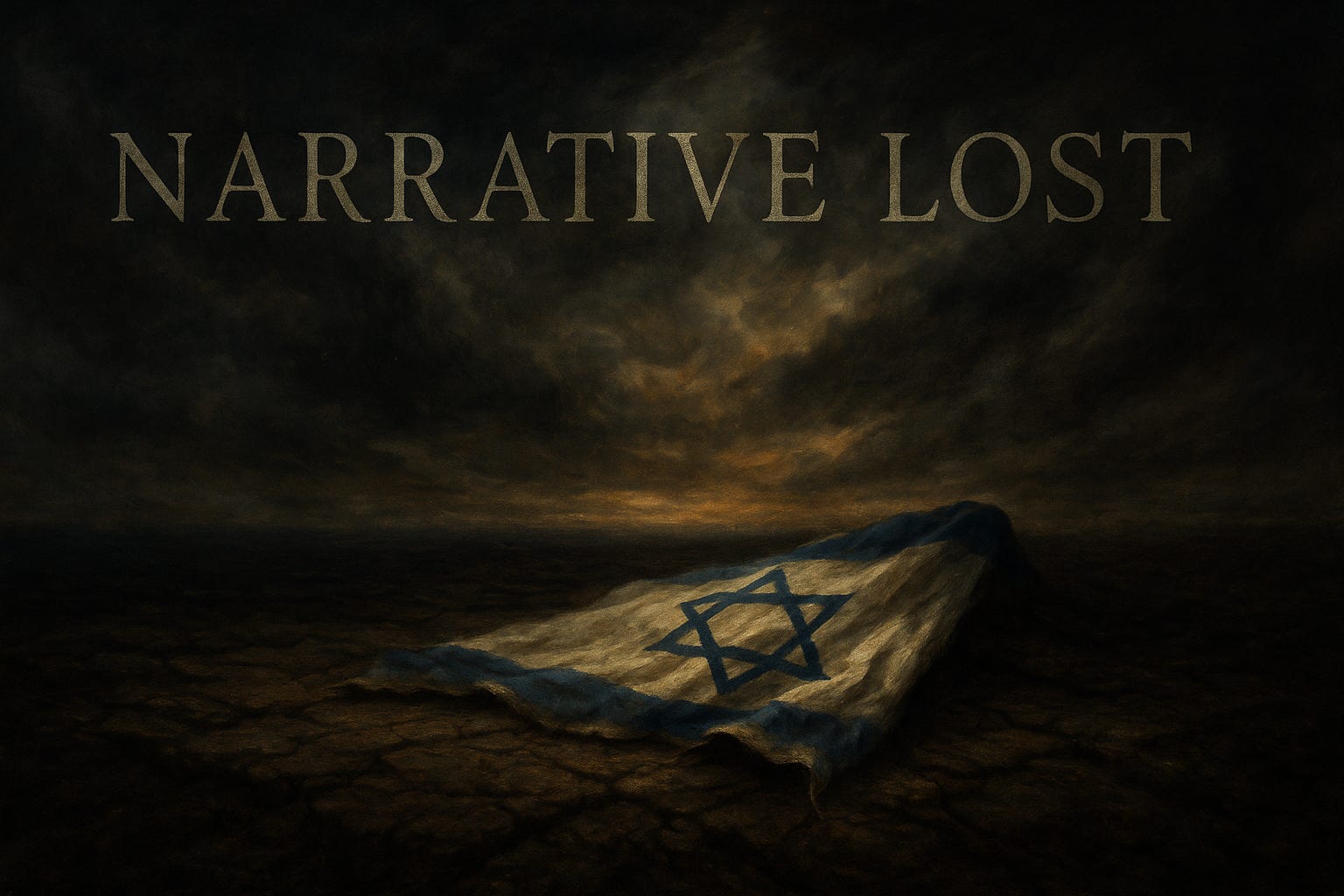
In 2023, Israel went from Paradise Engineered to Hell Televised. The Jewish state — long viewed by supporters as a battered miracle of survival, democracy, and grit — now finds itself cast in the role of the arch-villain in the global imagination. Not because the facts changed, but because the narrative did.
Milton understood what we’re living through: once you lose control of the story, you lose control of the meaning. And right now, Israel’s story — forged in ashes, sharpened by war, powered by democracy — is being unmade in real time.
There was a time — not long ago, but several ceasefires and hostage deals, and TikTok trends back — when Israel stood in the world’s imagination as a miracle. A scrappy little survivor state. A democracy of refugees. The tech-happy start-up nation whose army featured violinists, baristas, and reluctant engineers in uniform.
It wasn’t perfect, but it was admirable. Strong, but still wounded. Tough, but tethered to a moral compass forged in genocide. In the Jewish diaspora, it inspired a kind of complicated pride — the only country where “Jewish” wasn’t a punchline or a burden. Growing up, I remember it was customary for Jews in the US to donate money to Israel, to set aside “tzedakah” for planting trees, or for Hadassah or the United Jewish Fund. And we did so proudly, creating emotional and durable connections to the Jewish homeland. Many American Jews performed aliyah, and emigrated permanently to Israel driven by Zionist idealism and post-WWII Jewish statehood enthusiasm. Many were young, religious, or ideologically left-wing (kibbutzim).
And then came October 7.
The war in Gaza hasn’t just killed thousands and scar a region. It detonated Israel’s moral standing, especially in the West. On TikTok, in the academy, and across elite institutions, Israel is no longer David. It’s Goliath with a drone fleet. A once-revered underdog turned global pariah.
But this inversion didn’t happen on its own. It was scripted by a media industry addicted to victim porn, amplified by a propaganda machine headquartered in Gaza, and enabled by an Israeli leadership whose moral compass has been hijacked by self-preservation and far-right delusion.
If this is a battle for the soul of the Jewish story, then that story — for now — is losing.
Let’s start with what should have been clear: On October 7, Hamas launched the single most barbaric attack on Jews since the Holocaust. Babies shot in their cribs. Women raped and burned alive. Grandmothers dragged into tunnels. It was genocidal by any definition not marinated in post-colonial grad school jargon.
And yet — within days and even before Israel launched its defensive action — Western media began the great narrative inversion. ABC, NBC, and The Guardian cast doubt on the mass rapes due to “lack of photographic evidence.” Because apparently, Jewish women need to be re-traumatized in high-definition to be believed.
Then came the Al-Ahli Hospital hoax. A Palestinian rocket misfired and struck a parking lot near a hospital in Gaza. Within hours, the New York Times, BBC, and CNN blamed Israel — sourcing claims directly from Hamas. The death toll? Magically rounded to 500. No forensic verification. No skepticism. Just headlines.
When U.S. intelligence and open-source analysts confirmed the blast was self-inflicted — a terror rocket gone astray — the retractions, such as they were, were barely whispers in the back pages. But the protests had already erupted, the embassies had already been stormed, and the image of the Jewish state as hospital-bomber had been indelibly stamped on global consciousness.
And then, of course, the 14,000 babies lie — the Miltonic absurdity that deserves its own canto. In November, social media was flooded with claims that Israel would be killing 14,000 infants within 48 hours. The number was pure fiction, a grotesque aggregation of months of casualty figures, deliberately weaponized. But it went viral — reposted by journalists, influencers, and even Katie Couric. No correction. No accountability. Just the blood libel rebranded for a new generation: the Jewish state murders babies.
This isn’t media. It’s a morality play — and the Jews have been cast, again, as the devil. This is not journalism. It’s blood libel with better production values. As a former journalist inspired by Woodward and Bernstein, I am deeply appalled and embarrassed at the state of this once admirable institution.
And yet the real genius of the narrative inversion lies with Hamas. Their propaganda machine is a masterclass in post-truth warfare. They understand the algorithm, the camera, the cadence of Western guilt. They know how the Western media works. They know tragedy sells. They know if you point a camera at a wounded child or a pile of rubble and yell “genocide,” the algorithm takes care of the rest. They know how to control the narrative — not despite Western values, but because of them. They embed weapons in hospitals, launch rockets from kindergartens, and count on Israel’s response to generate the optics they need. They’ve weaponized our empathy, our journalism, our very language. “Occupation,” “apartheid,” “genocide” — the terms no longer mean anything. They are slogans, deployed with precision to erode Israel’s moral high ground.
And they do not fear civilian death — they rely on it. Every corpse becomes a martyr and a sermon. Every collapsed building a set piece. They flood WhatsApp channels with casualty reports (unverified, unsegregated by age, gender, or combatant status) and the media dutifully repeats them, unquestioned. Meanwhile, Israeli spokespeople hold up drone footage and talk about “precision-guided munitions” to an audience that has already stopped listening.
But perhaps the cruelest irony is this: Jews, more than any people, carry a deep historical discomfort with justifying ourselves to those who hate us. There’s something fundamentally dehumanizing in having to prove we’re not demons. After pogroms, after the Shoah, after generations of expulsion, many Jews instinctively recoil at PR. We want to live, not explain. But in this war — this digital Eden where narrative is everything — silence gets interpreted as guilt. Dignified restraint doesn’t go viral. And moral complexity gets flattened into a single Instagram slide with a crying child and a red “Free Palestine” banner across the top.
Nowhere is the narrative collapse more devastating than among young diaspora Jews.
On American campuses, Zionism has been rebranded as white supremacy. Birthright is suspect. Shabbat dinners are canceled. DEI offices (what’s left of them) treat Jewish students as problematic, privileged extensions of the Israeli military-industrial complex. Jewish students are told they must disavow Israel to be considered “progressive” or be cast as part of the “oppressor class”.
Even within Jewish homes, there’s a schism. Older generations remember 1967. Younger ones remember a trending infographic accusing their homeland of genocide. They feel trapped — forced to choose between Jewish identity and social acceptance. Between solidarity and safety. As a result, younger generations are split: is Israel a moral homeland or a militarized embarrassment?
It’s no wonder my nephew, who was raised Jewish with a bar mitzvah in Israel, and, who attended Jewish summer camps, feels anxious about any public displays of his Jewish identity. A Jewish generation adrift. Disaffection. And in many cases, a complete severance from Zionism — not out of betrayal, but out of fatigue.
And into this wasteland of moral confusion and generational fracture strides the embodiment of narrative collapse: Benjamin Netanyahu.
Bibi didn’t invent antisemitism. But he managed to confirm every anti-Israel stereotype while overseeing the worst security failure in Israel’s history. He dismantled judicial independence, empowered theocratic racists, ignored the military’s warnings, and governed like a Roman emperor facing indictment.
Instead of uniting the country after October 7, he weaponized grief. He let extremists stay in power. He refused to take responsibility. He made “winning” in Gaza a slogan, not a strategy. He is a man governing as if the state is a bunker built solely for his ego. He may currently be winning the war with Iran, but for many young Jews abroad, Bibi isn’t just a political liability — he’s an emotional dealbreaker. He confirms every slander, fuels every caricature. He has made it exponentially harder to defend Israel without wincing. To care without explaining. To stand with the Jewish state without having to clarify, “But not that government.”
For many diaspora Jews — even those who love Israel — he is a bridge too far. The leader who turned Paradise into parody. Who made standing with Israel feel like standing with a smirking strongman dodging subpoenas.
Regaining the Narrative
How this epic tragedy ends is beyond my speculative powers. But we need to be steadfast in our efforts to change the narrative. Israel is not a colonial project. It is not genocidal. It is not an apartheid state. But when you lose control of the story, the facts stop mattering. The world is no longer parsing your morality — it’s reacting to your image.
And when that image is shaped by enemies who seek your destruction, by journalists who outsource truth to terror ministries, and by a Prime Minister who treats the truth like a prop — the result is what Milton warned us about: a Hell made from what was once a kind of Heaven.
But if the soul of Israel is to survive this chapter, it needs to reclaim the lost narrative. And the real question isn’t just whether Israel can win the war in Iran and Gaza, it’s whether it can reclaim the story.
Because even if the field is lost, “all is not lost; the unconquerable will…” — and in that will lies the enduring essence of Jewish peoplehood: the refusal to submit, the courage to rebuild, and the stubborn hope that even the most inverted narrative can be set right.
Because if we let our enemies — and our own failures — dictate what Israel is, then we are no longer just defending a country. We’re mourning a narrative. And narratives, once lost, are not easily resurrected.
I watched a lot of CNN yesterday. To hear the details of Israel’s military prowess was at times inspiring, but seeing missiles eluding the iron dome and falling on Tel Aviv was just awful and hard to watch. Israel’s “preemptive” attack on Iran’s nuclear capabilities was a long time coming, but the outcome is far less certain and I fear for the safety of friends and family, and for all Israelis. We can only hope that as Nietzsche once said, the current chaos will lead to a new order.
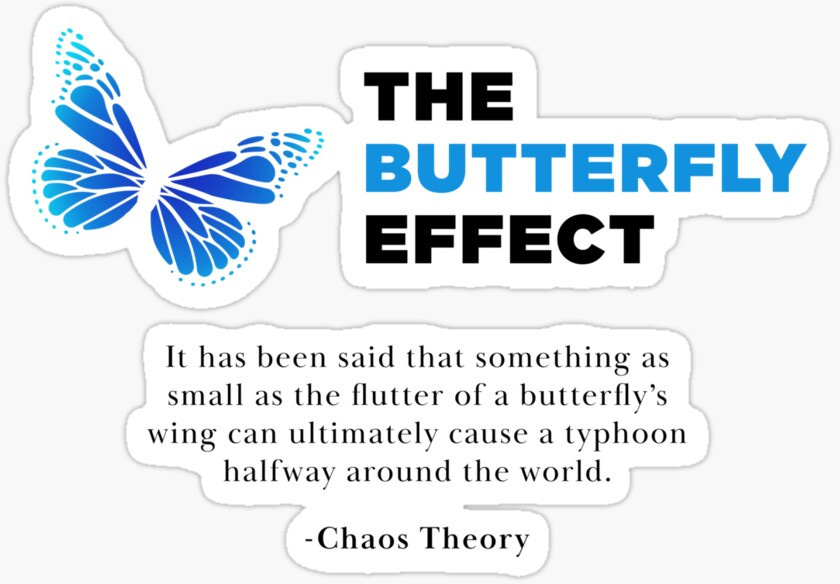
Chaos theory teaches us that a butterfly’s wing can stir a hurricane. But what about when a thousand rockets scream across the sky and awaken a sleeping world? In the stormy Middle East, Israel is not just reacting to chaos—it’s confronting its source. The current war with Iran isn’t merely another regional skirmish. It’s a civilizational struggle to cauterize a metastasizing wound that has fueled Islamic terrorism, destabilized nations, and held both Jews and Muslims hostage to tyranny.
For too long, the Islamic Republic of Iran has acted as chaos incarnate: training proxies, funding jihad, and threatening annihilation. And with a nuclear weapon, that threat is far more real. Israel is now doing what others have feared to do—piercing the storm at its eye.
But it wasn’t always this way. Before the mullahs, before the “Death to Israel” and “Death to America” chants echoed through the streets of Tehran, Iran was home to one of the world’s oldest Jewish communities. Jews thrived under the Shah, working in medicine, business, academia, and politics. They lived side by side with Muslims in relative harmony—until 1979.
The Islamic Revolution shattered that coexistence. The Jewish population plummeted from over 80,000 to less than 9,000. Jews became suspects by birthright. Businessmen were executed for “Zionist crimes.” Worship went underground. And yet, even today, beneath the black-robed tyranny of the ayatollahs, a sliver of Jewish life persists—tethered to survival, not sovereignty.
Since 1979, Iranian-backed groups have fired over 29,000 bombs, missiles, and dronesat Israel—almost all indiscriminately, with the intent to kill, terrorize, and disrupt daily life. This isn’t warfare; it’s calculated chaos, exported across borders, bankrolled by a regime that treats martyrdom as currency. Here are the details:
Hezbollah in Lebanon – Over 7,000 missiles fired since 2006
Hamas and Islamic Jihad in Gaza – More than 25,000 rockets since 2001
Houthis in Yemen – Dozens of missile and drone attacks in just the last two years
Proxies in Syria and Iraq – Launchpads for Iranian precision weaponry
April 2024 – Iran’s first direct missile barrage, over 350 drones and ballistic missiles, aimed at Israeli civilians
All of that firepower is aimed at the only Jewish state on the planet, a country the size of New Jersey, with the intent of committing a real genocide of the Jews. If you think that is an exaggeration, believe these quotes from Iranian leaders:
. Ayatollah Ruhollah Khomeini (Supreme Leader, 1979–1989):“Israel must be wiped off the map.”This phrase—though debated in translation—is widely attributed to Khomeini and often cited by Israeli and Western officials. The original Farsi refers to “removing this cancerous tumor of Israel from the pages of history.”2. Mahmoud Ahmadinejad (President, 2005–2013):“The Imam [Khomeini] said this regime occupying Jerusalem must vanish from the page of time.” (2005) While Ahmadinejad claimed he was quoting Khomeini, his public reiteration sparked international outrage and sanctions.3. Ali Khamenei (Supreme Leader since 1989):“The Zionist regime is a cancerous tumor that must be removed.” (June 3, 2018)“Israel will not survive the next 25 years.” (September 9, 2015) He made this statement while meeting IRGC commanders, suggesting divine assistance would bring about Israel’s destruction.4. Islamic Revolutionary Guard Corps (IRGC) Leadership:Major General Hossein Salami (Commander-in-Chief of the IRGC):“We have managed to obtain the capacity to destroy the impostor Zionist regime.” (2019)5. IRGC Missiles Displayed With Inscription:“Israel must be wiped off the Earth” (Farsi inscription seen on missiles in military parades, e.g., 2016 Tehran parade)
Israel: The Butterfly That Fights Back
In the face of all this, Israel isn’t just defending itself—it’s reshaping the dynamics of regional deterrence. It is disrupting the flow of terror, dismantling Iran’s weapons pipelines, exposing the hypocrisy of the global human rights chorus that says little when Jews are targeted, but howls when Jews dare to fight back.
By targeting Iranian IRGC operatives, Hezbollah commanders, and weapons facilities, Israel is not creating chaos. It’s confronting it. Chaos theory reminds us that small changes can ripple across vast systems. Israel’s actions may yet catalyze a larger reckoning inside Iran—where a young, secular-leaning population is already disillusioned with theocratic rule and hungry for change.
Imagine an Iran no longer ruled by hate-filled clerics, but by builders, artists, scientists—and yes, Jews. Imagine synagogues once again ringing with Persian melodies, Jewish children walking safely to school in Isfahan, and Torah scrolls unrolled not in fear, but in freedom.
The fall of the Islamic Republic would not only liberate Iranians—it could invite the Jewish people home to one of their most ancient diasporas. Just as Spain now welcomes descendants of expelled Sephardim, one day Iran might atone and open its doors to the children of Cyrus.
In a world paralyzed by chaos and complexity, Israel’s war against Iran may look like another unpredictable gust in the global storm. But perhaps it is the necessary disturbance—the force that upends the cruel equilibrium of terrorism, sectarianism, and cowardice.
The world should not fear Israel’s strength. It should thank her. For in striking at the heart of chaos, Israel offers the chance for a new order: one where Jews can live freely in Tehran, Muslims can pray without fear in Tel Aviv, and terror no longer masquerades as resistance.
Because sometimes, chaos must be confronted—not studied, not rationalized, not appeased—but confronted, so that peace can finally emerge from the rubble.
Am Yisrael Chai.
Let the nation of Israel live—and help others live freely, too.
And speaking of living freely, we are off to join in No Kings Day protests in our local area. If you want to continue enjoying the freedoms of a liberal democracy, add your voice to the protests. Join a march, and bring a friend.





 Jew News Review