The Jew News Review – June 7, 2025 – “Gaza Ceasefire Theater: Why “Peace Now” and “not this” could be a suicide pact”

Shabbat shalom!

Despite the insane headlines spinning our heads this week like Linda Blair’s in the Exorcist, I am choosing to ignore the national embarrassment of the petulant children in the Presidential playpen as well as the threat of Bibi’s coalition collapsing under the weight of 50,000 IDF draft notices sent this week to eligible Haredim. Instead, I want to talk about the war in Gaza. 
The pace of Israel's war in Gaza far exceeds previous conflicts

Anyone who follows this blog understands my deep and profound dislike of Nut-and-Yahoo and his radical right sycophants who are willing to sacrifice the soul of the country for, among other things, using food and aid as leverage and a tactic to get their hostages back and to defeat the existential threat posed by the Hamas jihadists.

This week, the anti-Israel lame stream and social media have been piling on incessant reports that there were three successive days of the IDF “massacring” Gazans queuing for food provided by the Gaza Humanitarian Foundation (GHF), the new aid distribution center operated by the US and backed by Israel.

Most of those claims have been debunked by the available evidence which is tricky since there is no real reporting by independent journalists coming out of Gaza. Most western news organizations rely upon Hamas as their sole source of information, hence they become a willing platform for the Hamas propaganda machine that spews out more lies than the orange turd. 

Think about it: It is in Israel’s best interests to make the GHF aid delivery process as successful as possible, as not only will it ultimately be more efficient in delivering aid directly to those in need but, more importantly, it bypasses the Hamas middlemen and prevents them from reselling the aid at inflated prices and using the proceeds to finance their war machine as well as control the Gazan population. Clearly, whoever controls the aid distribution process, will ultimately control Gaza. Hence, Hamas is desperate to stop Gazans from obtaining this newly organized aid because it has the capacity to destroy its power over the population. Desperate to avoid losing that control, Hamas has been provoking gun battles with the IDF and then claiming these are massacres by Israel of those queuing for food. These reports have been uncritically regurgitated by the Western press, who, lacking other sources, continue to channel Hamas propaganda out of pure laziness, and/or anti-Israel bias, which has been on continuous display since October 7. You don’t need any more evidence of Hamas culpability and lies on this matter than what Hamas political leader, Osama Hamdan, said just the other day, “We trust that our people will endure hunger and not extend their hands to the occupier asking for aid.” Not that we needed it, but more evidence of Hamas using the civilian population merely and only as fodder in achieving their jihadist goals. 

But I don’t want to get into the weeds on who did what to whom in this ongoing saga of horror and inhumanity. And, I have no illusions regarding the morality of Israel’s defensive war against a death cult that states outright real genocide intentions to eliminate the Jewish homeland and exterminate Jews. For those like Pierce Morgan who react emotionally to the current Israeli surge in Gaza and it’s sad and horrifying impact on civilians with “not this”, we should recall leading urban warfare specialist John Spencer’s comment that “even if we were to take Hamas’s casualty numbers at face value—which we should not—Israel would still have one of the lowest civilian-to-combatant casualty ratios in any comparable war or urban battle in modern history.” And, “to judge wars solely by casualty ratios is to hand a blueprint to every terrorist organization on earth: embed within civilians, provoke a response, inflate the death toll, and let the world do the rest. It would make lawful self-defense functionally impossible—especially for democracies.”

That doesn’t excuse the way Israel and the US have botched the rollout of the new GHF aid delivery center, a move I believe is strategically important for Israel to achieve its war goals. As any systems person will tell you, a best practice in the roll-out strategy for any new and complex system is to pilot them in a smaller representative part of the organization, make whatever adjustments are required, then roll out the system to the rest of the organization either in a “big bang” approach, or in phases geographically or functionally. This is considered a “best practice” for managing the risk in large system implementations. 

Clearly, Israel has not incorporated any of that thinking in their roll-out of the new GHF aid distribution process. Maybe they were too rushed. Maybe they didn’t think about or care enough about the risks. Whatever the reasons, the plan and its execution was a bust. As an experienced systems guy, I would have advised them to maintain the existing delivery system while piloting the new process in parallel, then converted the old process in a planned phased approach. Instead, Israel rushed a big bang approach without a pilot program and the consequences for Gazans and Israelis has been nothing short of disastrous. Two million hungry Gazans are forced to travel long distances in dangerous territory to just four centers located in the South, and are subjected to Hamas harassment leading to avoidable deaths of civilians. Other fallout from this boneheaded rollout plan includes: continued condemnation of Israel by the global community, one of the GHF leaders quitting, the consulting firm, BCG, who advised them on the new process pulling out, and now, a pause in the delivery of ANY aid until the GHF can make adjustments and get their shit in order. Even worse, the outcome has helped ignite an atmosphere of hysteria and incitement in which the cause of “Free Palestine” and “End Zionists” — the slogans shouted by an Islamist who last Sunday tried to burn Jews alive when he firebombed a weekly march in Boulder, Colorado supporting the Israeli hostages — has led directly to murderous attacks against Jews across the US and poured gasoline on the burning anti-semitic fires raging around the world. It feels to me like Diaspora Jews now constitute the eighth war front in this horrifying never-ending nightmare. 

This is bigger than Gaza 

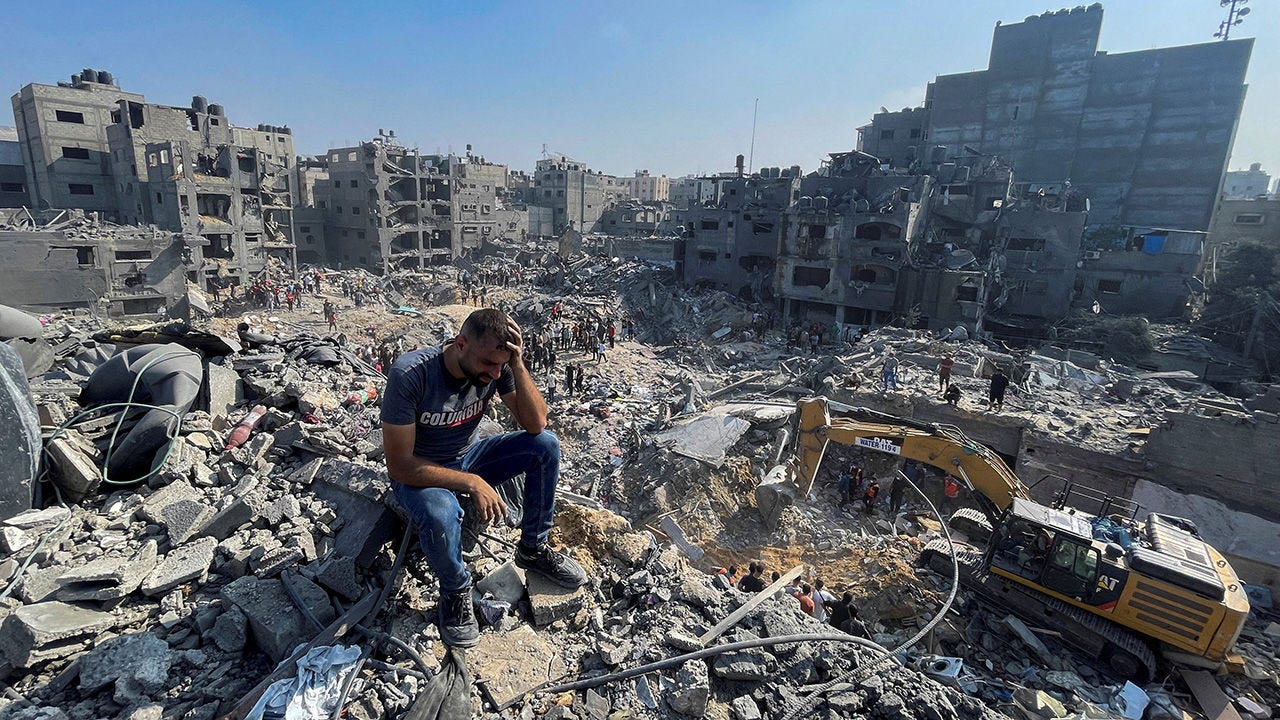
The war in Gaza is a theater of profound human suffering. The images are searing: bombed-out buildings, children pulled from rubble, aid trucks stalled at border crossings, mothers cradling lifeless bodies, and entire neighborhoods turned to dust. There is no just war without tragedy, and Gaza today is tragedy at scale.

But to understand this suffering in a vacuum is to misunderstand it entirely. The devastation in Gaza is not an accidental byproduct of Israeli aggression. It is the result of a brutal and cynical calculus made by Hamas—a jihadist organization that embeds its fighters in civilian areas, uses hospitals as command centers, and schools as weapons depots, all while launching attacks that deliberately provoke overwhelming retaliation. Hamas has no intention of building a peaceful, prosperous Gaza. It thrives on martyrdom, misery, and manipulation. It has hijacked an entire population and turned it into both a shield and a weapon.

Israel’s military response to the October 7th massacre—where Hamas militants murdered 1,200 people, raped women, mutilated corpses, and kidnapped babies and Holocaust survivors—must be seen not just as retaliation, but as an existential necessity. No country on earth would tolerate such an atrocity, nor could it survive if such acts were repeated. For Israel, surrounded by hostile actors and isolated on the world stage, allowing Hamas to persist would be a death sentence. 

But this war is not just about Israel.

Jihadism, of the sort practiced by Hamas, is a global phenomenon. It is not merely a reaction to poverty or occupation; it is an ideology—fueled by hatred, empowered by religious fanaticism, and committed to the destruction of Western values. It is the same ideology that brought down the Twin Towers, that tortured Yazidi girls in Iraq, that butchered concertgoers in Paris, and that executes gay men in Iran. Hamas is part of that same ideological hydra. It doesn’t just seek to liberate Palestine; it seeks to annihilate Jews, eliminate Israel, and expand a theocratic caliphate.

That’s why it’s especially chilling to hear activists in the West—many self-described progressives—chanting for a “global intifada.” This isn’t a call for peace or justice; it’s a call for violent uprising. Intifada, as history has shown, is not a metaphor. It is a real-world campaign of terror—bus bombings, stabbings, shootings, and suicide attacks. For people who pride themselves on being anti-racist, anti-fascist, and pro-human rights, the embrace of such language reflects a moral inversion so severe it borders on parody.

Meanwhile, a growing list of nations—including Spain, Ireland, Norway, and most recently South Africa—have thrown their weight behind demands for an immediate ceasefire. Some are doing so out of humanitarian concern. Others may be driven by geopolitical calculation, or domestic political pressure. What unites them is the belief that ending the war is more urgent than defeating Hamas.

The desire for peace is noble. But peace without the disarmament of Hamas is a pause, not a resolution. A ceasefire that leaves Hamas in power is a promise of future wars, more civilian casualties, and the further entrenchment of an ideology that glorifies death.

To defeat Hamas is not merely to restore Israeli security. It is to strike a blow against a broader jihadist threat that endangers not only Jews in Tel Aviv, but metro riders in London, theatergoers in Moscow, and cartoonists in Paris. This is not a war of choice; it is a war of survival—against a death cult that has mastered the art of weaponizing civilian suffering for Western outrage and diplomatic pressure.

It is also a war for civilization itself—against a worldview that pits religious conquest against secular pluralism, death against life, oppression against freedom. That Israel is asked to fight this war while observing a moral code its enemies deride as weakness is a tragic irony—but a necessary one. Because if Israel abandons that moral code, it loses what it is fighting to defend.

The moral challenge, then, is not to end the war at any cost. It is to end it in a way that ensures this war does not need to be fought again. That means Hamas cannot survive. And if Gaza is ever to know peace, it must be freed not only from Israeli bombs—but from the tyrants who invite those bombs in the first place.

No decent person wishes for the horrors we now witness daily. But no decent civilization can survive by surrendering to those who commit them deliberately.

Be safe out there everyone.

Brad out.

The Jew News Review – Special Edition – “simply because they were Jews”

On the day of Shavuot, a day to commemorate the delivery by Moses of a book that is foundational to western civilization, a supporter of Hamas used a flame thrower and molotov cocktails to burn Jews, “simply because they were Jews”. The victims had gathered at a Jewish community event in Boulder, Colorado, held in support of hostages in Gaza. The terrorist injured at least eight people ranging in age from 52 to 88 before being detained. One of the injured was a holocaust survivor. The attacker yelled “free Palestine” as he torched and maimed human flesh.

This horrific act comes on the heels of the killing in DC last week and the calls by many on the fringe left to “globalize the intifada”. For those “progressives” calling for a “free Palestine”, this is what free Palestine looks like:

I am reprinting (without permission, but I am sure he would approve) a letter from Israeli journalist Nadav Eyal. Nadav is a frequent guest on Dan Senor’s Call Me Back podcast who has been teaching at an American college campus and has spoken extensively with Jewish students on a number of campuses since 2023. 

Israel Is at War; the Diaspora Is Under Attack

Nadav Eyal

I’ve been covering terror attacks for over twenty years. I began my career as a journalist reporting from the West Bank for Israel’s Army Radio. I’ve seen Molotov cocktails thrown with my own eyes, and I’ve seen the aftermath of such attacks. But seeing those scenes from Boulder were deeply shocking—and even more so, the realization that this was a replication, an imitation, of terrorist attacks in Israel.

An intifada is, by definition, a violent uprising. The Second Intifada (2000-2005) is more widely remembered—the one of suicide bombings. But the First Intifada — which began in 1987 — was a popular grassroots movement of violent protests, stone throwing, and Molotov cocktails.

One of the most infamous attacks during that time was the firebombing of the Moses family’s car as they drove from Alfei Menashe to Tel Aviv during Passover 1987. As they passed near the Palestinian village of Hableh, a Molotov cocktail was thrown, hitting their car and igniting it. Ofra Moses, the mother, was six months pregnant. Despite her husband’s efforts to save her, she was burned alive. Their 5-year-old son, Tal, was critically injured and later died. The father and two other children were seriously wounded but survived.

Over the past year and a half, we’ve heard increasingly loud calls to “globalize the intifada”—a slogan now commonly used by those who support Hamas in its war. They said they would do it—and they are. The attack in Washington, and now the one in Boulder, reveal just how easily the war in Gaza can shift into global violence against Jews.

Young students at Ivy League universities chose to end their graduation this year with symbols and slogans expressing radical support for the values of the intifada. I haven’t heard a single voice in these ceremonies speak about peace, coexistence, rebuilding Gaza, victory for moderates, or even the establishment of an independent Palestinian state alongside a secure Israel. The tone and rhetoric are exclusively of binary struggle against Israel and anyone who supports it, the delegitimization of its very existence, and the demonization of the idea that Jews deserve a state—like every other people.

Needless to say, even the fiercest opponents of Russia in its war aren’t calling for the dismantling of the Russian state, the erasure of Russian self-determination, or promoting military uprisings worldwide against Russia’s allies. That kind of treatment is reserved only for Israel—for reasons that are well-known and, yes, antisemitic.

Those who spent years spreading hatred toward “Zionists” — meaning Jews — and toward Israel are now reaping the rewards: violence. A walk and run for the hostages in Boulder turned into a terror attack site, with people scrambling to pour water on victims set aflame. If you reduce everything to comparison to Nazi Germany and the Holocaust, then attacking the “Nazi sympathizers” is legitimate and brave.

As an Israeli, I think now of the American communities I visited over the past two years—of the time, attention, emotion, and resources that American Jews have invested in Israel since the beginning of the war. These are the people who came every Sunday since October 7th in Boulder, Colorado, because they wanted to demand the hostages’ return. And now, they’ve been attacked—the attacker stood just a few feet from a woman on fire and kept cursing “the Zionists.”

Israel is at war, but Jews are the majority there. I do not presume to give advice to the minority—the Jewish community in America—on how to respond to what may be the signs of a local intifada. All I can offer is this: remember Jewish history. When Jews were attacked, they survived by organizing, protecting themselves, and being prepared for what may come.

Beyond all that, as an Israeli who sees patriotic Americans and Jews injured in a terror attack because they marched for the hostages thousands of miles from Jerusalem, I feel the need to say something Israelis should practice more often toward the Jewish community here—and that word is TODA.

“Thank you” cannot begin to express the depth of Israel’s debt to the most successful Diaspora in Jewish history—living in a country that remains humanity’s best hope. After October 7, Israelis learned a hard truth: they are mostly alone. Those standing with them—above all—are Americans. And among Americans, it is the Jewish community that stands with them most deeply. What we’ve all learned over the past 20 months is that, in the end, what we have is mostly each other. Israel’s leaders must never forget that lesson.

I thank you — as a person and as an Israeli — each and every American who works to release our hostages, the paramount aim of this war according to the Israeli public, in every poll. And I salute those who marched in Boulder, Colorado, and were attacked because they are human beings, Jews, and American patriots.

Brad out.

The Jew News Review – May 31, 2025 – “Are you “living Jewish”? Or just “feeling Jewish”?”

Shabbat shalom! 

This week’s Tip of the Kippah goes to the management at Marriott Bonvoy in Virginia, who took a principled stand by barring antisemitic conspiracy crank Stew Peters from speaking at an event hosted by the USS Liberty Veterans Association. While others waffle in the face of fringe bigotry disguised as “veteran advocacy,” Marriott chose menschkeit over mendacity.

Thanks for reading The Jew News Review! Subscribe for free to receive new posts and support my work.

Peters, best known for spewing holocaust denial bullshit and venom about Jews, vaccines, and whatever else trends on Telegram, was scheduled to bring his particular brand of bile to a conference that’s long been a magnet for Israel-bashers and revisionist historians. But thanks to Marriott’s leadership, hate speech didn’t get room service this time. In an age where hospitality chains sometimes host Holocaust deniers alongside continental breakfast, it’s refreshing to see a corporation say, “Not in our lobby.” So, a well earned Tip of the Kippah to the staff and leadership who made the call: I see you, I appreciate you, and I raise a complimentary bottled water in your honor.

Kol hakavod! (well done!) 

This weekend, I am particularly anxious about the news of an imminent deal to release more living and dead Israeli hostages in exchange for a temporary truce and the release of more murderous Palestinian prisoners. There is no question in my mind that this new progress on the hostage front is a direct result of increased military pressure along with Israel’s new method for controlling and distributing aid in the region, a method that bypasses Hamas all-together. I have been a pretty harsh critic of the Nut-and-Yahoo administration’s use of food as leverage in this ongoing nightmare, but I have to admit, cutting out Hamas from looting aid trucks and stopping them from raising funds by selling that aid at inflated prices in the market is a brilliant approach that will also result in Gazans finally finding the courage and support to turn against Hamas. And it is this turn of events that is directly bringing Hamas back to the negotiating table. Are there some start up glitches with the new process? Obviously, but Israel will iron them out. Let’s hope for more good news this weekend.

Shavuot - The Holiday of the Giving of the Torah - Chabad.org
Shavuot – The Holiday of the Giving of the Torah

A few weeks ago I wrote about Dan Senor’s State of World Jewry Address he gave in New York. Dan’s address expanded upon many of the topics he covers on his Call Me Back podcast, but it primarily focused on the challenges ahead for Diaspora Jewish communities in a post-10/7 world. Dan also laid out a first draft of an action plan for Jewish Peoplehood that is no longer “prominent and weak” but one that is instead “Jewish and strong”.  His plan emphasized the need for American Jews to find a renewed sense of purpose and commitment to their heritage to ensure the community’s vitality. He called on all Jews to help counter the prevailing negative trends by “living a Jewish life” and underscored the urgency of investing in Jewish education, culture, and institutions to ensure a vibrant and resilient future.

And then last week I had dinner with my brother-in-law’s family. During dinner, my 26 year old nephew, who was raised Jewish, went to Jewish day camp, had his Bar Mitzvah in Israel, and is now dating a religious Jew, stated that he was no longer comfortable wearing a Star of David publicly due to the latest surge in anti-semitism and his discomfort with what is happening in Israel. 

And it got me to thinking: what does Dan mean by “living a Jewish life?” And how can we help our kids grow up to be “Jewish and strong”? This Substack, The Jew News Review, is one of my personal answers to the latter question. I started writing this blog as a way to help myself re-connect with my Jewish heritage, but also, more importantly, as a way to reach out to the younger generations in my family (and now beyond), to help them connect to their own Jewish personal brand. To help guide them on their journey to be “Jewish and strong”.

Are You Living Jewish or Just Feeling Jewish? 

There are two kinds of Jews in the world: the kind who live Jewishly, and the kind who feel Jewish while watching Seinfeld reruns or The Marvelous Mrs. Maisel. But let’s be honest—feeling Jewish is seductive. It requires no follow-through or weekly attendance at shul. It’s cultural identity by osmosis. You grew up around kugel and bagels and lox, hearing from Bubbie and Zaydie that all non-Jews were Goyim, and learning through life that “oy” covers roughly 87 emotions. Mazel tov! You feel Jewish. You have a favorite deli. You can spot another Jew at Costco by instinct alone. You wrapped your trees in blue ribbon. You cried watching Schindler’s List. You post #NeverAgain on Instagram. It’s a vibe. 

But living Jewish? That’s harder. That’s action. That’s showing up. That’s putting on pants and going to synagogue when it’s raining. That’s schlepping your kids to Hebrew school or day school and pretending you totally remember how to chant the V’ahavta after the Sh’mah. It’s building a sukkah from IKEA that collapses in the wind.

I didn’t grow up Orthodox, or even particularly observant. After my Bar Mitzvah I basically became a lapsed Jew. My Jewish identity was more cultural pride meets salty fish loyalty meets Woody Allen Jewish anxiety. But recently, maybe it’s an age thing or retirement, I have started asking: is feeling Jewish enough? Or am I just spiritually coasting on my Substack blathering and our holiday traditions? 

Because here’s the thing: I am starting to believe that Jewish life is not just a spectator sport. You don’t get credit for thinking Barbra Streisand is a national treasure and Sandy Koufax was the greatest pitcher ever. That’s just taste and opinion. A Jewish life is built the hard way—one mitzvah, one kvetch, one awkward Kiddush cup spill at a time.

Living Jewishly means learning the rhythms. It means lighting candles even when the kids are screaming and the dog just threw up and you’re 95% sure you left the oven on. It means marking time—not just with calendar alerts, or a new series on Netflix, but with rituals that tether you to something ancient and weird and wonderful. A life where mourning and celebration are spelled out in centuries-old choreography. Where you don’t have to invent meaning from scratch every time a tragedy hits, because the playbook is already there.

And look, I get it—modern life is already a mess of obligations. Who has time for a religion that demands you stop working and eating bacon once a week? But here’s my experience: every time I lean into Jewish practice, even just a little—Shabbat dinner (on Sunday), Grandparent Day at the Temple, this weekly blog post, —I feel more like myself. Not in a narcissistic way, but in the sense that I’ve dropped anchor in a culture storm. 

So, maybe it’s not enough to feel Jewish. We have to live Jewish. And maybe that is more important now, in these times of surging antisemitism, than ever. I’ve always felt proud to be a Jew. To be part of this remarkable people that have accomplished so much for so long, despite amazing hardships and near extermination. The haters are going to hate. They have for millenniums, and we are kidding ourselves if we think this will ever go away. But we need to live our Jewish values proudly. And we should remember Senor’s line he took from Douglas Murray, we need to be “Jewish and strong”, not “prominent and weak”. Or as Bruce Springsteen said in his “New York City Serenade” “Walk tall, or don’t walk at all”. 

Now, without further ajieu, here is your weekly smorgasbord of superbly selected semitic stories from sources such as The Forward, JTA, The Times of Israel, Haaretz, Nosher, Kveller, and Jewish Boston to name a few.

  1. Strange bed fellows at a unified Harvard? Trump’s criticism of Harvard has unexpectedly united a campus long divided over Gaza, free speech, and the future of higher education. A former student Hillel president was introduced at a Tuesday rally by a student who gave speeches at a pro-Palestinian encampment last year. The two could “still fight the common fight together,” the latter said. The rally was organized to support international students after Trump announced plans last week to strip Harvard of its ability to enroll them. A federal judge temporarily blocked that move on Friday. “School pride is probably at an all-time high,” said a student from Pakistan, as the university prepares for commencement this week. (New York Times)
  2. Elsewhere on campuses…
    • The Trump administration is widening its campus investigations beyond the Ivy League to schools like the University of California, with Leo Terrell, the head of the Justice Department’s antisemitism task force, warning of potential “massive lawsuits.” (Bloomberg)
    • In a shift that could mark progress in California’s ethnic studies debate, Jewish lawmakers are now teaming up with leaders from other racial and ethnic caucuses on a bill to combat antisemitism in schools. (JTA)
    • Brandeis University and its Hillel chapter are renovating a former campus building into a 28,000-square foot Center for Jewish Life. (Brandeis)
  3. Is Trump good for the Jews? Well, personally, I don’t think the orange man is good for humanity. But this question is a debatable one. In the first SAPIR sponsored debate, two prominent Jewish voices take opposing sides of this emotionally charged question: Jason Greenblatt, who served as Trump’s Special Envoy to the Middle East and worked for him for 20 years, and Rahm Emanuel, former chief of staff to President Obama, Mayor of Chicago, and US Ambassador to Japan. Moderated by SAPIR Editor-in-Chief Bret Stephens, IMHO, unfortunately, Greenblatt wins this debate. Rahm, a potential presidential candidate, came across a bit cheesy, emotional, and less prepared. You be the judge: Link to Debate.
  4. The orange man at it again….
    • President Trump on Tuesday said that if Canada joined the U.S. as the 51st state, it wouldn’t have to pay for access to the Golden Dome, the missile defense system modeled after Israel’s Iron Dome. (The HillAxios) Canada to Trump: Drop dead. 
    • Spanish hatmaker said its four-decade tradition of selling felt black fedoras to Orthodox Jews in the U.S. was at risk due to the orange man’s trade war. (Reuters)
  5. Elsewhere in politics…
  6. Israel announces biggest West Bank settlement expansion in decades – Israel is embarking on the largest expansion of West Bank settlements in decades, its finance minister announced Thursday, a step meant to reinforce Israeli control of the territory. Bezalel Smotrich, a far-right moronic minister who holds authority over civilian affairs in Israel’s settlements, announced the establishment of 22 settlements in the West Bank. Some are existing outposts that the Israeli government considered illegal but will now authorize. Others will be new towns. Most of the world considers the West Bank to be occupied by Israel and considers Israeli settlements there illegal according to international law. Israel, which disputes that stance, conquered the West Bank from Jordan in the 1967 Six-Day War; the first settlements were established there shortly afterward.
  7. Israel prepares to call up 450,000 soldiers amid mounting toll on reservists and their families – TEL AVIV — Tzemach David Schloss has spent 290 days in Israel’s army reserves over the last 19 months — close to half of the time that has passed since Hamas attacked Israel on Oct. 7, 2023. He says the hardest part isn’t just the danger of combat, but of what he experienced when he first came home.“I didn’t want to get too close to my wife or children because I was scared that any minute I’d be called up again,” he said. Soon, he was. “My son was born during the war into my arms at home, and a week later I was back in the rubble of Gaza, where at any given moment you can get shot,” he said. “I’ve probably spent more time in uniform than with my baby. That horrifies me,” Schloss added. On Monday, the Israeli government authorized calling up as many as 450,000 reservists over the next three months — more than were called up on Oct. 7, 2023, and the most at any time in Israel’s history. When the first call-ups in support of an expanded offensive in Gaza went out last month — despite a decision made in November to cap reserve duty in 2025 at two and a half months — it was the seventh time being called up since Oct. 7 for some. Let’s hope a truce makes the call up moot.

That should do it this week. Happy Shavuot everyone! Enjoy the rest of the weekend, maybe living a Jewish life celebrating the delivery of the Torah? And be safe out there.

Brad out. 

The Jew News Review – May 24, 2025 – “More dead Jews”

Shabbat shalom.

What a horrible week. Just when I thought things couldn’t get much worse, here we are. On Wednesday night, two young Israel embassy staffers in Washington, DC were gunned down outside the Capital Jewish Museum by a man shouting, “I did it for Gaza!”

Let’s not pretend this is an isolated incident. Let’s not delude ourselves into thinking this was just a nut job looking for attention. Let’s call this what it is: the obvious endpoint of 19 months of relentless, institutionalized anti-semitic and anti Israel propaganda perpetuated by the woke left, mainstream media and algorithmic social media platforms. Some sick fuck may have pulled the trigger, but there is a lot of blood on many hands in this latest attack on Jews, Israel and western civilization. 

From Clicks to Carnage

Misinformation about Israel isn’t just misguided; it’s dangerous. It transforms moral outrage, however misguided, into murderous conviction. One of the most pernicious and virally repeated lies in recent months is the claim that Israel is committing genocide — specifically, that its military operations are targeting civilians, especially children, with genocidal intent. These claims are not grounded in credible data or legal analysis, but they are emotionally powerful and algorithmically amplified.

Take, for example, a viral re-post by Katie Couric — once one of America’s most trusted news anchors — who shared an unverified claim that “14,000 Gazan babies could be killed in 48 hours” due to the Israeli aide blockade and military actions. The post was not only false, but grotesquely inflammatory. No retraction. No nuance. Just an open accusation that a sovereign nation is planning mass infanticide.

Couric’s post ricocheted through Instagram and X (formerly Twitter), garnering millions of views. It didn’t just misinform — it dehumanized. And when Jews are collectively portrayed as baby killers, it draws on one of the oldest antisemitic tropes: the blood libel. In medieval Europe, that lie led to pogroms. In Washington, D.C., it led to bullets.

Posts like Couric’s are not anomalies. Social media platforms are flooded with doctored images of injured children, videos ripped from context, and slogans like “From the River to the Sea” — which many interpret as a call for the erasure of Israel altogether. These platforms reward emotion over evidence, and outrage over accuracy. In that environment, genocide accusations, apartheid analogies, and Holocaust comparisons become not only common but viral.

And it’s not just influencers or anonymous accounts. Elected officials and academic elites have begun echoing this rhetoric. Terms like “settler colonial state,” “ethnic cleansing,” and “open-air prison” are deployed not to encourage dialogue or reform, but to delegitimize the Jewish state’s very right to exist. Once you do that, violence against its citizens — or Jews anywhere — becomes, in some minds, an act of liberation.

The collapse of rhetorical guardrails — aided by misinformation — blurs the line between opposition to a government and hatred toward an entire people. When campus protests feature chants of “Glory to the Martyrs” or demonstrators mock Jewish students with swastikas and slogans like “Keep the world clean” beside a Star of David, it is no longer political speech. It’s antisemitism masquerading as activism.

The suspect in D.C. reportedly told police he had been “radicalized online” and acted to “defend Palestine.” What was he defending it from? According to his social feed, from genocide, from baby killing, from Nazis in kippahs. These aren’t positions — they’re hallucinations built from viral lies and reinforced by moral cowardice.

Far too often, public figures on the political left who would be first to condemn hate directed at other communities hesitate when the victims are Jewish — especially if they’re Israeli or affiliated with Israel. Representative Ilhan Omar’s initial refusal to condemn the D.C. shooting is part of a pattern: a performative moral relativism that emboldens extremists.

The refusal to draw clear lines — between criticism of policy and incitement, between activism and antisemitism — is no longer an academic concern. It’s a matter of life and death.

The Washington shooting did not happen in a vacuum. It happened in an atmosphere thick with slander, saturated with disinformation, and supercharged by platforms that monetize outrage. Every tweet that falsely accuses Israel of genocide, every influencer post that likens Jews to Nazis, every university president who stays silent as Jewish students are threatened — they all contribute to the same moral collapse.

You don’t need to pull a trigger to be responsible for violence. Sometimes, all it takes is pressing “Share.”

The Radical Left

The last time I can recall such a horrible act of terrorism inspired by misguided morality on the left was way back in the 60’s and 70’s, when The Weather Underground used the Vietnam War protests to ignite their bombs and their communist agenda. It appears that this week’s version of moral stupidity has also been inspired by the left and nurtured by the Pro-Palestinian industrial propaganda complex.

As David Josef Volodzko wrote in his Radicalist Substack, “What is so chilling here is the psychopathic intellectual insulation acts like this, or that of Luigi Mangione, so warmly receive. The woke left simultaneously claims words are violence, even silence is violence, yet justifies the literal slaughter of innocent people so long as the “correct” ethnic group is targeted. Indeed, they are not seen as victims but are blamed even in their death as oppressors….” Volodzko continues,

Make no mistake, just as many moderate Muslims fails to speak out against the horrors perpetrated by their fascistic brothers and sisters in the faith, this act of terrorism was similarly aided by the intellectual left’s failure to confront the ethical cost of its moral confusion and racist hate. This has been a long festering rot and these murders once again reveal the true face of the movement, a movement that has so thoroughly dehumanized Jews that gunning two of them down actually feels to some like a political statement of liberation rather than an echo of the most infamous and brutal oppression the world has ever known. But let’s be even more clear. This was not about Gaza. There were no tanks in downtown Washington. No checkpoints. No troops. There was no “occupation” of this man’s life. This was leftist antisemitism and it happened right in America’s capital. That it was dressed in the language of freedom does not exonerate but rather indicts the culture that gave him moral license.

This ethical collapse, this contagion of borrowed grievance overlaid onto identity politics, is but sociopathy masquerading as social justice. It’s political psychopathy as social contagion, a phenomenon I’ve written about before, but here empathy is parceled out by power dynamics and moral value is indexed to victimhood. This is the psychosis of our age, the idea that the scales of history must be balanced by a pound of flesh while absolving those people with knives by outsourcing blame to systems and structures.

And in that moral outsourcing, the individual loses accountability and what remains is pure will unmoored from truth and aimed at whoever is cast as oppressor. In this case, two young Jews leaving a reception about turning pain into purpose. There is no context that makes the cold-blooded murder of two beautiful young people a matter of debate. Either we recognize this for what it is — a terrorist attack born of ideological rot — or we open the door to more of it. To be sure, we can now expect the left to double-down on their repulsive moral calculus and I fear we can also expect the Trump administration to use this in further targeting pro-Palestinian activists for their speech. But we do not defeat these people by bending on our principles. After all, what makes them our political enemy is precisely that that they chose to take that path in the pursuit of ending oppression. We must not follow in their steps. No ends justify such means. Rather, our means must be an end in themselves.

It’s been a grey and dreary week here in Sharon, MA. But I look out my window at the sun poking through the clouds, and think there will always be sunshine and rays of hope to get us through the tough times. And I can’t help but reflect on the senselessness of it all, and the two precious lives that were destroyed by misguided morality and “idealogical rot”. 

Israeli Embassy Releases First Picture of Couple Killed in D.C. Shooting
Yaron Lischinsky, 30, and Sarah Lynn Milgrim, 26, both Israeli embassy staffers

Yaron Lischinsky, 30, and Sarah Lynn Milgrim, 26, both Israeli embassy staffers — and an adorable couple engaged to be married. Sarah, an American Jew from Kansas, was reportedly committed to peace building and advancing relations in the Middle East and North Africa while Yaron “always had a smile on his face” and spoke at Wednesday night’s event, sharing “how excited he was to be going back home to spend the Jewish holiday of Shavuot with his family in Israel.”

May their memory be a blessing.

Be careful out there.

Brad out.

The Jew News Review – May 17, 2025 – “The state of World Jewry and Israel at a Moral Crossroad”

Shabbat shalom!

A tip of the kippah this week to Dan Senor for his presentation in New York on “The State of World Jewry”. For those of you unfamiliar with Dan, he is an American columnist, writer, and political adviser and was a senior foreign policy adviser to U.S. presidential candidate Mitt Romney during the 2012 election campaign. Currently, he authors a weekly podcast called, “Call Me Back”, and is considered a rational and respected voice in the Jewish community, and frequently interviews analysts that are considered the top minds on Israel and the middle east. 

Thanks for reading The Jew News Review! Subscribe for free to receive new posts and support my work.

I highly recommend you carve an hour out of your time to listen to his presentation. It is a frank, but uplifting outlook on the state of Jewry in Israel and the diaspora generally, but more specifically in the United States. His address was a compelling call to action for the American Jewish community. While expressing confidence in Israel’s resilience, Senor voiced concern about the trajectory of American Jewry. He pointed to rising antisemitism, political polarization, and a weakening sense of Jewish purpose as significant challenges. Senor emphasized the need for American Jews to find a renewed sense of purpose and commitment to their heritage to ensure the community’s vitality. He called on all Jews to help counter the prevailing negative trends by “living a Jewish life” and underscored the urgency of investing in Jewish education, culture, and institutions to ensure a vibrant and resilient future. 

Drawing inspiration from Holocaust survivor Viktor Frankl, Senor stressed the necessity of having a clear “why” to navigate challenging times. He shared that hostages held by Hamas, like Hersh Goldberg-Polin, found strength in Frankl’s teachings. Senor challenged the audience to reflect on their own “why” and to ensure that future generations carry forward a strong sense of Jewish identity and purpose.

Senor’s message was clear: the time to act is now, and the responsibility lies with each individual to contribute to the strengthening of Jewish life in America. His speech ended thusly:

The state of World Jewry depends on how we answer.

If we answer in the way I’m suggesting, by resolving to live Jewish lives, and making sure our children do as well, we will begin to find that answer. The road in the near term will not be smooth. We know enough to know that we are witnessing another story, another chapter in Jewish history. There will be libraries invaded by campus mobs, there will be Nazi graffiti scrawled on the walls of subway cars, there will be another podcaster spreading libels about the Jewish people. Of this, we can be sure. I am confident, however, that in the long term, if we strengthen our Jewish identity, our people will not be prominent but weak. They will be Jewish and strong.

Many young American parents over the past 18 months have chosen to pay tribute to some of the Israeli heroes we lost in this war. Everywhere you look, it seems, you might meet a young baby Hersh—named for Hersh Goldberg-Polin—or baby Carmel, for Carmel Gat, or Ori, for Ori Danino, or Maya, for Maya Goren.

These young American Jews will carry their names into the future. I imagine, 18 years from now, young Hershs and Carmels and Oris and Mayas walking onto the quad together, on one of a thousand American campuses. And my prayer is that as much as they carry their names, they will also carry their courage, their essence. That they will know who they are, where they come from—and where they’re going.

Amen to that Dan.

For a deeper understanding, watch the full length speech here:

The Blockade of Gaza After the Ceasefire: A Moral Crossroads for Israel

Aid official warns Gaza is reaching famine levels : NPR

I share and agree with Senor’s views on the trajectory of Jewry here in the good ole US of A. But I am less than sanguine about his optimism on Israel. Yes, Israelis are strong and resilient, and are probably in a stronger position militarily now than prior to October 7, relative to the ring of enemies surrounding them. But I worry about the moral degradation of Nut-and-Yahoo and his right wing coalition of nut jobs that appear to be using starvation of Gazan civilians as a leverage point for hostage negotiations. Is Bibi leading the country down a path of moral decay and further isolating Israel from the rest of the world? What does this policy say to young people about the way to lead an honorable Jewish life? Has Israel lost the “why” in determining the “how”? 

Maybe this will all be resolved in a few weeks time, as Israel hammers out a new aide distribution process with its partners. But maybe not. The images coming out of Gaza of emaciated children are already horrific, and will only get worse. Why are we even talking about this? 

A little background: Following the latest ceasefire in Gaza, Israel has sharply restricted the flow of humanitarian aid into the strip. Government officials argue the blockade is necessary to prevent Hamas from hijacking international assistance. Yet with civilian suffering mounting by the hour, this policy poses not just a strategic question—but a moral reckoning for the Jewish state.

French President Emmanuel Macron called Israel’s policy “shameful”. Italian Prime Minister Giorgio Maloney called it ever more “unjustifiable”. At a big hearing of the UN Security Council this week the man in charge of humanitarian affairs, British diplomat, Tom Fletcher, talked about this being a step on the way to “genocide”.

Unlike a drought situation, this is not an act of God. This is an act of Israeli government policy. In April, Israel’s Defense Minister, Israel Katz, said, Israel’s policy is clear. No humanitarian aid will enter Gaza. Blocking this aid is, he said, one of the main pressure levers on Hamas. Israeli spokesmen have been on the airwaves this week trying to walk that back, and talk their way out of it. Katz, Gallant and other Israeli leaders insist that Hamas has repeatedly diverted humanitarian supplies and uses them to fund its war machine or sell them at extortionate prices to starving civilians. Aid, they say, cannot be allowed to function as a subsidy for terror. 

And they’re not wrong to worry. There’s real evidence Hamas has stolen fuel and food, manipulated distribution, and used civilian infrastructure for military gain. Israel also points out that before this latest shutdown, Gaza was stocked with nearly three months’ worth of food—enough, in theory, to ride out a temporary halt in deliveries.

But here’s the problem: reality is moving faster than theory.

The stockpiles are drying up. The United Nations, the World Food Program, and multiple aid organizations report worsening famine, disease, and the breakdown of hospitals. The average Palestinian family in Gaza now receives a fraction of the daily calories needed for survival. Children are starving. The elderly are dying for lack of medicine. And there is growing consensus among legal experts that the policy, in effect if not in name, constitutes collective punishment—something explicitly banned by international law.

Israel is not obligated to supply aid to its enemies. But it is obligated not to block life-saving resources from reaching innocent civilians. The claim that Hamas might exploit aid is a legitimate concern. The assumption that the solution is to shut off the tap completely, even after a ceasefire, is not.

Experts claim there are other ways forward. Internationally monitored aid corridors. Independent oversight mechanisms. Strict targeting with outside partners like Egypt, Jordan, and UN agencies. These options are not without risk. But they are better than starving a civilian population to keep Hamas on its heels. Because starvation doesn’t defeat terrorism. It breeds despair, radicalism, and international outrage—none of which serve Israel’s security or standing.

But, this is not about appeasing the world. It’s about preserving our own moral compass. It’s about preserving the “Why” of Israel and the Zionist project. 

Israel faces a legitimate threat in Hamas. But if we lose sight of Jewish values in the fight—if we allow necessity to justify cruelty—we risk becoming unrecognizable to ourselves. The blockade may be tactically defensible. But ethically, it’s skating dangerously close to indefensible.

The ceasefire was a chance to pivot toward relief, recovery, and real diplomacy. Instead, the continuation of the blockade raises a difficult but unavoidable question: what does victory look like if we lose our humanity in the process? 

That’s all this week. Enjoy the weekend everyone! And hey, let’s live a good Jewish life, but do it safely. 

Brad out.

The Jew News Review – May 10, 2025 – “Happy Mother’s Day!”

Shabbat shalom! A tip of the kippah to the new Pope, and a special tip of the kippah to all the Mom’s out there, as we recognize their amazing contributions to our lives, our families, and our culture. In a world increasingly scarred by conflict, division, and the callous inhuman policies of a certain orange man, Mother’s Day might seem like a quaint, even frivolous tradition—a sentimental pause in an otherwise brutal and incessant news cycle. With wars flaring up between India and Pakistan, the unrelenting tragedy unfolding between Israel and Hamas, and the cruel treatment of immigrants and asylum seekers in the United States, what place is there for flowers, cards, and breakfast in bed?

My answer: Now more than ever.

Mother’s Day is not merely about bouquets or brunch reservations or planting gardens. It’s about honoring the most foundational relationship that exists in human society—the bond between mother and child. At its best, it celebrates care, resilience, and unconditional love. And in a time when global headlines are dominated by suffering, violence, and political cruelty, the values we associate with motherhood—empathy, protection, nurturing—are not luxuries…..they are necessities. And while no holiday will stop a war or reform a broken immigration system, Mother’s Day can help us remember why those things must be done. 

In Israel, there is no longer a separate holiday for Moms. Israel celebrates a holiday that honors mothers, but it has evolved over time into a broader celebration known as Family Day (Yom HaMishpacha). Originally, Israel observed Mother’s Day (Yom HaEm) on the 30th of Shevat in the Hebrew calendar, which typically falls between late January and early March. This date was chosen to commemorate the passing of Henrietta Szold, a prominent Jewish leader and founder of the Hadassah organization, who was regarded as a mother figure for her efforts in rescuing Jewish children during the Holocaust .

In the 1990s, reflecting changes in societal norms and family structures, the Israeli Ministry of Education redefined Mother’s Day as Family Day. This shift aimed to acknowledge the diverse forms of modern families, including single-parent households and same-sex couples, and to promote equality among all family members .

Today, Family Day in Israel is celebrated primarily in educational settings, where children create cards and gifts to honor their family members. While it may not have the commercial prominence of Mother’s Day in other countries, it serves as a meaningful occasion to appreciate the roles and contributions of all family members. I think I like the US version better than the watered down Israeli version, but let’s move on to the usual round up of news for the Jews from Israel and around the world. 

  1. Jewish Leaders Open Letter in NYT calls out Trump threats to Democracy – More than three dozen former leaders of major Jewish organizations published an open letter advertisement in The New York Times rebuking current leadership for being “far too silent about the stunning assault on democratic norms.”Although they did not name President Donald Trump in the letter published Thursday, the signatories — which included directors and former chairs of the Anti-Defamation League, American Jewish Committee, Hillel International, the American Israel Public Affairs Committee and major federations — decried his administration’s approach to fighting antisemitism.“A range of actors are using a purported concern about Jewish safety as a cudgel,” they wrote. “We call on Jewish leaders and institutions — national and local — to resist the exploitation of Jewish fears.”
  2. Plus…
    • Trump pulled his nomination for Ed Martin, a controversial figure who praised a well-known Nazi sympathizer, to serve as U.S. Attorney for D.C. — then swiftly announced that Martin would instead direct a group investigating “the Weaponization of our Government under the Biden Regime” at the Department of Justice. (ForwardX)
    • Also in controversial Trump nominees: His new pick for surgeon general, Casey Means — a Stanford Medical School graduate who never finished residency and practices alternative medicine — blames the Nazis for pesticides used in U.S. food production. Does she have a point? (Forward)
    • And, part three: Among Trump’s nominees to the board of the U.S. Holocaust Memorial Museum — after he broke precedent to fire numerous Biden appointees last week — is Siggy Flicker, an Israeli-American who starred in The Real Housewives of New Jersey and whose stepson pleaded guilty to charges related to his involvement in the Jan. 6, 2021 Capitol riot. Flicker appeared to endorse her stepson’s actions in a social media post at the time. (Washington Post)
  3. More on Israel…
    • In advance of Trump’s Middle East visit next week, his administration has dropped a demand that Saudi Arabia normalize relations with Israel as part of negotiations over a deal that would let Saudi Arabia develop commercial nuclear power with U.S. technology. (Times of Israel)
    • Trump is also putting pressure on Israel to reach a hostages-for-ceasefire deal with Hamas before his trip. (Haaretz)
    • A new documentary claims to have identified the Israeli soldier who killed Palestinian journalist Shireen Abu Akleh in the West Bank in 2022; the soldier named was killed in combat last summer. (Guardian)
    • U.S. Ambassador to Israel Mike Huckabee said that Trump has ordered humanitarian aid to be distributed in Gaza as quickly as possible; separately, the administration is pushing international humanitarian groups to sign on to Israel’s new plan to resume aid distribution in Gaza. Israel has blockaded aid from entering the strip since March; its plan would only provide food for about 60% of the current population of Gaza. (HaaretzTimes of Israeltimes two)
    • The Israeli military extended the detention of a Palestinian journalist from the West Bank, despite acknowledging it lacked “sufficient evidence” to back the allegations of terrorism funding that it has made against him. (CNN)
    • Israel closed three schools for Palestinian children run by UNRWA — the United Nations agency that serves Palestinian refugees, which Israel recently banned — in East Jerusalem. (BBC)
  4. ✝️ Robert Prevost, newly elected as Pope Leo XIV, had an expert in Jewish-Catholic relations — and former board member of the U.S. Holocaust Memorial Museum — as a teacher while studying at a Chicago seminary. And Israeli leaders greeted Prevost’s election with warm wishes; “I wish the first Pope from the United States success in fostering hope and reconciliation among all faiths,” said Prime Minister Benjamin Netanyahu. (JTATimes of Israel)
  5. 😨 Nine people who celebrated Adolf Hitler’s birthday with a swastika-adorned cake in a British pub last month were arrested. Meanwhile, Ye, the rapper formerly known as Kanye West, debuted a music video for a song called “Heil Hitler,” which features a lengthy sample of a speech by Hitler. (BBCJTA)
  6. 📰 Columbia University suspended four student journalists who covered the Wednesday library protest; one suspension has been lifted. (Columbia Daily Spectator)
  7. 😥 A Jewish jeweler in Tunisia was attacked with an axe on the island of Djerba, the site of Africa’s oldest synagogue, which will welcome thousands of pilgrims next week for the holiday of Lag B’Omer — a celebration at which five were killed in a shooting two years ago. The 50-year-old victim is expected to be released from the hospital on Friday. (Associated Press)
  8. 👀 Amid escalating conflict with Pakistan over the contested region of Kashmir, an Indian political party announced that India’s forces had killed a Pakistani terrorist involved in the kidnapping and beheading of American journalist Daniel Pearl in 2002. (Jerusalem Post)

That’s all for the week! Enjoy the rest of the weekend! And to all you Moms out there, have a great day, and stay safe everyone.

Brad out.

The Jew News Review – May 3, 2025 – “The enemy from within”

Shabbat shalom!

As Israel marked its 77th Independence Day, the skies above Jerusalem were choked not with fireworks, but with smoke. Flames swept through more than 5,000 acres of forest and brush land, forcing the cancellation of dozens of celebrations across the country. But it wasn’t just the fires that darkened the mood — it was the absence of unity. The sense of national solidarity that so often defines Yom Ha’atzmaut felt, to many Israelis, painfully out of reach.

Yom HaAtzma'ut (Israel's Independence Day) - BJE
Israeli Independence Day – Yom HaAtzma’ut

For the families of hostages still held in Gaza, this marked a second Independence Day spent in limbo, yearning for reunion, suspended between fear and hope. And yet — Israelis are nothing if not resilient. The nation presses on.

Today, Israel’s population has surpassed 10 million. Forty-five percent of the world’s Jews now call Israel home. That statistic, more than any flag or speech, is a symbol of perseverance — and of promise.

Yes, there are reasons for concern. But there are also, always, reasons for hope.

When the war in Gaza ends, as all wars eventually must, Israel will face a new and perhaps even more daunting question: What kind of country will they be when the dust settles? Will they return to the bitter divisions of October 6th, when it felt as though the bonds tying Israeli society together had frayed to the breaking point? Or will they find a way to hold on to the sense of unity that emerged on October 8th, when the shock of massacre gave way to a rare and visceral feeling that Israelis are, after all, one people?

Before October 7th, Israel was already fighting a war — not against Hamas or Hezbollah, but against itself. The protest movement against judicial overhaul, the rifts between secular and religious, between left and right, between center and periphery, had reached a fever pitch. For many, it felt as if we were no longer speaking the same language. Yom Kippur prayers in public spaces had turned into battlegrounds. Soldiers were threatening not to report for duty. Trust in institutions — the courts, the Knesset, the IDF — was unraveling.

And then came the blood-soaked dawn of October 7th.

In an instant, everything changed. The country remembered, with painful clarity, that it has enemies who do not distinguish between settlers and activists, between Ashkenazim and Mizrahim, between left and right. For a moment — perhaps only a moment — Israel remembered that what unites the country is far greater than what divides it.

The outpouring of solidarity was immediate. Reservists reported for duty in record numbers. Civil society mobilized with breathtaking speed. People opened their homes, their wallets, and their hearts. The flags returned to the balconies. It was grief that brought Israelis back together, but also something else: recognition. Recognition of a greater national purpose. Recognition that all Israelis belong to each other.

But unity forged in trauma is fragile. Already, the old fault lines are beginning to show. Debates about legal reform, the conduct of the war, about the hostages, about the future of Gaza and of Israeli democracy are reopening wounds that had only just begun to scab over. The sense of national purpose is giving way once more to suspicion and recrimination.

So we return to the question: When the war ends, what kind of country will Israel be?

They cannot afford to go back to October 6th. The stakes are too high. The luxury of division is one that history has shown they cannot afford. If we are to honor the memory of those that were lost — not only on October 7th, but throughout this war — then the people must build a new Israeli covenant.

One that makes room for disagreement, but not delegitimization. One that cherishes dissent, but not disunity. One that remembers that Israel has always been a fractious people, but they are, still, a people.

The enemy from within is cynicism and the mistaken belief that Israelis cannot live together. That their tribes are too different, their wounds too deep. That the Israeli shared project is broken beyond repair.

If October 8th taught us anything, it is that in their darkest moments, Israelis remember who they are. And the healing will come, not led by the current generation of leaders who created the schism, but by the generation that is paying the price for that schism. A generation who have rose to the occasion and sacrificed blood, limbs and treasure to fight Israel’s most thankless war. No previous Israeli war has been more disparaged around the world. In no other war have Israeli soldiers been so cavalierly compared to Nazis. They are fighting with extraordinary heroism under conditions that no other army has ever had to fight. They are fighting in the darkness of torture tunnels, they are fighting door to door in the booby-trapped homes of Gaza. 

And yet, they keep showing up. 

Will this new generation rise again to the occasion to battle against the enemy from within? Will they recognize that external threats may end at the borders, but the peace will, and must, begin at home?

Let’s end this on a positive note, taken from an interview by Dan Señor with author Yossi Klein Halevi:

“So the extraordinary transition that we made as a society from the lowest point of our schism in Israel’s history, which is the year leading up to October 7th, to literally pivoting overnight from October 6th to October 8th to one of the peak moments of Israeli unity is, I think, the single most impressive expression of Israeli solidarity in our history. And the reason that I say that is because we have had other moments, tremendous moments of national unity, the weeks before and after the Six Day War in 1967, the celebration over the Entebbe rescue in 1976, but never were we coming from such a low point of schism and instantly moving to unity. And so what we proved to ourselves on October 8th was that we haven’t lost the instincts of peoplehood, of national solidarity.”

“And when this war is over, Israeli society is going to be faced with a very stark choice. October 6th or October 8th. Do we go back to the profound schisms of October 6th, where Israelis were beginning to feel that we have nothing in common with each other? Or is our model October 8th? 

Every Israeli poll that I see points to the direction that there is a majority, even a strong majority, that wants healing and not schism.”

Let’s hope for healing. And let’s also be careful out there. 

Brad out.

The Jew News Review – April 26, 2025 – Pope Francis: An open heart to everyone

Shabbat shalom!

And a tip of the kippah this week to Jorge Mario Bergoglio, more commonly known as Pope Francis, who passed away this last week after 12 years at the helm of the Catholic church. As a Jew, I have not spent a lot of time studying his teachings nor can I claim any deep understanding of his impact on the Church and its doctrines. But, from what I have learned from my recent readings and from the publicity around his leadership over the years, he was a good man, and most Catholics believe he was a great Pope, who tried his best to promote grace, humility, and love of Christ. As Andrew Sullivan, a devout Catholic noted in the latest post in his Weekly Dish Substack,

He wore simple vestments, eschewing the intricate and fabulous outfits of his predecessor, remarking as he turned them down: “The Carnival is over.” After the flinty Pole and the prissy German, here, at last, was a warm Italian again, like John XXIII — even though he was from Argentina.

His voice was clear but quiet and softly pitched. And then, rather than assert papal authority as Benedict had done so often and so rigidly, he sought a simple moral authority — by embracing the grotesquely disfigured, listening intently to small children, washing the feet of male and female prisoners, eschewing the Papal palace for a simple apartment, and inviting transgender men and women on the streets to lunch with him in the Vatican.

I recently listened to an interview by Sam Harris with Tom Holland, author of Dominion: How the Christian Revolution Remade the World, in which Holland argues that Christianity has profoundly shaped the modern world, even in ways that many people may not immediately recognize. Holland contends that Christianity’s influence is so embedded in the modern world that even those who reject its religious tenets often unknowingly live by its values. That the “Christian revolution” was not just a theological shift but a profound transformation of how humans understand ethics, society, and their relationship with each other. And these Judeo-Christian values shaped the moral and ethical foundations of western society, helped give rise to secularism and human rights, and has had a major influence on everything from legal systems, to art, politics and scientific revolution. 

Within that enduring legacy, there is still room for improvement in the Catholic church and doctrine, and Pope Francis understood that more than most gave him credit for. Progressives were disappointed that he did not move doctrine one bit on the touchy subjects of women priests, on gay men and lesbians, on communion for divorced couples, on transgender people, and other “progressive” agenda items. He may not have overturned doctrine, but he did remove stigma by both walking the walk, and talking the talk. After decades of horrible reports of sexual abuse and pedophilia widespread within the church, Francis cleaned house by replacing over 80% of the Church’s cardinals. And while not changing any doctrine, his healing words on homosexuality were a much needed salve on a deep wound in the Catholic community. “Every man and every woman must have a window in their life where they can turn their hope and where they can see the dignity of God. And being a homosexual is not a crime. It’s a human condition.”

For the most part, Francis had a great respect and friendship with Jews all over the world. That relationship was marked by a deep commitment to acknowledging shared history, promoting peace, and combatting antisemitism. His actions and statements reinforced the importance of Jewish-Christian dialogue in modern times. Many of his friends were Rabbis that frequently visited him at the Vatican where the Pope made sure to serve Kosher wine. 

Perhaps one of the most significant strands in Pope Francis’ relationship with the Jewish community was his repeated condemnation of antisemitism. He consistently called for global awareness and vigilance against hate. In 2014, shortly after becoming pope, Francis visited the Yad Vashem Holocaust Memorial in Israel where he kissed the hands of Holocaust survivors and made a poignant remark, stating, “The memory of the Shoah must never fade.” This moment was a symbol of continued Catholic acknowledgment of the atrocities of the Holocaust.

One of my favorite Pope Francis stories involved him playing soccer with Jewish kids. In 2017, during a visit to the Vatican’s annual summer camp for children, Pope Francis shared a particularly playful moment with Jewish children attending the camp. He took part in a “picnic” with the kids, where they discussed everything from sports to their hopes for the future. He jokingly promised the children that he would come back and play soccer with them, a promise he later kept during a public visit. It was an endearing display of the Pope’s genuine love for all children, regardless of their faith, and his recognition of the importance of cultivating Jewish-Christian friendships from a young age.

Of course, his relationship with Jews wasn’t all roses and rosaries. I personally did not care for his comments on the war in Gaza, where he called for an investigation into whether the actions there constituted the technical definition of “genocide”, as those comments are not only untrue, but they fuel antisemitism and misrepresent the complexities of the conflict. But in the broader context of his life’s work, that opinion was a minor stain on the legacy of this Pope and his genuine affinity with the Jewish people. He visited Israel in 2014, where he made the first papal pilgrimage to the tomb of Theodor Herzl, a pioneer of Zionism. He also toured Auschwitz-Birkenau in 2016, and in 2017 met with leaders of the Anti Defamation League. And I could go on and on. 

When you look up “Grace” in the dictionary, there should be a picture there of Pope Francis. May he rest in peace.

Last week I promised to get back to the news of the Jews with my usual round up. I think, subconsciously, I have been avoiding news of the Jews, particularly the news out of Israel, because the situation there is an even worse shit show than the clown carnival we are contending with here in the US of A. 

The fault lines in Israeli society are getting so stressed, some are questioning whether the country is descending into madness! Yikes! The key indicator of this latest stress fracture came on Tuesday, when Shin Bet chief Ronen Bar submitted a news-making affidavit to Israel’s Supreme Court, claiming he was dismissed by Prime Minister Netanyahu for refusing to carry out politically motivated orders. Bar also provided a 31-page affidavit to the court which is classified. But among the claims from the affidavit that was unclassified, Netanyahu told Barr that in the event of a disagreement between the Prime Minister and the Supreme Court, the Shin Bet should follow the Prime Minister’s orders, not the High Court’s (a very obvious analogy to the orange turd’s loyalty tests). 

A quick summary of how we got here:

  1. Netanyahu fires the head of the Shin Bet two months before he’s planning to attack Iran, (according to the New York Times). 
  2. The head of the Shin Bet refuses to be fired. 
  3. It goes to the Supreme Court precipitating the most chaotic, crazy day in the history of the Supreme Court.
  4. Bar files his affidavit

Prime Minister Netanyahu has responded in the press to Bar’s charges and was ordered to submit his own affidavit to the high court by Thursday. Netanyahu requested an extension, citing Bar’s delayed filing and the absence of one of his attorneys due to a Holocaust Remembrance Day ceremony. The court granted Netanyahu an additional four days, giving him until Sunday, April 27, to submit his affidavit .

In his affidavit, Bar accused Netanyahu of attempting to politicize the Shin Bet and subvert democratic norms. He alleged that Netanyahu pressured him to surveil anti-government protesters, ignore court rulings during a potential constitutional crisis, and provide a security-based document to shield Netanyahu from testifying in his corruption trial. Bar refused all such demands, emphasizing the need to maintain the agency’s professional independence .

Netanyahu’s office has dismissed Bar’s claims as false and politically motivated. They have accused Bar of failing to prevent the October 7, 2023, Hamas attack and have suggested that his dismissal was justified due to a breakdown in trust .

The Supreme Court’s forthcoming decision and Netanyahu’s response could precipitate a constitutional crisis, testing both Israel’s institutions and the loyalty of its public servants . As one analyst stated on Dan Senor’s Call Me Back podcast, “Think of how crazy it is that a month before we thought we may be attacking Iran and taking the most dramatic action in our history since 1948, we got bogged down into this internal crisis. That shows you a country that lost its way.” 

Maybe. But Israel has faced similar shit shows and managed to survive. They will probably survive this one as well, but wouldn’t it be marvelous if Nut-and-Yahoo would resign, and a center coalition can emerge with a commitment to actually write a constitution? I can dream.

Now, without further ajieu, here is your weekly smorgasbord of superbly selected semitic stories from sources such as The Forward, JTA, The Times of Israel, Haaretz, Nosher, Kveller, and Jewish Boston to name a few.

  1. Harvard’s Jewish president says Trump crackdown has “nothing to do” with fighting antisemitism – Harvard University President Alan Garber announced a lawsuit seeking to squelch the Trump administration’s punitive actions, saying that he was alert to the dangers of antisemitism the government says it wants to rout, in part because he is Jewish. Harvard on Monday sued the administration to block various measures proposed by the White House to pressure the school into compliance with its plan to combat antisemitism, including a $2.2 billion federal funding freeze and the revoking of its nonprofit status. The White House plan to fight antisemitism at Harvard set 10 conditions to restore the funding, which include the hiring and admitting of a “critical mass” of new faculty and students to achieve “viewpoint diversity” based on an external audit, and the discontinuation of diversity, equity and inclusion programs. In its lawsuit, Harvard said Trump’s plan to pull funding for medical, scientific, technological, and other research “has nothing at all to do with antisemitism.” More than 100 Jewish Harvard students have signed an open letter saying they are harmed by the funding cuts.
  2. Opinion | Trump’s heedless approach to an Iran deal could be a big problem for Israel. President Donald Trump’s efforts to seek a new nuclear deal with Iran appeared to move forward this week, with a second meeting between his envoy Steve Witkoff and Iran’s foreign minister. With Trump pushing for a rushed timeline, Israel should be worried about the many ways the endeavor could endanger it, writes Alex Lederman of the Israel Policy Forum: “If Iran opts for a deal to walk back its nuclear efforts in exchange for loosening U.S. sanctions, it may leverage that economic relief to reinvest in its conventional military capabilities and proxies that threaten the U.S. and Israel.”
  3. While many countries are sending heads of state to Pope Francis’ Saturday funeral, Israel’s only representative will be its ambassador to the Vatican, after relations declined amid the Israel-Hamas war. (Reuters)
  4. ‘F–k Israel’ message displayed at Coachella music festival and streamed to millions – What’s with the Irish? (JTA) — The Irish band Kneecap displayed a large anti-Israel message during its set Friday at Coachella, a music festival held in the California desert. A series of messages projected behind the band accused Israel of genocide in Gaza and condemned the United States for its support for Israel’s military. The messages concluded with a small phrase on top of a larger one: “F–k Israel. Free Palestine.” The progressive Twitch streamer Hasan Piker beamed the performance to his millions of followers, widening Kneecap’s reach beyond the estimated 125,000 people attending Coachella in person. Piker previously caused Democratic Rep. Richie Torres to call for Twitch to improve its handling of Israel-Hamas war content. I say, F-k Kneecap. 
  5. Jewish students, alumni decry ‘weaponization of antisemitism’ across country – Jewish community members at Harvard, Emerson College, Georgetown University, Brown and more have condemned the Trump administration’s actions. At Harvard, over 100 Jewish students signed a letter decrying the Trump administration’s announcement earlier this month that it would review $9 billion in federal funding to the school. The letter was written before the administration froze $2.2 billion in funding this week and was rebuked by Harvard’s president.“We are compelled to speak out because these actions are being taken in the name of protecting us — Harvard Jewish students — from antisemitism,” the students wrote, according to The Harvard Crimson. “But this crackdown will not protect us. On the contrary, we know that funding cuts will harm the campus community we are part of and care about deeply.” Harvard Hillel said in a statement on Fridaythat the Trump administration’s actions are harming Jews on its campus.
  6. Larry David’s ‘My Dinner with Adolf’ essay skewers Bill Maher’s meeting with Trump – (JTA) — Add Larry David to the list of celebrities who were put off by comedian Bill Maher’s friendly sitdown with President Trump. In a New York Times opinion piece, “My Dinner with Adolf,” the Jewish creator of “Curb Your Enthusiasm” imagines a get-to-know-you meeting “at the Old Chancellery with the world’s most reviled man, Adolf Hitler.” The narrator ends up being charmed by the Nazi leader. “I thought that if only the world could see this side of him, people might have a completely different opinion,” he gushes. FYI, last night Al Gore took Maher’s side and confessed that he too met with Trump to try and convince him of climate change, sadly, to no avail. 
  7. More on politics…
    • The Trump administration said senior State Department official Michael Anton will lead U.S. technical talks with Iran. In 2020, Anton invented a conspiracy theory that Democrats funded by George Soros were seeking to stage a coup. (PoliticoForward)
    • A Trump-nominated prosecutor, Ed Martin, apologized for praising the Nazi sympathizer Timothy Hale-Cusanelli at an event last year, saying he was previously “unaware of the full scope of his repulsive behavior.” (Forward)
    • Five Jewish Democratic senators, including Chuck Schumer and Jacky Rosen, wrote in a letter to Trump that they are “extremely troubled and disturbed” by his actions toward universities that his administration has accused of fomenting antisemitism; they fear the president is “using what is a real crisis as a pretext to attack people and institutions who do not agree with you,” they wrote. (Senate Dems)
    • Separately, Trump this week signed an executive order demanding that colleges and universities begin reporting all their foreign funding, a policy long advocated for by pro-Israel groups, including AIPAC. And, Penny Pritzker, the Jewish head of one of Harvard’s two governing boards, pushed back on the government’s moves against the university, saying “Attacking research, attacking who you’re going to hire on campus, attacking lifesaving medical therapies — I don’t see how that’s related to fighting antisemitism.” (JTASemafor)
    • Rep. Jerry Nadler, speaking at a Manhattan protest of an appearance by Israel’s national security minister, Itamar Ben-Gvir, announced plans to introduce legislation that would codify former President Joe Biden’s sanctions against Israeli and Jewish extremists. (X)

That should do it! Be safe out there everyone. And enjoy the rest of the weekend.

Brad out.

The Jew News Review – April 19, 2025 – “One if by land, two if by DC…”

Shabbat shalom!

A tip of the kippah today to Paul Revere and his fellow Sons of Liberty. Two-hundred and fifty years ago, in the quiet hours of April 18, 1775, Revere and a few of his freedom-loving friends rode through the Massachusetts countryside, sounding the alarm: the British were coming! I think I was in the third grade when we were asked to memorize Longfellow’s poem about Revere’s famous ride to “spread the alarm through every middlesex, village and farm” of the impending move by British troops to quell the revolt of the locals against taxation without representation. 

Projections on the Old North North Church by Silence Dogood…

His midnight mission wasn’t just a call to arms—it was a warning that liberty was under threat. That the new policies of the government were enacted without any check by the people. And that giving that sort of power to any man would clear a path toward tyranny. The story and the poem endure not only for its drama, but because it illustrates a timeless truth: freedom and Democracy require people willing to raise the alarm before it’s too late.

Today, the threats look different—but they are no less real. Many have been warning for some time of the tyranny of the orange turd, and the danger he poses to Democracy. Those that do so get labelled as “hyperbolic”, or suffering from “Trump Derangement Syndrome”. “The institutions will hold” they say. “The courts will save us”. Or, “he’s just playing and trolling the libs.” 

Bullshit. This shit’s been getting real for some time, and the more the turd gets away with, the more he doubles down on consolidating his power. And it’s all about power and his ability to use it for whatever transaction or act of revenge strokes his maniacal ego. Remember the apologue of the the frog being slowly boiled alive. The premise is that if a frog is put suddenly into boiling water, it will jump out, but if the frog is put in tepid water which is then brought to a boil slowly, it will not perceive the danger and will be cooked to death. Well, the water is boiling and Democracy may be cooked. We are now plucking people off the street and sending them to a gulag without any due process. This is worse than “taxation without representation”, we are now in banana republic territory. 

Under the orange turd’s presidency, there is a clear pattern of undemocratic “executive orders” (kingly decrees) that challenge the core pillars of American democracy: the independence of the judiciary, the sanctity of free elections, the press, and the peaceful transfer of power, just to name a few. Whether through authoritarian executive orders, weaponizing the justice system and the IRS against anyone who opposes his orders, efforts to undermine voting rights, the embrace of lies and disinformation, or the treasonous effort to overthrow an election, the turd’s tenure has sparked deep concerns about the erosion of democratic norms. In less than 100 days, he and his clown car administration have: blown up the international order, sucked up to autocrats, wrecked the world economy, sowed doubt about vaccines, spread medical quackery, strangled lifesaving foreign aid, pardoned violent rioters, spewed nonstop lies, and extorted the press, law firms, and universities. Yesterday the moron even cancelled Head Start funding!

History informs us that freedom is fragile. It depends not just on institutions but on those brave enough to defend them. Longfellow used the story of Revere and friends to inspire a later generation to work to stop tyranny in his own time. The poem is not a strictly accurate historical account, but rather a patriotic and romanticized portrayal of Revere’s actions, intended to inspire and uplift the nation during the Civil War era. 

As in 1775, the call goes out once again: the threat to Democracy is not just near, it is here! Will we rise to meet it? In this context, Revere’s ride offers more than just historical nostalgia—it offers a metaphor for modern leadership. Who are today’s riders? 

They are Harvard University, and the law firms refusing to capitulate to the turdly king’s decrees and pressure tactics. They are journalists, Substack writers, whistleblowers, judges, civil rights leaders, and engaged citizens who refuse to stay silent when liberty is at risk. They are the thousands of us attending Tesla Takedown and/or Hands Off rallies across the country. 

Like Revere, we must all understand that the most dangerous enemy is often not foreign soldiers, but complacency. It’s not noticing the tepid water is getting freaking hot! And the longer we wait, the hotter it gets, and the harder it becomes to jump out of the pot. A scary quote this week from US Senator Lisa Murkowski, “We are all afraid. … And I’ll tell ya, I’m oftentimes very anxious myself about using my voice, because retaliation is real”. Holy shit. That from a United States Senator is pretty freaking scary. But don’t be intimidated. Take arms against this sea of trouble, and by opposing, let’s end them. What can we do? Here is a link to the Hands Off organization. Sign up. Join the protests. Make phone calls. Contribute.

So through the night rode Paul Revere; 
And so through the night went his cry of alarm
To every Middlesex village and farm,— 
A cry of defiance, and not of fear, 
A voice in the darkness, a knock at the door, 
And a word that shall echo forevermore! 
For, borne on the night-wind of the Past, 
Through all our history, to the last, 
In the hour of darkness and peril and need, 
The people will waken and listen to hear
The hurrying hoof-beats of that steed, 
And the midnight message of Paul Revere. 

Be safe out there. Next week I will return with my usual round-up of news of the Jews.

Brad out.

The Jew News Review – April 12, 2025 – “Let freedom ring”

Shabbat shalom! And Chag Passover sameach!

There is much discussion and lots written this week about the paradox of Passover. How can we have a “happy” Passover, celebrating our freedom, when there are still 59 souls trapped in the torture tunnels of Gaza? 

This Passover, “Let my people go” isn’t just a 3,000-year-old plea from a Haggadah. It is the present reality for Israelis and diaspora Jews from all over the world, who wait for a miracle as we cry out to our present-day captors, “let our people go!” Hence, this year, we are asked to wish others not a “happy Passover” (chag sameach) but instead, a “meaningful Passover”(Passover melea Te’amir).

Freedom is among the most enduring and powerful themes in human storytelling. Across cultures and centuries, people have told stories—real and imagined—about breaking chains, defying oppression, and reclaiming dignity. These narratives don’t just entertain us; they remind us who we are and what we value most.

In literature, few works speak more forcefully about freedom than the Passover story in the Book of Exodus, or in Les Misérables, where Jean Valjean struggles to escape his past and live a life of moral integrity in a rigid society. Similarly, Uncle Tom’s Cabinstirred the conscience of 19th-century America by putting a human face on the horrors of slavery. And in 1984, George Orwell warned of a world where the erosion of freedom begins not with violence, but with language and surveillance.

History, too, gives us real-life epics of the struggles for freedom. Harriet Tubman’s daring rescues through the Underground Railroad made her a legend of courage and compassion. Nelson Mandela’s decades-long imprisonment, followed by his leadership in a free South Africa, became a global symbol of perseverance. The fall of the Berlin Wall remains an unforgettable moment of collective liberation, captured in images of families embracing across once-divided streets.

These stories endure because freedom is not guaranteed; it must be claimed, reclaimed, and defended. Whether in fiction or fact, they echo the same truth: freedom is not just a political condition—it is a deeply human need. 

This year we are leaving an empty chair at the Seder table as a reminder of those who are with us in spirit only, and of those 59 souls still held hostage in the torture tunnels of Gaza. They deserve more. They deserve their freedom. And as Martin Luther King famously said in his I have a Dream speech, “And so let freedom ring from the prodigious hilltops of New Hampshire. Let freedom ring from the mighty mountains of New York. Let freedom ring from the heightening Alleghenies of Pennsylvania. Let freedom ring from the snowcapped Rockies of Colorado. Let freedom ring from the curvaceous slopes of California. But not only that, let freedom ring from Stone Mountain of Georgia. Let freedom ring from Lookout Mountain of Tennessee. Let freedom ring from every hill and molehill of Mississippi. From every mountainside, let freedom ring.”

And from every tunnel in Gaza, let freedom ring.

Passover melea Te’amir.

Be safe everyone.

Brad out. 

188 Bring Them Home Ribbon Royalty-Free Images, Stock Photos & Pictures |  Shutterstock